
Why Benchmark AI Voice Agents
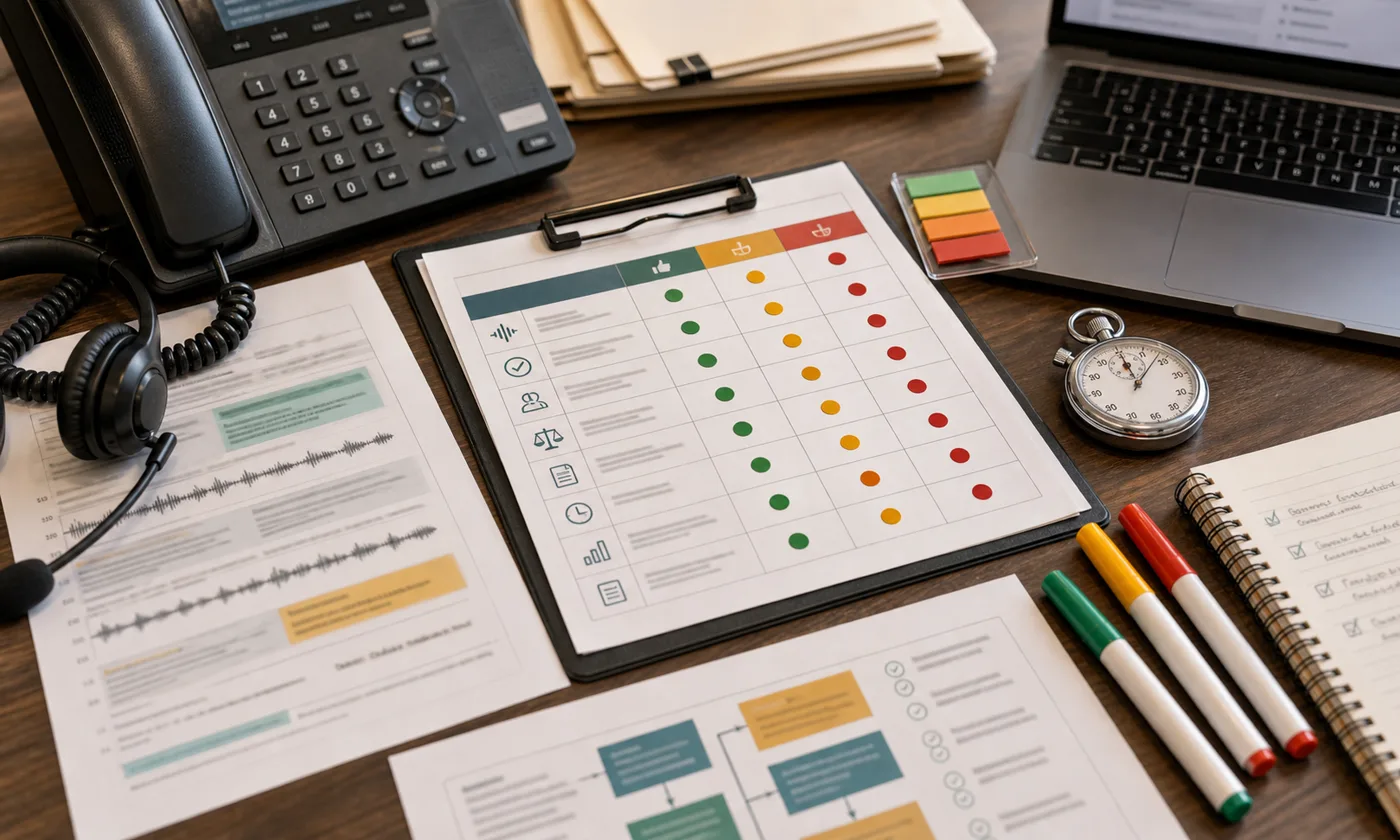
AI voice agents can sound polished in a demo and still fail in normal caller conditions. A useful benchmark has to measure the whole operating path: call answer, turn-taking, workflow completion, tool calls, escalation, evidence, and cost visibility.
The goal is not to declare one universal winner. The goal is to help buyers compare vendors with the same test conditions and see where each platform needs configuration, integration, staffing, or risk review before launch.
Use this methodology before vendor demos, during RFP review, and again in the first production pilot. It pairs with the evaluation scorecard, call test script, voice agent testing and QA stack, and RFP generator.
Scoring Categories
Score each category from 1 to 5. A high score should require evidence, not a verbal claim.
| Category | What to verify | Strong evidence |
|---|---|---|
| Caller experience | Greeting, pacing, interruption handling, clarity, and repair language. | Recorded calls, transcript timestamps, reviewer notes. |
| Workflow completion | The agent completes the intended job without unsafe shortcuts. | Booking, ticket, lead, order, or transfer result tied to the call. |
| Latency and turn-taking | Response gaps, barge-in recovery, and tool-call silence. | Timestamps for greeting, responses, interruptions, tool waits, and transfer start. |
| Tool reliability | Calendar, CRM, ticketing, routing, or order actions work under messy inputs. | Tool request and response logs, retries, failure messages. |
| Human handoff | The agent escalates quickly with context and fallback. | Transfer event, summary packet, callback task, staff-visible context. |
| Observability | Staff can review what happened and improve the workflow. | Transcript, recording policy, structured fields, outcome tags, error reasons. |
| Compliance posture | Consent, recording, opt-out, privacy, and sensitive topics are handled as approved. | Policy settings, approved scripts, audit trail, data retention controls. |
| Cost visibility | Cost is visible by call, minute, workflow, and fallback. | Quote, usage model, logs, and monthly forecast. |
Test Pack Rules
Keep the test pack stable across vendors:
- Use the same phone path or document differences clearly.
- Run each scenario at least three times.
- Capture the transcript, recording policy, and timestamps.
- Require the same tool or integration actions.
- Trigger at least one failure path.
- Trigger at least one human handoff path.
- Score the worst credible call, not only the best call.
If a vendor requires a different configuration, record that as implementation complexity. A benchmark should reveal what a buyer must build, not only what a vendor can demo.
Evidence Packet
Every benchmark run should produce a packet a buyer can review later:
| Evidence | Why it matters |
|---|---|
| Call recording or recording policy | Lets the team inspect tone, silence, interruption, and transfer behavior. |
| Transcript with timestamps | Shows response gaps, misunderstandings, and repair turns. |
| Tool-call log | Proves whether booking, CRM, ticket, or lookup actions actually happened. |
| Transfer or fallback log | Shows who received the call, what context arrived, and what happened if no one answered. |
| Post-call summary | Shows whether staff get usable next steps. |
| Structured fields | Shows whether the agent captured data cleanly enough for operations. |
| Cost estimate | Shows whether the call was expensive because of minutes, model use, fallback, or support. |
The voice agent testing and QA stack turns this packet into a launch process by deciding which failures become regression tests, which alerts need owners, and which calls require human review. The voice agent evals guide translates benchmark scenarios into reusable rubrics.
Publishing Standard
Public benchmark scores should be conservative. Do not publish a score if:
- The scenario was not repeatable.
- The setup differed materially across vendors.
- The reviewer cannot keep the evidence packet.
- The vendor was tested with demo-only behavior that buyers cannot reproduce.
- The workflow depends on a custom integration that was not built.
It is acceptable to publish a protocol before public scores exist. A protocol helps buyers immediately, and it creates a fair standard for future vendor testing.
Minimum Pass Bar
Before a buyer trusts a vendor with real calls, the benchmark should show:
- The agent answers promptly.
- The agent can be interrupted.
- The main workflow completes or fails honestly.
- Tool calls are logged.
- Human handoff includes caller context.
- A fallback path exists when humans are unavailable.
- Staff can review transcripts and outcomes.
- The cost model is visible enough to forecast.
That bar is intentionally practical. A voice agent does not need to be perfect. It needs to be observable, bounded, and safe enough to improve after launch.
Benchmark FAQs
Can a benchmark score replace a pilot?
No. Benchmark scores are a screening tool. Buyers should still run a production-like pilot with their own phone path, staff, data, compliance rules, and fallback ownership before launch.
What is the most important benchmark category?
Workflow completion with safe handoff is usually more important than raw voice quality. A pleasant voice does not help if the agent books the wrong appointment, loses caller context, or traps urgent callers.