

Direct answer: Accent cloning turns caller verification into a voice-agent procurement test. The Wall Street Journal's September 2026 coverage framed familiar accents as a security vulnerability, and related 2026 research shows why: people can be more persuaded by similar voices, while modern synthetic speech is difficult for ordinary listeners to judge reliably. Buyers should require proof that a voice workflow verifies caller identity through trusted records, callback paths, consent markers, transaction limits, detector review and human escalation instead of trusting accent, tone, caller ID or urgency.
What happened
- The Wall Street Journal's September 2026 story described how AI-generated voices can mimic familiar regional accents and make callers sound more trustworthy.
- The story pointed to academic work on familiar or similar voices lowering skepticism, which matters when a caller sounds local, known or socially close.
- A 2026 Journal of Marketing Research article studied vocal similarity in persuasion settings and found voice similarity can increase trust and persuasive outcomes, especially when external credibility signals are weaker.
- A May 2026 arXiv study, Eroding Trust in Real Speech, collected 35,532 judgments from 1,768 participants across many text-to-speech and voice-conversion systems.
- That study found modern synthetic speech made listeners less reliable at identifying real speech, with real-speech accuracy dropping after exposure to fakes.
- The practical buyer lesson is that a familiar-sounding voice should be treated as a risk signal, not as proof of identity or authority.
Why this is trending
- Voice cloning has moved from celebrity deepfakes into everyday phone risk, where accent, timbre, age, region and social familiarity can all influence trust.
- Voice-agent buyers are automating identity, scheduling, billing, account updates, support triage, refunds and handoffs that attackers may try to trigger by phone.
- A local or familiar accent can make a fraudulent caller feel less suspicious even when the number, request or workflow is risky.
- Detection tools help, but the latest research shows ordinary listeners and some automated checks still need human and procedural backup.
- The same proof packet protects both sides of a deployment: customers calling an AI agent and employees receiving calls that appear to come from customers, executives or vendors.
The Voice Agent Index take
A voice-agent buyer should not approve sensitive workflows where accent, caller ID, voice match or urgency can move the process forward on their own. Ask for an Accent-Aware Caller Verification Packet showing which caller attributes are ignored as proof, which actions require trusted callback, how consent is captured, what limits block risky requests, which synthetic-voice signals are logged, and when a trained human takes over. The standard is simple: a familiar voice can start a conversation, but it cannot authenticate one.
Accent-Aware Caller Verification Packet
A voice-agent buyer checklist for validating familiar-voice risk, trusted callback, consent boundaries, sensitive-action limits, detector limits, escalation and human review.
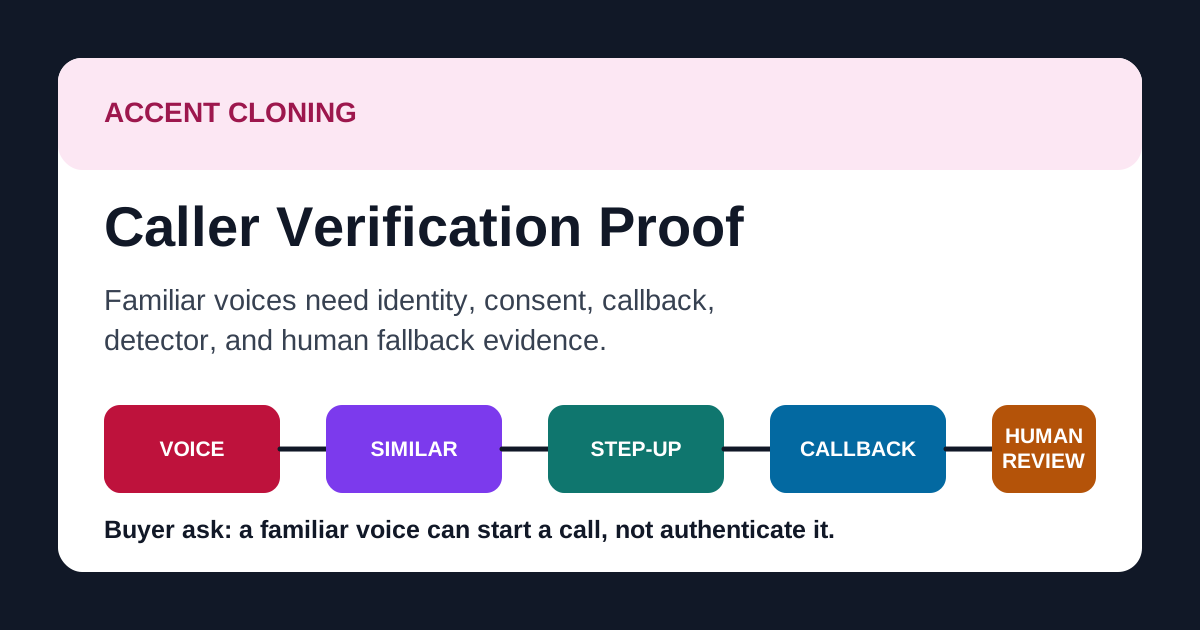
| Proof item | Why it matters | Buyer ask |
|---|---|---|
| Familiar-voice risk | A regional accent, familiar cadence or similar vocal quality can make a caller sound more trustworthy than the evidence supports. | Show that verification rules do not treat accent, tone, caller ID, job title or urgency as standalone proof of identity. |
| Trusted callback | If the caller controls the phone number or link, the attacker can steer the workflow through a convincing voice path. | Require callback through a known directory, account record, customer portal, banked number or separate approved channel for sensitive actions. |
| Consent boundary | Voice cloning and accent mimicry raise consent questions around source audio, recording, model use and impersonation. | Document recording notice, voice-use consent, clone prohibition, transcript retention, opt-out, revocation and abuse-report handling. |
| Sensitive-action limit | A convincing voice can pressure staff or automation into changing credentials, payments, schedules, records or account settings. | List the actions that voice can never complete alone and prove blocked, delayed, escalated and callback-required test cases. |
| Detector limits | Synthetic-speech detection can support triage, but false positives and missed fakes make it unsafe as the only control. | Show model threshold, reviewed samples, false-positive process, human reviewer role and evidence retention for suspected clones. |
| Human escalation | High-risk voice requests need a person trained to slow the call down, verify context and close the evidence loop. | Define exactly when the voice agent transfers, pauses, blocks, creates a fraud ticket, starts callback or asks a supervisor to review. |
What buyers should do next
- Inventory every voice workflow that can change access, money, records, appointments, prescriptions, claims, refunds or vendor instructions.
- Mark which caller attributes are never accepted as proof, including accent, caller ID, tone, title and internal-sounding details.
- Add trusted callback requirements for payment, credential, refund, high-risk support and account-change workflows.
- Run test calls with familiar accents, urgent requests, spoofed numbers, cloned-voice samples and ambiguous consent language.
- Keep evidence packets with transcripts, recordings, detector output, callback logs, escalation notes and final disposition.
Turn this brief into a vendor packet
Make the vendor prove the workflow before the demo gets polished.
Use the RFP generator and call-test script to turn this news framework into concrete evidence requests, acceptance tests, and escalation rules for your own voice AI rollout.
Buyer FAQs
Is accent cloning the same as ordinary voice cloning?
It is a related risk. Ordinary voice cloning focuses on mimicking a person, while accent cloning can make a caller sound local, familiar or socially close even when the identity claim is false.
Can a detector replace callback verification?
No. Detection can add evidence, but sensitive actions still need trusted callback, account records, consent controls, transaction limits and human escalation.
What should buyers test first?
Start with high-risk workflows: credential resets, payments, refunds, account updates, medical or financial records, vendor changes and urgent executive requests.
Sources
- The Wall Street Journal: September 2026 reporting on AI accent mimicry and familiar-sounding voices as a security vulnerability.
- Journal of Marketing Research: March 2026 research on vocal similarity, trust and persuasion in consumer-spokesperson interactions.
- arXiv: May 2026 study of human real-versus-fake speech judgments across modern text-to-speech and voice-conversion systems.
- Neuroscience News: September 2026 summary of research on familiar voices, vocal similarity and scam compliance risk.