

Direct answer: The Australian Federal Police and JPC3 warned that criminals are using AI to build fake investment-scam ecosystems, including fake platforms, reviews, performance data, landing pages, advertisements, and media coverage. CyberDaily reported Scamwatch figures showing more than $45 million already lost to investment scams this year after more than $160 million in 2025. Voice-agent buyers should treat the warning as a verification proof test: any voice AI that books, qualifies, transfers, advises, or routes callers must prove caller identity, advisor authenticity, payment-stop rules, channel escalation, transcript evidence, and fraud recovery.
What happened
- Mirage News republished the Australian Federal Police release on July 23, 2026 under the headline AI-Powered Crime Networks Target Australians' Millions.
- The release says JPC3 launched the ClickFit: Investment Scams campaign and warned that criminals are tapping AI to generate fake investment platforms, reviews, performance data, landing pages, advertisements, and media coverage.
- The AFP release says more than $45 million had already been lost to fraudulent investment scams this year, after investment scams ranked as Australia's top scam by reported loss in 2025 with more than $160 million.
- It describes scams beginning through online ads or social posts, followed by contact through message, phone, text, email, or social media.
- It says scammers may pose as financial advisers or account managers and may use Australian or English accents, fake dashboards, fabricated profits, and constant communication to build trust.
- The release included a Queensland case where a victim who lost more than $166,000 was directed to communicate with an AI chatbot when trying to contact the investment platform.
- CyberDaily independently covered the warning and reported the same more-than-$45-million and more-than-$160-million loss figures.
Why this is trending
- The warning makes AI fraud operational, not theoretical: fake voices, fake dashboards, fake advisers, fake platforms, and fake support paths can all appear in one customer journey.
- The incident pattern overlaps with voice-agent procurement because customers often trust spoken interactions, callbacks, appointment setters, and account-manager handoffs faster than static web pages.
- Investment-scam losses create a concrete buyer reason to demand payment-stop rules, trusted callback paths, and fraud escalation before any AI voice workflow touches financial or identity-sensitive conversations.
- The official AFP/JPC3 campaign plus independent CyberDaily coverage makes the story a public-risk signal rather than a vendor promotion.
The Voice Agent Index take
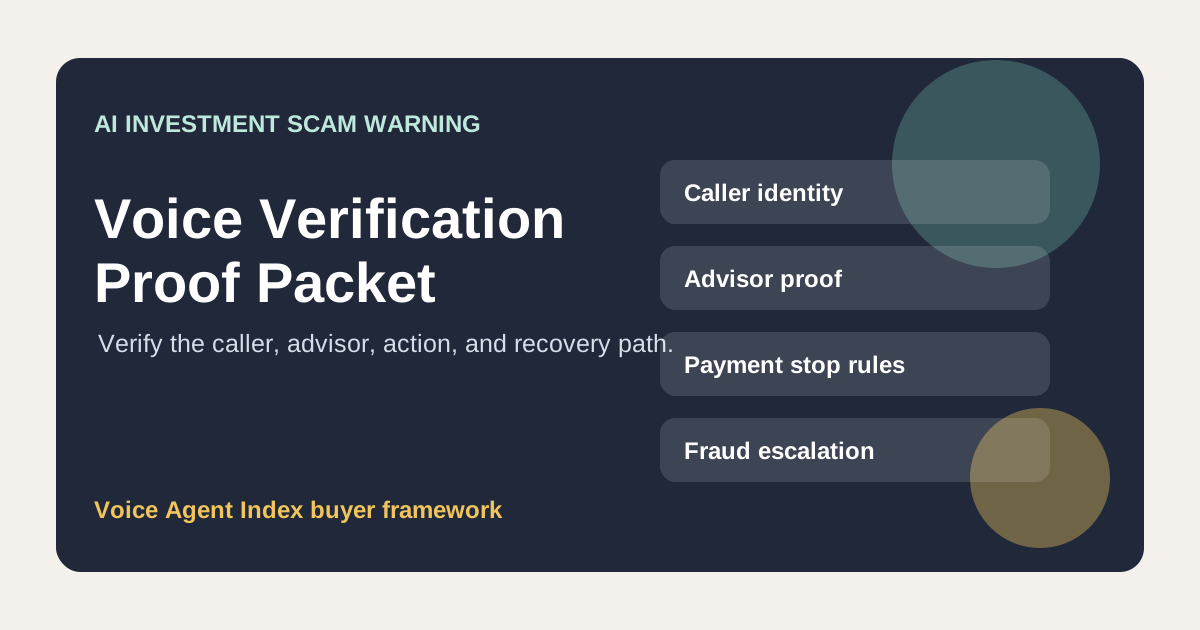
A voice-agent buyer should not ask only whether a synthetic voice sounds natural. The buyer needs an AI Scam Voice Verification Proof Packet: who the agent says it is, how caller or advisor identity is verified, which actions are blocked, which payment or credential phrases stop the call, which channels are trusted for callback, how transcripts and recordings are retained, how fraud reports escalate, and who owns customer recovery when a fake adviser or fake support path appears.
AI Scam Voice Verification Proof Packet
A voice-agent buyer checklist for validating caller identity, advisor authenticity, channel handoff, payment-stop rules, transcript evidence, fraud escalation, and recovery ownership.
| Proof item | Why it matters | Buyer ask |
|---|---|---|
| Caller identity | Scams often begin with a familiar or professional-sounding contact, then use repeated phone, text, email, or social messages to build trust. | Require trusted-number ownership, caller authentication, callback verification, and a rule that high-risk requests must use a verified channel. |
| Advisor authenticity | Fake advisers and account managers can use confident speech, local accents, and fake dashboards to make an invented investment feel legitimate. | Ask vendors to prove how the agent identifies itself, prevents fake-professional claims, validates staff identity, and blocks unauthorized financial advice. |
| Payment stop rules | Victims are pressured to invest fast, pay fees, unlock supposed profits, move funds, or transfer cryptocurrency. | Define phrases, intents, and account actions that force a stop, human review, fraud notice, or verified callback before any payment-related step. |
| Channel escalation | Scammers move targets across ads, social messages, phone, text, email, online meetings, and private messaging apps to control the journey. | Map allowed channels, disallowed channel switches, callback paths, support handoff, and customer warnings when a conversation moves outside approved systems. |
| Transcript evidence | When customers report suspected fraud, the company needs enough call and message evidence to reconstruct what happened. | Retain transcripts, recordings where lawful, caller metadata, transfer events, agent messages, warning triggers, and supervisor review notes. |
| Fraud recovery | A customer who reaches a fake platform or AI chatbot after losing money needs fast containment, not another automated loop. | Require a recovery workflow for account lock, bank or payment guidance, case owner assignment, regulator reporting, and customer follow-up evidence. |
What buyers should do next
- List every voice workflow that can mention payments, investment, account access, identity, credentials, refunds, withdrawals, or urgent action.
- Write the exact identity disclosure the agent uses at the start of the call and after transfer.
- Create trusted callback rules for account, payment, or fraud-sensitive requests.
- Add stop conditions for investment promises, guaranteed returns, crypto transfer, tax or fee payment, private messaging app movement, and urgency pressure.
- Test transcripts for fake-adviser language, fake-professional claims, fake dashboard references, and customer confusion.
- Use the voice AI readiness checklist and RFP generator to require fraud escalation and recovery evidence from vendors.
Turn this brief into a vendor packet
Make the vendor prove the workflow before the demo gets polished.
Use the RFP generator and call-test script to turn this news framework into concrete evidence requests, acceptance tests, and escalation rules for your own voice AI rollout.
Buyer FAQs
What did the AFP and JPC3 warn about?
They warned that criminal networks are using AI to create convincing investment-scam ecosystems, including fake platforms, reviews, performance data, landing pages, advertisements, and media coverage.
Why is this relevant to voice-agent buyers?
Voice agents and AI receptionists can influence trust, routing, callbacks, and handoffs. Buyers need proof that voice workflows verify identity, stop risky payment requests, and escalate suspected fraud.
What should buyers ask vendors for first?
Ask for caller verification, advisor-authenticity controls, payment stop rules, allowed-channel maps, transcript retention, fraud escalation, and recovery ownership.
Sources
- Australian Federal Police: Official July 2026 AFP media release on JPC3's ClickFit: Investment Scams campaign and AI-powered investment scam ecosystems.
- Mirage News: Accessible republication of the AFP release with details on AI-generated fake ecosystems, Scamwatch loss figures, fake advisers, contact channels, and case studies.
- CyberDaily: Independent coverage of the AFP/JPC3 warning, including investment-scam loss figures and current AI-enabled fraud concerns.
- AFP ClickFit: AFP public education feature for the ClickFit: Investment Scams campaign and warning signs.