
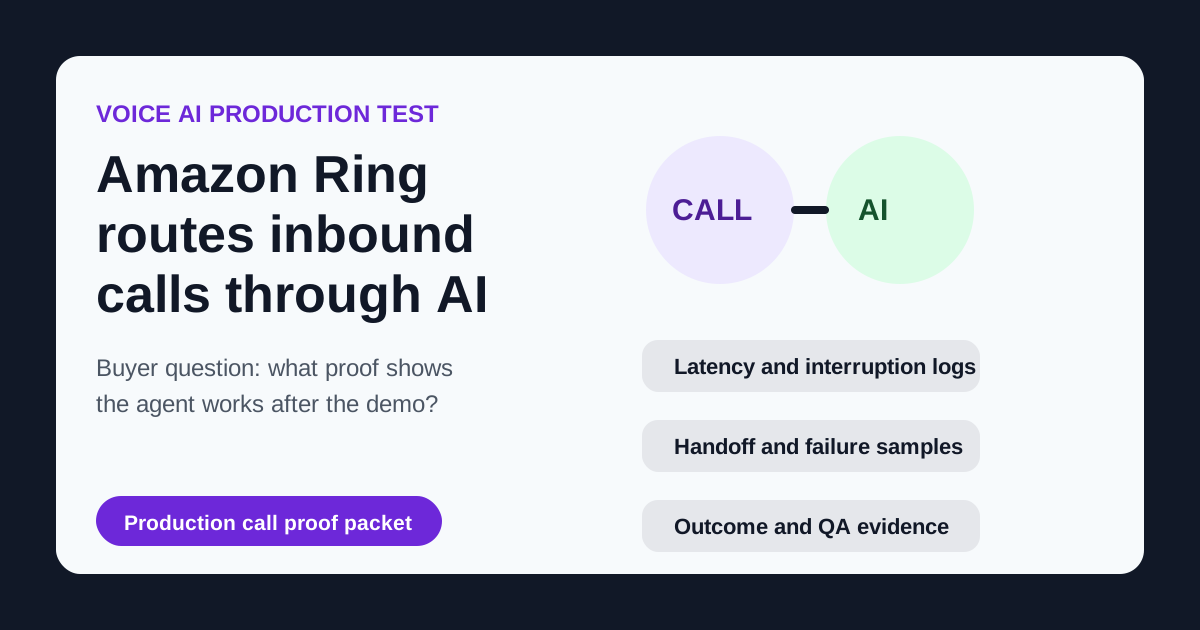
Direct answer: TechCrunch reported on May 12, 2026 that Amazon Ring routes 100% of inbound calls through Vapi after evaluating more than 40 AI voice vendors, and that Vapi raised a $50 million Series B at about a $500 million valuation. Vapi says its platform has handled more than 1 billion calls. Buyers should treat this as a proof-standard story, not a vendor endorsement: production voice AI needs evidence across latency, interruptions, escalation, failures, data handling, and customer outcomes.
What happened
- TechCrunch reported that Amazon Ring evaluated more than 40 AI voice vendors before choosing Vapi for inbound phone traffic.
- The report says Ring now routes 100% of inbound calls through Vapi's platform.
- TechCrunch also reported that the Ring deployment helped Vapi raise a $50 million Series B led by Peak XV Partners at a valuation of roughly $500 million after investment.
- Vapi says it has handled more than 1 billion calls, processes between 1 million and 5 million calls a day, and serves enterprise customers as well as a large self-serve developer base.
Why this is trending
- Voice AI is moving from demos into full inbound call paths for major consumer brands.
- The story gives buyers a concrete production benchmark: 100% inbound routing is a very different claim from a controlled test call.
- It also raises the diligence burden for every vendor selling AI receptionists, phone agents, or customer-support voice automation.
The Voice Agent Index take
The practical takeaway is not to copy Amazon Ring's vendor choice. The takeaway is that voice AI procurement now needs production evidence. A buyer should ask what happens during peak volume, bad audio, interruptions, authentication, unhappy callers, failed tool calls, sensitive requests, and human transfer before moving real inbound traffic.
Production Call Proof Packet
A buyer checklist for verifying a voice AI deployment with full-call samples, latency data, failure logs, human handoff evidence, QA outcomes, and customer-impact metrics.
| Proof item | Why it matters | Buyer ask |
|---|---|---|
| Full-call samples | Edited clips hide caller confusion, retries, silence, transfer loops, and unresolved outcomes. | Review complete calls from the same workflow, including normal, edge, and failed interactions. |
| Traffic and latency data | A system that works on ten calls may fail at peak volume or under long-tail caller behavior. | Request response-time distribution, concurrent-call handling, fallback latency, and outage behavior. |
| Failure logs | Production readiness depends on how the agent fails, not only how it succeeds. | Ask for failed intent, repeated caller, tool-call, billing, cancellation, and complaint examples. |
| Human handoff evidence | Inbound voice AI must know when to stop and transfer context to a person. | Verify transfer triggers, transcript handoff, ownership, wait time, and post-transfer outcome. |
| Data controls | Voice calls can contain account details, payment context, addresses, family information, and private background audio. | Check recording policy, transcript retention, redaction, model-training use, and access logs. |
| Customer-impact metrics | Containment can rise while customer effort, callbacks, escalations, or churn also rise. | Compare completed workflow rate, CSAT, recontact rate, escalation accuracy, and complaint rate. |
What buyers should do next
- Define the exact inbound workflow before evaluating a voice AI vendor.
- Ask for complete call evidence, not only a polished demo or headline customer quote.
- Run peak-volume, noisy-caller, repeat-caller, complaint, cancellation, and human-transfer tests.
- Approve production only when latency, failure handling, data controls, and outcome quality are documented.
Turn this brief into a vendor packet
Make the vendor prove the workflow before the demo gets polished.
Use the RFP generator and call-test script to turn this news framework into concrete evidence requests, acceptance tests, and escalation rules for your own voice AI rollout.
Buyer FAQs
What did TechCrunch report about Amazon Ring and Vapi?
TechCrunch reported that Amazon Ring evaluated more than 40 AI voice vendors, chose Vapi for inbound phone traffic, and now routes 100% of inbound calls through Vapi's platform.
Why is this important for voice AI buyers?
It shifts the market from demo claims to production proof. Buyers should expect vendors to show full-call evidence, latency data, failure logs, handoff proof, and outcome metrics.
Does this mean Vapi is the right vendor for every buyer?
No. The useful lesson is the proof standard. Different buyers may need different architecture, compliance, integrations, language support, fallback, or human staffing models.
What should be in a production call proof packet?
A proof packet should include full-call recordings, timestamped transcripts, latency distribution, escalation logs, failed-call samples, data-retention controls, and customer-outcome metrics.
Sources
- TechCrunch report: Independent report on Amazon Ring's vendor evaluation, 100% inbound call routing through Vapi, Vapi's Series B, and reported platform scale.
- Vapi Series B announcement: Company source for the $50M Series B, total funding, call-volume claims, and voice AI market thesis.
- Vapi platform page: Company product context for voice agent building, deployment, and operational positioning.