
Direct answer: TechCrunch and The Verge reported on July 23, 2026 that Anthropic upgraded Claude Voice Mode so users can use more capable Opus and Sonnet models rather than only Haiku. The Verge also reported broader language support, switching between voice and text, and model switching mid-conversation. Voice-agent buyers should treat the upgrade as a production-readiness test: require proof of model choice, language fit, latency and session limits, tool permissions, human handoff, monitoring, fallback, and change control before a voice mode touches customer or employee workflows.
What happened
- TechCrunch reported on July 23, 2026 that Anthropic updated Claude Voice Mode with more capable models.
- The Verge reported that voice mode is now available for Opus and Sonnet after previously being limited to Haiku.
- The Verge also said users can switch between voice and text and switch among models mid-conversation.
- The Verge reported that voice mode moved from beta to full release and added support for multiple languages beyond English.
- Anthropic's model documentation gives buyers a current official reference point for Claude model families and tradeoffs when choosing between speed, cost, and capability.
Why this is trending
- Voice mode improvements are moving from novelty dictation toward more capable task execution, which raises the risk of letting spoken interactions trigger workflow changes.
- Model switching creates a buyer question: which voice tasks need the fastest model, which need stronger reasoning, and which should stop before any tool action happens.
- Multilingual voice support broadens deployment scope, but it also requires language-specific QA, escalation, compliance wording, and fallback coverage.
- Independent coverage from both TechCrunch and The Verge shows hard product momentum, while the procurement frame keeps the story focused on readiness proof rather than promotion.
The Voice Agent Index take
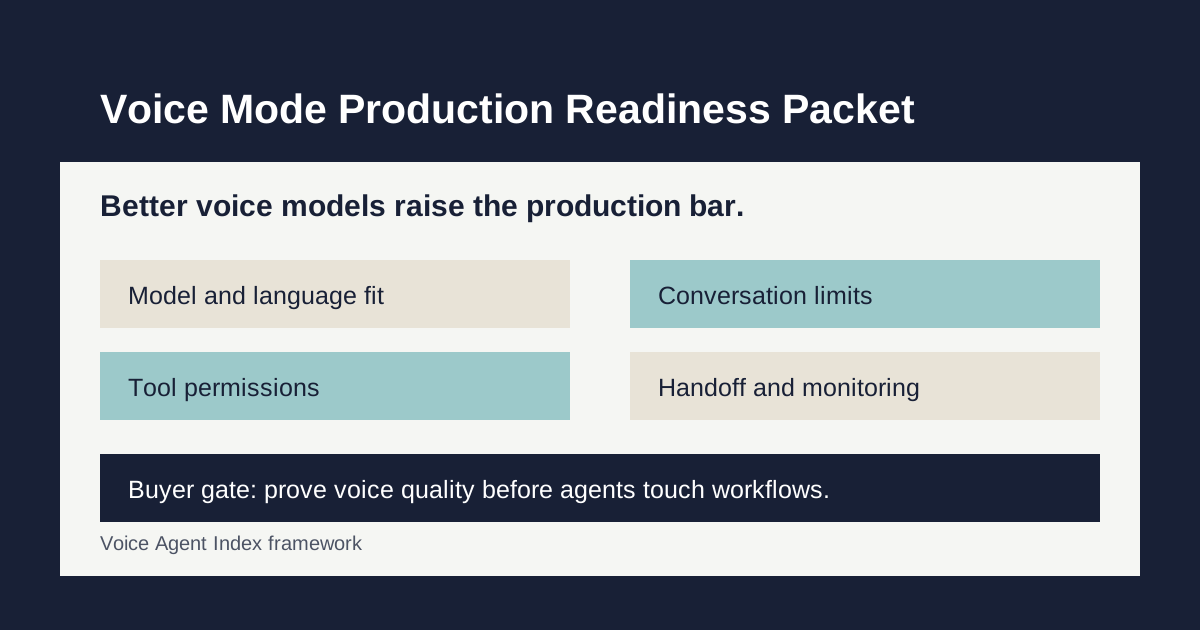
A voice-agent buyer should use Claude Voice Mode's upgrade as a checklist for any enterprise voice mode, not as a one-vendor endorsement. The required packet is a Voice Mode Production Readiness Packet: model-routing rules, language QA, latency and session limits, identity checks, tool-permission boundaries, approved actions, handoff triggers, transcript and recording policy, live monitoring, fallback channel, and rollout history.
Voice Mode Production Readiness Packet
A voice-agent buyer checklist for validating upgraded voice modes across model selection, language fit, conversation limits, tool permissions, human handoff, live monitoring, fallback, and rollout controls.
| Proof item | Why it matters | Buyer ask |
|---|---|---|
| Model selection | A faster voice model may be enough for simple capture, while a stronger model may be needed for reasoning, summarization, or complex support triage. | Require a model-routing matrix that explains when Haiku, Sonnet, Opus, or another model is allowed, plus fallback behavior when quality or latency drops. |
| Language fit | Multilingual voice support can fail through accent, terminology, compliance wording, translation drift, or missing human coverage. | Ask for language-specific QA samples, escalation scripts, glossary handling, accent coverage, and human fallback by market. |
| Conversation limits | Voice sessions can hide long-context drift, missed interruptions, poor audio, repeated silence, and user frustration. | Define maximum session length, interruption behavior, silence rules, confidence thresholds, and when the voice mode must stop or ask for help. |
| Tool permissions | A voice mode that can act in calendars, CRMs, support systems, billing, or internal tools needs tighter controls than a transcription assistant. | List every tool, field, record, and action available to the agent, then mark approval-required and forbidden actions. |
| Handoff and monitoring | Customers can become stuck when the model sounds natural but cannot complete the task, handle emotion, or recover from a tool failure. | Require live-quality signals, failed-transfer handling, supervisor takeover, transcript review, and post-call QA queues. |
| Controlled rollout | Changing voice models or language coverage can change behavior even when the workflow appears unchanged. | Ask for version history, regression tests, staged rollout, rollback criteria, and owner approval for every model or language expansion. |
What buyers should do next
- Choose one voice workflow and write the allowed model, language, tools, actions, and handoff rule before testing.
- Run QA samples for each supported language, accent group, and policy-sensitive phrase.
- Separate dictation, conversation, retrieval, summarization, and tool-action use cases into different permission tiers.
- Define stop conditions for low confidence, repeated silence, user frustration, poor audio, policy ambiguity, and tool failure.
- Create a rollout log that records model changes, language changes, test results, incidents, and rollback decisions.
- Use the voice AI readiness checklist and RFP generator to ask vendors for production evidence instead of demo fluency.
Turn this brief into a vendor packet
Make the vendor prove the workflow before the demo gets polished.
Use the RFP generator and call-test script to turn this news framework into concrete evidence requests, acceptance tests, and escalation rules for your own voice AI rollout.
Buyer FAQs
What changed in Claude Voice Mode?
TechCrunch and The Verge reported that Anthropic expanded Claude Voice Mode to more capable Opus and Sonnet models after previously limiting it to Haiku.
Why does this matter to voice-agent buyers?
More capable voice models can handle richer tasks, but production buyers still need proof for model choice, language QA, session limits, permissions, handoff, monitoring, and fallback.
What should buyers ask before production?
Ask for a Voice Mode Production Readiness Packet covering model routing, language fit, conversation limits, tool permissions, handoff, monitoring, and controlled rollout.
Sources
- TechCrunch: July 23, 2026 independent coverage reporting that Anthropic updated Claude Voice Mode with more capable models.
- The Verge: July 23, 2026 coverage reporting Opus and Sonnet support, voice/text switching, model switching, full release, and multilingual support.
- Anthropic docs: Official Claude model overview for buyer review of model families and tradeoffs.