

Direct answer: Assort Health announced on June 25, 2026 that it raised a $120 million Series C led by Menlo Ventures at a $1.2 billion valuation, bringing total funding to more than $222 million. Fierce Healthcare reported that the company builds specialty-specific AI voice agents for scheduling, referrals, intake, eligibility, lab requests, payments, and other patient access workflows. Healthcare buyers should respond by asking for a proof packet, not just a natural-sounding demo.
What happened
- Assort Health said its Series C was led by Menlo Ventures and valued the company at $1.2 billion.
- The announcement says Assort has supported more than 190 million patient voice interactions.
- Fierce Healthcare reported that Assort launched in November 2023 and expanded from scheduling into broader patient journey voice workflows.
- Fierce also reported that Assort cites more than 62,000 specialty-specific protocols and 1.6 million patient access pathways.
- MobiHealthNews independently covered the funding and framed it around scaling patient-journey AI agents.
Why this is trending
- A $120 million round and unicorn valuation make healthcare voice AI hard for patient-access leaders to ignore.
- The story moves beyond generic receptionist automation into regulated, specialty-specific workflows such as referrals, eligibility, intake, lab requests, and payments.
- Healthcare organizations are under pressure to reduce call volume, missed appointments, and front-desk burden without harming trust, access, or compliance.
The Voice Agent Index take
A healthcare voice AI buyer should treat the funding headline as market proof that demand is rising, not as product proof. The vendor still needs to show workflow-specific evidence: which calls the agent can complete, which systems it touches, how identity and consent are handled, when it escalates, and how clinical or billing-sensitive decisions are audited.
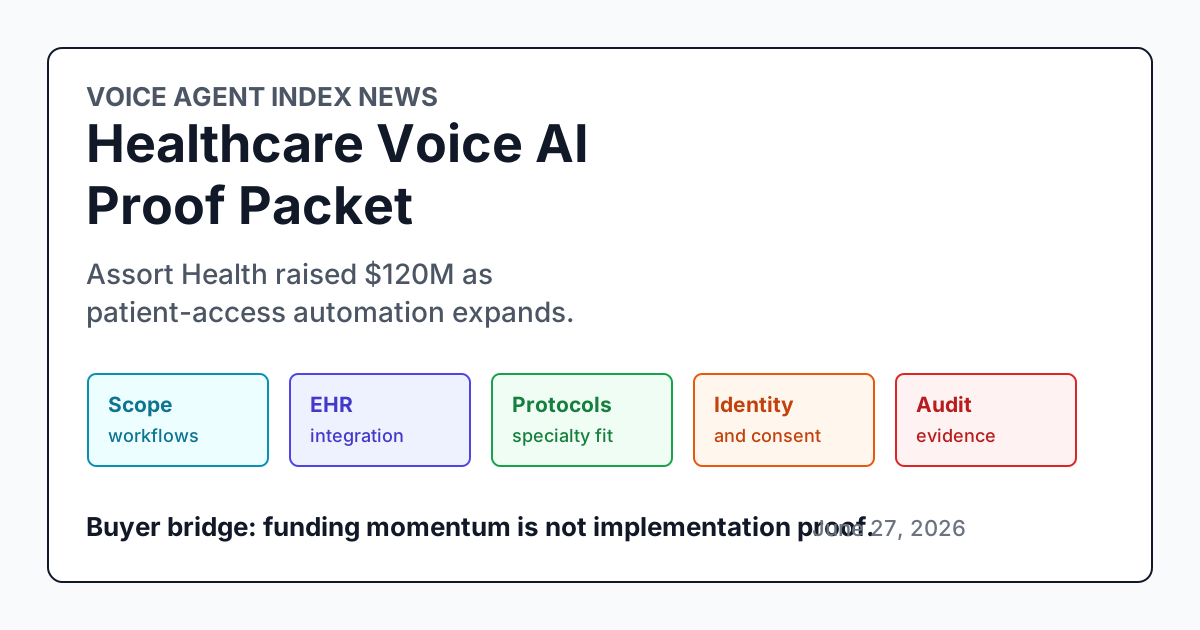
Healthcare Voice AI Proof Packet
A buyer checklist for validating patient-access voice AI across workflow scope, EHR and practice-management integration, specialty protocols, identity, consent, escalation, and audit evidence.
| Proof item | Why it matters | Buyer ask |
|---|---|---|
| Patient access scope | Scheduling alone is different from referrals, intake, eligibility, lab requests, payments, and rescheduling. | Show production examples by workflow, call type, completion rate, abandon rate, and human fallback outcome. |
| EHR and PM integration | Voice agents can create rework if appointment, insurance, provider, or patient-record data is stale or incomplete. | Document every system touched, write permissions, field updates, rollback path, and audit trail. |
| Specialty protocols | Orthopedics, dermatology, primary care, behavioral health, and urgent care do not share the same call rules. | Provide specialty-specific call scripts, eligibility rules, escalation triggers, and QA samples. |
| Identity and consent | Patient calls can involve protected information, caregiver access, minors, payment details, and sensitive services. | Show identity verification, consent capture, PHI boundaries, redaction, and caller-authentication handling. |
| Human escalation | A safe patient-access agent must know when not to continue, especially for symptoms, urgent issues, complaints, and unclear requests. | Define escalation rules, warm-transfer options, after-hours paths, and staff ownership for failed calls. |
| Audit and QA evidence | Healthcare operators need to prove what the agent heard, said, changed, and handed off. | Require transcripts, recordings where allowed, action logs, QA rubric, exception reports, and periodic clinical review. |
What buyers should do next
- Separate simple scheduling from high-risk patient-access workflows before comparing healthcare voice AI vendors.
- Ask vendors for workflow-specific proof across EHR integration, identity, consent, escalation, and audit logs.
- Run test calls for referrals, eligibility, rescheduling, payment-adjacent questions, and urgent or unclear patient requests.
- Model retained staff work for failed calls, QA review, manual corrections, and patient complaints.
Turn this brief into a vendor packet
Make the vendor prove the workflow before the demo gets polished.
Use the RFP generator and call-test script to turn this news framework into concrete evidence requests, acceptance tests, and escalation rules for your own voice AI rollout.
Buyer FAQs
Is Assort Health only a scheduling voice agent?
No. Fierce Healthcare reported that Assort supports broader patient-access workflows including scheduling, referrals, intake, eligibility, lab requests, payments, and related tasks.
Why does the funding round matter to buyers?
It signals investor and market momentum for healthcare voice AI, but buyers still need implementation proof before trusting patient-facing workflows.
What proof should healthcare buyers request first?
Ask for workflow-specific call evidence, EHR or practice-management integration details, specialty protocol coverage, identity and consent handling, escalation rules, and audit logs.
Sources
- Assort Health announcement: Primary announcement for the $120 million Series C, $1.2 billion valuation, funding total, and patient voice interaction claim.
- Fierce Healthcare: Independent healthcare coverage describing workflows, specialty protocols, growth, and market positioning.
- MobiHealthNews: Independent digital health coverage of the funding and patient-journey AI agent positioning.