
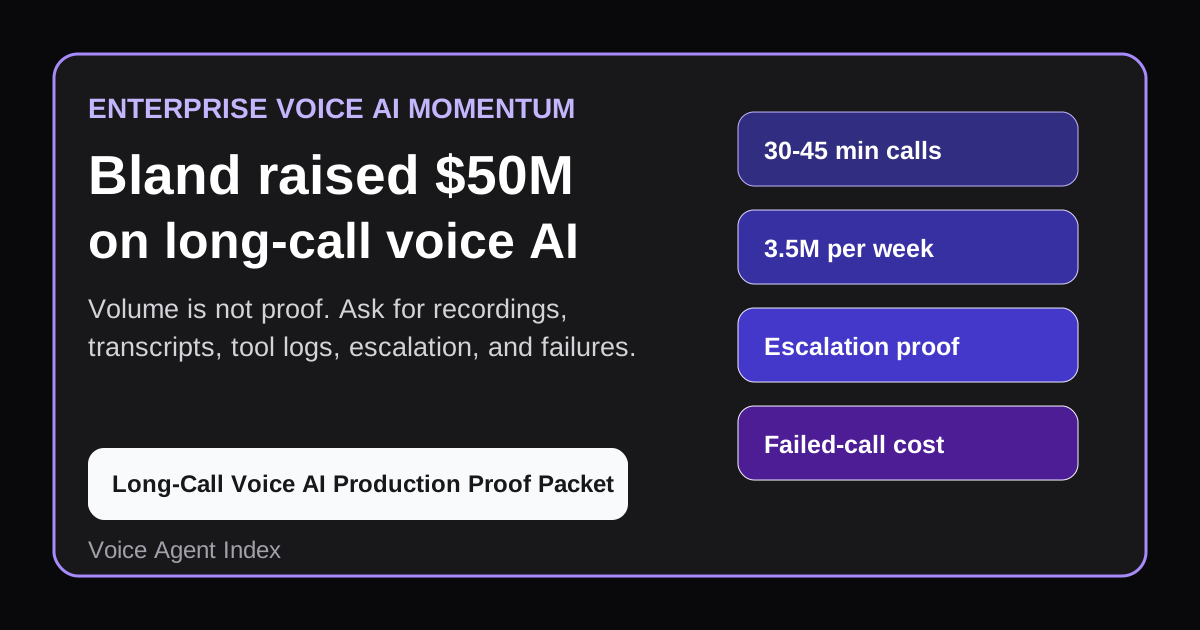
Direct answer: Fortune reported that Bland raised a $50 million Series C led by Dell Technologies Capital and says it handles more than 3.5 million calls per week, with typical calls lasting 30 to 45 minutes. TNW independently covered the round and the same production-volume claims. Buyers should treat the news as market momentum, then ask for proof that long voice AI calls complete the right workflow, handle interruptions, obey compliance rules, and escalate before damage.
What happened
- Fortune reported on June 16, 2026 that Bland closed a $50 million Series C led by Dell Technologies Capital.
- The report says Bland has raised more than $100 million and handles more than 3.5 million calls per week.
- Fortune also reported that Bland says typical calls run 30 to 45 minutes and that the company has more than 250 enterprise customers.
- TNW independently reported the $50 million Series C, the 3.5 million weekly call claim, and Bland's emphasis on proprietary voice AI models.
- Both reports noted adoption resistance and regulated-industry concerns, including healthcare, financial services, disclosure, and data-retention issues.
Why this is trending
- A $50 million round makes enterprise voice AI funding visible even after earlier skepticism that phone calls would disappear.
- The long-call claim is more operationally meaningful than a short demo because 30- to 45-minute calls stress turn-taking, context retention, tool use, and escalation.
- The story arrives as buyers are trying to decide whether voice agents are ready for complex support, revenue, scheduling, collections, and regulated workflows.
The Voice Agent Index take
A buyer should not treat weekly call volume as enough proof. High-volume voice AI can still fail if long calls drift, interrupt callers, misuse tools, mishandle regulated data, or transfer without context. The right buyer response is to request representative recordings, transcripts, tool logs, escalation examples, failed-call samples, and compliance boundaries for the exact workflow being automated.
Long-Call Voice AI Production Proof Packet
A buyer checklist for validating long-duration voice AI across call completion, interruptions, tool use, compliance boundaries, escalation, audit evidence, and failed-call economics.
| Proof item | Why it matters | Buyer ask |
|---|---|---|
| Long-call completion | A 30-minute call can lose context, repeat questions, skip required fields, or satisfy the caller without completing the workflow. | Show representative long calls with start state, completed fields, final outcome, and whether a human corrected anything afterward. |
| Interruption handling | Real callers talk over agents, change topics, hesitate, correct themselves, and give partial answers. | Provide timestamped transcripts showing barge-in behavior, pauses, reprompts, and recovery after caller corrections. |
| Tool and data boundaries | Long calls often require CRM, calendar, billing, order, policy, or account updates that can create lasting errors. | Document every tool permission, write action, confirmation step, rollback path, and audit log. |
| Compliance controls | Healthcare, financial services, and regulated support workflows can involve disclosure, consent, retention, and sensitive data. | Show disclosure script, consent capture, retention policy, redaction rules, HIPAA or regulated-workflow boundaries, and self-hosted options where relevant. |
| Escalation quality | A long call that transfers late or cold can be worse than routing to a person early. | Provide warm-transfer examples, escalation reasons, human context packet, and post-transfer outcome data. |
| Failed-call economics | Volume can hide expensive failures: missed bookings, angry callers, incorrect notes, refunds, compliance review, and staff cleanup. | Price failed calls, reopened cases, manual corrections, QA review, and complaint recovery into the ROI model. |
What buyers should do next
- Pick one long-call workflow to test instead of asking for a generic enterprise voice AI demo.
- Require recordings, timestamped transcripts, tool logs, escalation logs, and failure samples from calls that resemble your own workflow.
- Define what the agent may say, which tools it may use, and which decisions require human approval.
- Model retained human work for QA, escalation, compliance review, manual corrections, and customer recovery.
Turn this brief into a vendor packet
Make the vendor prove the workflow before the demo gets polished.
Use the RFP generator and call-test script to turn this news framework into concrete evidence requests, acceptance tests, and escalation rules for your own voice AI rollout.
Buyer FAQs
What did Bland raise?
Fortune reported that Bland closed a $50 million Series C led by Dell Technologies Capital, with participation from investors including HubSpot Ventures, Archerman, Tribeca, and existing backers.
Why is the 3.5 million calls per week claim important?
It suggests production-scale demand, but buyers still need workflow-specific proof because volume does not prove long-call quality, compliance, escalation, or customer outcome.
What should buyers ask before deploying long-call voice AI?
Ask for representative recordings, timestamped transcripts, tool logs, escalation examples, compliance controls, failed-call samples, and a cost model that includes QA and manual correction.
Sources
- Fortune: Independent business coverage of Bland's $50 million Series C, call-volume claims, enterprise traction, and regulated-industry concerns.
- The Next Web: Independent coverage of the Series C, production-volume claims, proprietary model positioning, and adoption challenges.