

Direct answer: California AB1609 is a customer-service chatbot bill that advanced in the Senate on July 1, 2026 after a committee vote and re-referral to Appropriations. CalMatters' Digital Democracy summary says the bill would prohibit large private businesses from representing a customer-service chatbot as human, require certain disclosures, require human customer-service access for at least 10 hours during regular business hours, and require a good-faith effort to connect customers to an agent within 15 minutes or schedule an appointment. Voice agent buyers should treat the bill as a human-handoff proof signal, not wait for final enactment.
What happened
- CalMatters Digital Democracy lists AB1609 as Customer service chatbots and shows a July 1, 2026 status update: do pass and re-refer to the Senate Appropriations Committee after an 11-1 committee vote on June 30.
- LegiScan also lists the July 1 action, a pending Senate Appropriations hearing, and the bill title Customer service chatbots.
- The CalMatters summary says AB1609 would prohibit large private businesses from representing a customer-service chatbot as human and would require disclosures when a reasonable person could be misled.
- The same summary says large private businesses would need a customer service feature allowing consumers to contact a human customer-service agent for at least 10 hours per day during regular business hours.
- It also describes a good-faith effort to connect a customer to an agent within 15 minutes after a human-service request is made, or to schedule an appointment, with additional requirements for online chatbot and telephonic platforms.
Why this is trending
- The bill converts a common customer complaint about AI service loops into measurable operating requirements: disclosure, human access, wait time, and fallback.
- Voice agents and customer-service chatbots are converging in real workflows, so chatbot legislation can affect phone, web, SMS, and contact-center handoff design.
- The July 1 committee movement gives compliance, CX, and procurement teams a current reason to test human handoff before scaling AI receptionists, service bots, or agentic phone flows.
The Voice Agent Index take
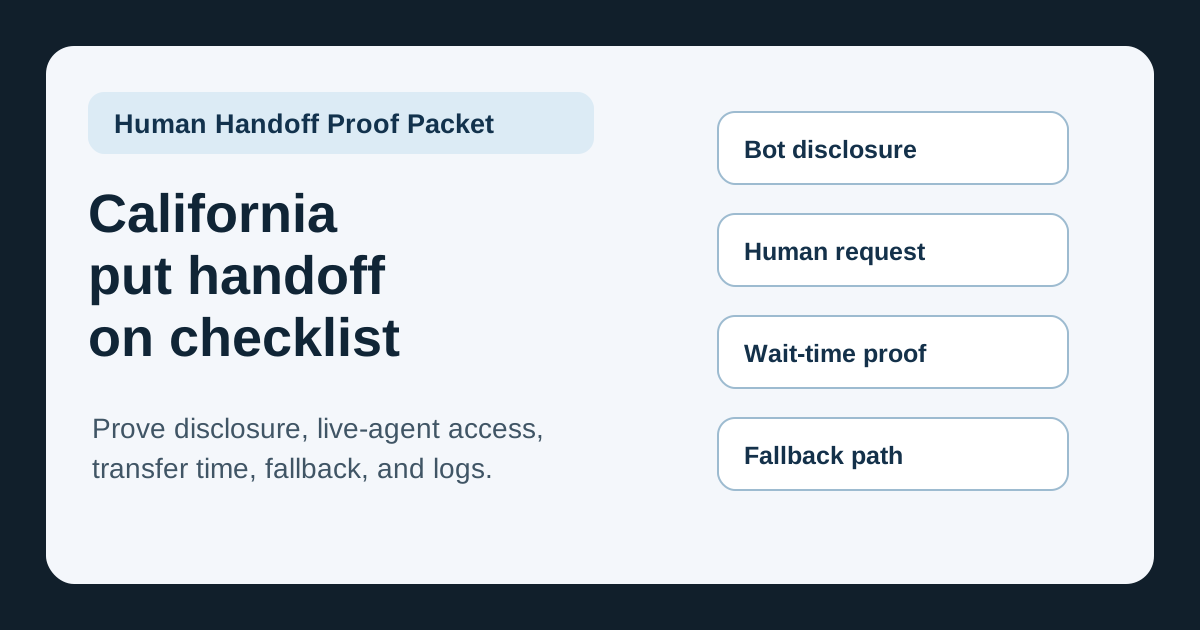
A voice agent buyer should not approve deployment only because the demo transfers to a person once. The buyer needs a human handoff proof packet: bot identity disclosure, customer request capture, live-agent availability, wait-time evidence, appointment scheduling fallback, telephonic hold-time controls, logs, and escalation ownership across every channel the AI touches.
Human Handoff Proof Packet
A buyer checklist for validating AI voice and chatbot workflows across artificial-identity disclosure, human-service request handling, wait-time evidence, appointment fallback, telephonic hold-time controls, logs, and escalation ownership.
| Proof item | Why it matters | Buyer ask |
|---|---|---|
| Artificial-identity disclosure | AB1609 targets representations that could make a customer believe a customer-service chatbot is human. | Show the exact disclosure language for voice, chat, SMS, web, after-hours, and transferred interactions, plus the QA evidence that it appears before substantive service. |
| Human request capture | A customer must be able to request human service without being trapped in an AI loop or hidden menu path. | Provide supported phrases, button paths, DTMF options, failure handling, language support, and transcripts proving the system recognized human-service requests. |
| Live-agent availability | The bill summary describes human customer-service access for at least 10 hours during regular business hours for covered businesses. | Document staffing hours, coverage calendars, after-hours messaging, queue ownership, overflow rules, and exceptions for holidays or outages. |
| Wait-time proof | The current summary describes a good-faith effort to connect customers to an agent within 15 minutes or schedule an appointment. | Export wait-time logs, transfer outcomes, abandonment rates, appointment scheduling records, callback completion, and failed-handoff review. |
| Telephonic fallback | The bill summary references online chatbot and telephonic customer-service platforms, so phone flows cannot be treated as a separate loophole. | Test phone, web, mobile, IVR, SMS, and chatbot handoffs with the same compliance packet and a named owner for failures. |
| Evidence retention | Public-prosecutor enforcement and civil penalties make unsupported compliance claims risky for covered businesses. | Retain disclosures, transcripts, recordings, transfer timestamps, appointment records, queue logs, QA review, release notes, and customer-repair actions. |
What buyers should do next
- Treat AB1609 as an in-progress compliance signal, not final legal advice, and ask counsel how it could affect covered customer-service workflows.
- Run test calls and chats where the customer asks for a person in plain language, frustrated language, another language, silence, and menu-only paths.
- Measure whether the AI discloses its artificial identity clearly before the customer relies on the service interaction.
- Export transfer, wait-time, callback, appointment, abandonment, and failed-handoff logs for the workflows most likely to affect California consumers.
- Make human handoff proof a launch gate before scaling AI receptionists, customer-service chatbots, billing agents, appointment agents, or complaint workflows.
Turn this brief into a vendor packet
Make the vendor prove the workflow before the demo gets polished.
Use the RFP generator and call-test script to turn this news framework into concrete evidence requests, acceptance tests, and escalation rules for your own voice AI rollout.
Buyer FAQs
Is California AB1609 law now?
No. As of the July 1, 2026 status shown by CalMatters and LegiScan, AB1609 was still in progress and had been re-referred to the Senate Appropriations Committee after a committee vote.
What would AB1609 require for customer-service chatbots?
The CalMatters summary says the bill would prohibit covered large private businesses from representing a customer-service chatbot as human, require disclosures when a reasonable person could be misled, and require human customer-service access and good-faith connection or appointment efforts.
Why should voice agent buyers care about a chatbot bill?
Voice agents, IVRs, web chatbots, SMS bots, and contact-center handoffs often share the same customer-service workflow. Buyers need proof that customers can identify AI, ask for a person, reach fallback coverage, and produce logs if a handoff fails.
Sources
- CalMatters Digital Democracy: Current AB1609 status, summary, committee movement, disclosure language, human-service access, and 15-minute good-faith connection/appointment framing.
- LegiScan AB1609 status: Legislative tracker confirming the July 1, 2026 action, pending Senate Appropriations status, roll calls, and bill history.
- LegiScan latest bill text: Latest amended bill text for AB1609 customer-service chatbot provisions.
- Assemblymember Rick Chavez Zbur: Sponsor announcement framing AB1609 as the Right to Human Customer Service Act.