

Direct answer: Coval announced a $28 million Series A on June 23, 2026, led by Norwest with participation from Base10 Partners, Twilio Ventures, Y Combinator, MaC Ventures, and Swift Ventures. TNW independently framed the round as a bet on stress-testing voice agents before real callers hear them. Buyers should treat the news as proof that voice AI reliability is becoming its own infrastructure layer, not an optional QA checklist.
What happened
- Coval said it raised a $28 million Series A and has now raised $31 million since its 2024 launch.
- The company said it is building infrastructure for voice AI simulation, monitoring, human review, and production feedback loops.
- Coval's post says enterprises are already putting agents on phones for support, scheduling, collections, and patient intake.
- The company claimed roughly 95% of voice agents work in a demo while about 62% survive their first week live, citing accents, interruptions, and background noise as real-world failure modes.
- TNW independently reported the round and said Coval applies a simulation-first approach from founder Brooke Hopkins' Waymo evaluation work to messy phone-call behavior.
Why this is trending
- Voice AI funding has shifted from agent demos to the reliability layer underneath production deployments.
- The TNW story highlights the operational issue clearly: a voice agent can sound polished in a demo and still fail when callers interrupt, change topics, or speak in noisy environments.
- Twilio Ventures, Zoom, and Deepgram appearing around the story gives the category more market signal than a generic vendor launch.
The Voice Agent Index take
A voice AI buyer should not accept a polished demo as production evidence. The buyer needs a testing packet that proves the agent survives representative calls, noisy audio, accents, interruptions, tool failures, compliance boundaries, escalation moments, and post-launch monitoring before customers become the test set.
Voice Agent Testing Proof Packet
A buyer checklist for validating voice AI before production across scenario coverage, accents, interruptions, background noise, tool calls, compliance, regression gates, monitoring, and human review.
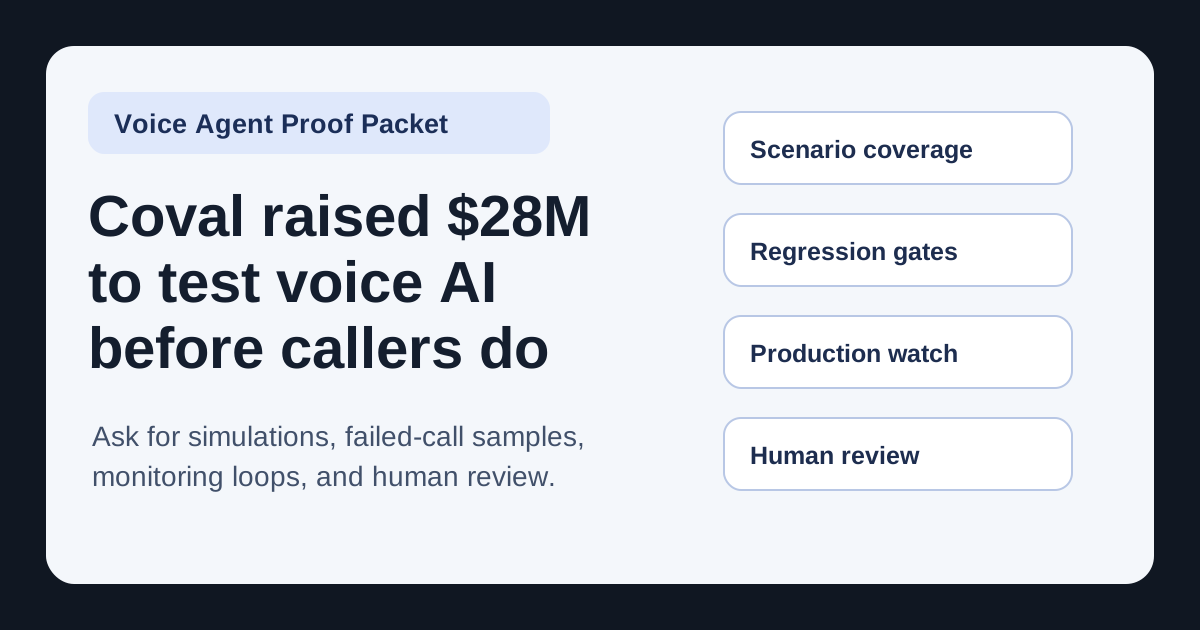
| Proof item | Why it matters | Buyer ask |
|---|---|---|
| Scenario coverage | A demo often covers the happy path while live callers bring edge cases, missing details, repeated questions, interruptions, and emotional context. | Show the scenario library, persona mix, accent/noise coverage, off-script prompts, and the percentage of business workflows represented. |
| Audio and interruption tests | Voice agents fail differently from chat because transcription, turn-taking, latency, noise, and barge-in all affect the call. | Provide test results for background noise, overlapping speech, silence, accents, low-quality phones, and caller corrections. |
| Regression gates | A prompt, model, tool, or knowledge-base change can quietly break behavior that worked last week. | Document release gates, baseline calls, pass/fail thresholds, rollback triggers, and what changed between versions. |
| Tool-use boundaries | Production voice agents can schedule, update records, collect details, transfer calls, or trigger workflows with lasting consequences. | List every write action, approval step, blocked action, confirmation phrase, audit log, and recovery process. |
| Human review loop | Automated scores can miss tone, compliance nuance, customer frustration, and business-specific judgment. | Show human-review sampling, QA rubric, failed-call examples, coaching loop, and how reviewed failures become new tests. |
| Production monitoring | Failure patterns appear after launch through hangups, repeats, transfers, complaints, and tool errors. | Track containment, early hangups, escalation reasons, failed tool calls, callback recovery, complaint themes, and reopened cases. |
What buyers should do next
- Choose one real call workflow and write the failure modes before asking for a vendor demo.
- Request scenario tests that include accents, interruptions, silence, background noise, angry callers, partial details, and off-script requests.
- Require regression evidence for every prompt, model, voice, tool, or knowledge-base change before production.
- Ask for failed-call samples and human-review notes, not only success clips.
- Define launch monitoring for hangups, transfers, complaints, reopens, tool errors, and customer recovery.
Turn this brief into a vendor packet
Make the vendor prove the workflow before the demo gets polished.
Use the RFP generator and call-test script to turn this news framework into concrete evidence requests, acceptance tests, and escalation rules for your own voice AI rollout.
Buyer FAQs
What did Coval raise?
Coval announced a $28 million Series A led by Norwest, with participation from Base10 Partners, Twilio Ventures, Y Combinator, MaC Ventures, and Swift Ventures.
Why does this matter for voice AI buyers?
It shows that the market is funding the reliability and evaluation layer beneath voice agents. Buyers should ask for scenario tests, regression gates, monitoring, and human review before launch.
What proof should buyers ask for first?
Ask for representative test scenarios, failed-call examples, audio edge-case coverage, tool-use logs, release gates, escalation evidence, and production monitoring metrics.
Sources
- Coval Series A announcement: Primary company announcement covering the $28 million Series A, investor list, production-reliability thesis, and testing roadmap.
- The Next Web: Independent coverage framing Coval as a stress-testing layer for voice agents before real callers hear failures.
- MarTech Cube: Coverage of the financing, enterprise evaluation positioning, Zoom and Deepgram references, and simulation-monitoring workflow.