

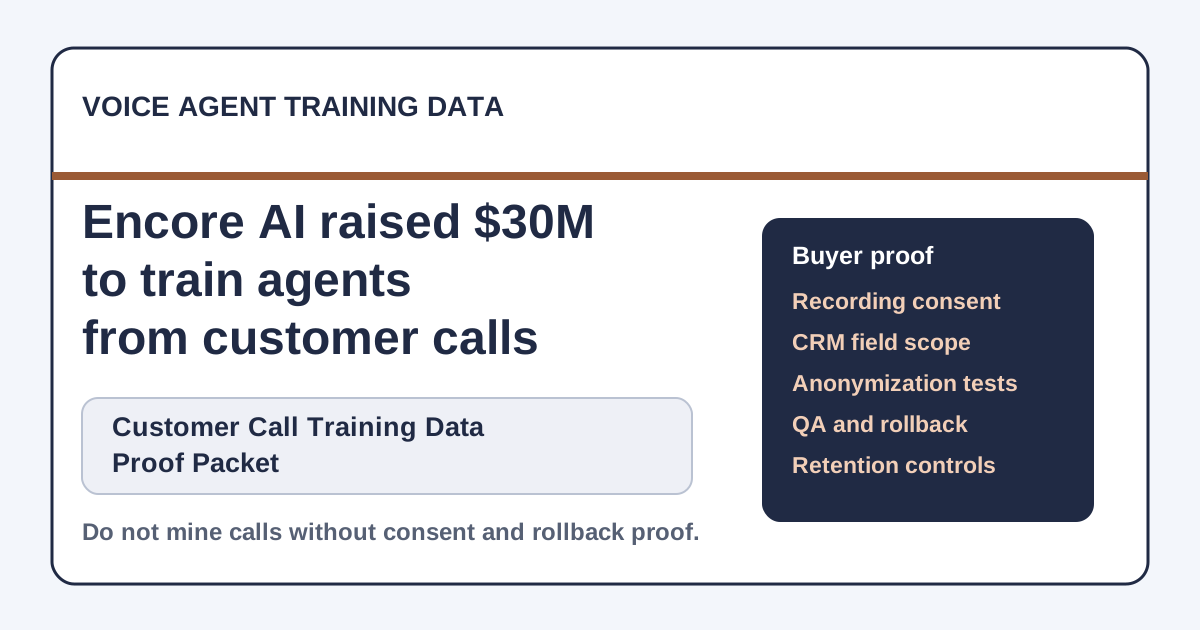
Direct answer: Encore AI announced a $30 million Series A on July 29, 2026, and TechCrunch reported the company uses customer calls, messages, and CRM data to train AI voice agents from successful employee interactions. Voice-agent buyers should treat the round as a training-data proof test, not a vendor endorsement. Before a voice agent learns from real customer calls, require evidence for consent, data scope, anonymization, approved playbooks, QA, update rollback, customer opt-out, retention, and revenue-vs-service limits.
What happened
- TechCrunch reported on July 29 that Encore AI raised $30 million in a Series A round led by Team8.
- TechCrunch said the company, founded as Insait IO, rebranded as Encore AI and analyzes customer interactions to train and deploy AI voice agents.
- The same report said Encore's platform collects call recordings, emails, text messages, and CRM data to identify effective interaction patterns.
- CMSWire independently covered the round and described the company as targeting banks, insurers, healthcare, and other regulated industries with revenue-focused agents.
- CTech and PR Newswire also covered the financing, rebrand, and enterprise customer-interaction platform positioning.
- The buyer-relevant issue is not the funding amount alone. It is whether customer calls and CRM history can be used as training material with consent, scope, QA, and rollback proof.
Why this is trending
- The story had current funding momentum, a rebrand, and same-day coverage from startup, customer-experience, and technology outlets.
- It connects voice agents to customer interaction mining, not only generic call answering. That makes call recordings, CRM context, and employee playbooks part of the production system.
- The stated targets include regulated industries, where consent, data minimization, auditability, and retention are procurement issues.
- Voice AI buyers increasingly ask whether agents can learn from top performers, but the risk is that high-performing sales behavior, sensitive customer facts, or unsupported promises get copied into automation.
The Voice Agent Index take
A voice-agent buyer should not approve customer-call training because the demo sounds like the best employee. The buyer needs a Customer Call Training Data Proof Packet: which calls and messages are eligible, what consent covers, which CRM fields are included, how data is anonymized, who chooses the top-performer signal, how QA catches copied bad behavior, how model updates roll back, how customers opt out, and how long training material is retained.
Customer Call Training Data Proof Packet
A voice-agent buyer checklist for validating whether customer calls, messages, CRM records, and top-performer playbooks can safely train AI agents for support, sales, or revenue workflows.
| Proof item | Why it matters | Buyer ask |
|---|---|---|
| Recording consent | Call recordings may be allowed for quality, training, sales coaching, or service review, but those permissions do not always cover AI model training or autonomous agent behavior. | Require consent language, jurisdiction rules, recording notice, training-use terms, customer opt-out, and proof that excluded calls stay out of the training set. |
| CRM data scope | CRM records can include account value, complaints, payment status, health details, internal notes, escalations, and sales opportunities. | Map every CRM object and field used for training, retrieval, scoring, or prompt context, with read/write boundaries and field-level exclusions. |
| Anonymization and minimization | Customer-call training can copy names, account IDs, addresses, pricing, confidential notes, and regulated data into analysis or examples. | Ask for redaction tests, entity removal, sensitive-field blocking, sample review, retention limits, and evidence that model outputs do not leak training snippets. |
| Top-performer selection | A top seller's successful call may include tactics that are off-brand, noncompliant, too aggressive, or unsuitable for service scenarios. | Require a playbook approval process that separates revenue signal from compliance, service quality, fairness, and customer trust. |
| QA and rollback | If the agent learns from new calls, the behavior can drift after a campaign, policy change, or bad batch of examples. | Review model-update notes, test-call results, blocked phrases, supervisor approvals, version logs, rollback time, and affected-call reports. |
| Retention and recovery | Training data can outlive the customer relationship, employee authorization, campaign, vendor contract, or consent period. | Define retention periods, deletion evidence, customer-request workflow, vendor offboarding, affected-data reporting, and recovery ownership. |
What buyers should do next
- List every call recording, message, transcript, CRM object, and employee playbook that could train or condition the voice agent.
- Confirm whether recording and privacy notices explicitly allow AI training, automated agent behavior, and revenue optimization.
- Exclude regulated fields, payment data, health information, internal escalation notes, and sensitive attachments unless approved by policy.
- Create a playbook approval lane that checks compliance, service quality, fairness, brand tone, and customer trust before top-performer behavior is copied.
- Run regression calls after every training-data or playbook update and keep versioned evidence for rollback.
- Use the Voice Agent Index readiness checklist and RFP generator to require consent, scope, QA, rollback, and retention proof from voice AI vendors.
Turn this brief into a vendor packet
Make the vendor prove the workflow before the demo gets polished.
Use the RFP generator and call-test script to turn this news framework into concrete evidence requests, acceptance tests, and escalation rules for your own voice AI rollout.
Buyer FAQs
What did Encore AI announce?
Encore AI announced a $30 million Series A on July 29, 2026, alongside a rebrand from Insait IO. TechCrunch reported the company analyzes customer calls, messages, and CRM data to train AI voice agents.
Why does this matter to voice-agent buyers?
Training agents from customer calls can improve workflows, but it also creates consent, data-scope, redaction, playbook, QA, rollback, opt-out, and retention risk.
What proof should buyers request first?
Ask for a Customer Call Training Data Proof Packet covering consent, CRM fields, anonymization, top-performer selection, QA, rollback, opt-out, retention, and recovery.
Sources
- TechCrunch: July 29, 2026 report on Encore AI's Series A, rebrand from Insait IO, customer-interaction analysis, CRM data use, and AI voice-agent training.
- CMSWire: Independent July 29, 2026 customer-experience coverage of Encore AI's $30 million Series A and regulated-industry positioning.
- CTech: Technology coverage of Encore AI's financing, investors, enterprise positioning, and customer-interaction analysis.
- PR Newswire: Official July 29, 2026 release announcing the rebrand from Insait IO and the $30 million Series A.