

Direct answer: The FCC's July 1, 2026 RMD fact sheet proposed tightening the Robocall Mitigation Database and broadening how voice-service-provider accountability is verified. The FCC framing covers providers across the call path, including non-facilities-based interconnected VoIP resellers. CommLaw Group's legal analysis says the proposal could also affect call centers, SaaS providers, and AI platforms that touch PSTN or NANP voice traffic. Voice AI buyers should require call-path proof before launching production agents.
What happened
- The FCC released a July 1, 2026 fact sheet on improving the effectiveness of the Robocall Mitigation Database, or RMD.
- The fact sheet describes the RMD as a central transparency and compliance tool for robocall mitigation and STIR/SHAKEN implementation.
- The FCC proposal discusses providers across the call path and references non-facilities-based providers, including interconnected VoIP resellers and mobile virtual network operators.
- The fact sheet says downstream providers would accept traffic only from providers listed in the RMD under the proposed approach.
- CommLaw Group's July 2 analysis interprets the proposal as a major expansion that could affect call centers, SaaS platforms, AI platforms, and other businesses that touch PSTN or NANP voice traffic.
Why this is trending
- Voice AI is moving into live outbound and inbound call paths at the same time regulators are tightening robocall, provider, number, and traceback accountability.
- Many AI voice buyers focus on model quality and conversational performance while assuming the carrier, telephony API, reseller, or platform already covers compliance proof.
- The RMD proposal gives compliance, legal, telecom, and CX leaders a concrete reason to map every entity in the call path before allowing AI agents to place or receive production calls.
The Voice Agent Index take
A voice AI buyer should not approve launch because a vendor can connect to a phone number and produce natural speech. The buyer needs a call-path proof packet: RMD status for relevant providers, NANP number ownership, originating/intermediate/terminating roles, STIR/SHAKEN and attestation evidence, traceback response ownership, customer identity controls, and a fallback route if any provider status changes.
AI Voice Call-Path Proof Packet
A buyer checklist for validating voice AI compliance across RMD filing status, call-path roles, number ownership, STIR/SHAKEN attestation, traceback response, customer identity, and fallback.
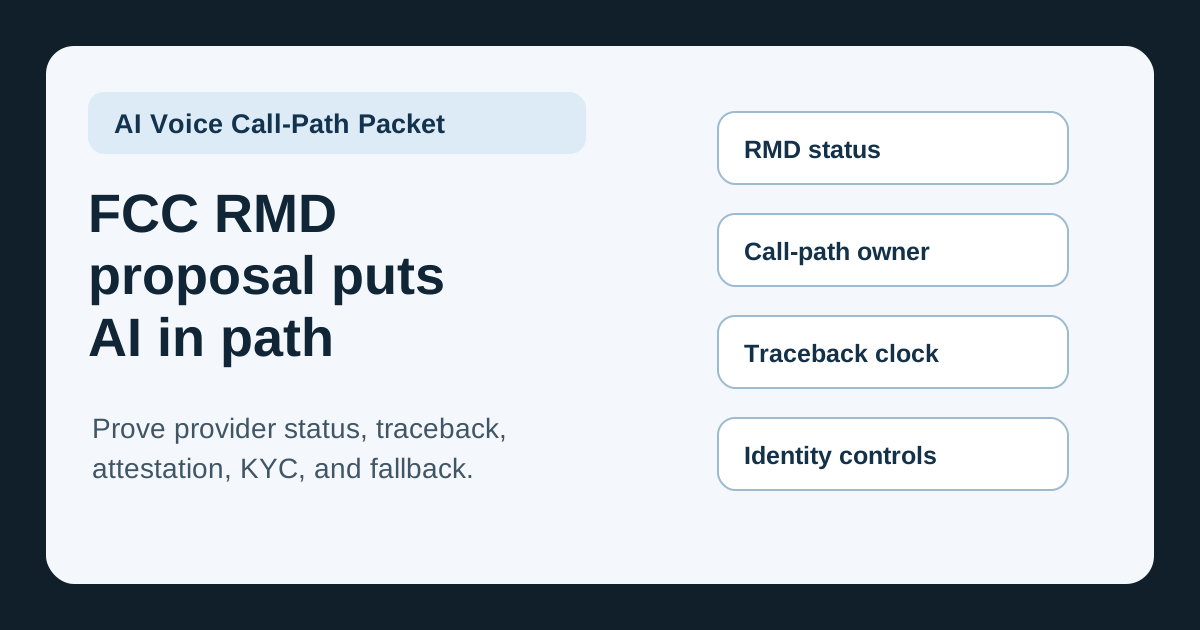
| Proof item | Why it matters | Buyer ask |
|---|---|---|
| RMD status | If a provider in the voice path is not properly listed or recognized, downstream providers may reject or block traffic under tightened RMD rules. | Show RMD filing status, legal entity name, provider role, certification owner, update cadence, and evidence for each provider in the call path. |
| Call-path role map | AI voice deployments can involve an app vendor, telephony API, reseller, carrier, contact center, and enterprise customer, with unclear accountability. | Map initiating, originating, intermediate, terminating, reseller, platform, and customer roles before production traffic starts. |
| Number ownership and KYC | Robocall enforcement often starts with who controlled the number and whether the customer was vetted before traffic began. | Provide number inventory, assignment records, customer identity checks, campaign approval, blocked-use policy, and abuse escalation owner. |
| STIR/SHAKEN and attestation | Voice AI calls can be downgraded, mistrusted, filtered, or investigated if caller ID authentication and attestation are not clear. | Show attestation path, signing provider, caller-ID rules, branded-calling status, test-call evidence, and remediation steps. |
| Traceback response | A traceback request can arrive after a complaint or enforcement inquiry, and delays can expose the buyer as well as the provider. | Name the 24-hour traceback owner, evidence source, escalation contact, transcript/recording retention, and legal review path. |
| Fallback and traffic stop | If a provider is delisted, blocked, degraded, or under investigation, production voice agents may need to stop or reroute quickly. | Define kill switch, route change, customer notification, human backup, campaign pause, and post-incident review procedures. |
What buyers should do next
- Draw the full call path for one AI voice workflow, from customer identity and phone number assignment through the platform, telephony provider, carriers, and recipient.
- Ask each vendor which legal entity owns RMD filings, STIR/SHAKEN signing, number assignment, and traceback response.
- Collect evidence for number ownership, customer KYC, campaign purpose, attestation, call recordings, transcripts, and release logs.
- Define when AI calls must pause because of provider status changes, complaint spikes, traceback requests, or attestation failures.
- Turn the call-path proof packet into a launch gate before expanding outbound campaigns, AI receptionists, or contact-center automation.
Turn this brief into a vendor packet
Make the vendor prove the workflow before the demo gets polished.
Use the RFP generator and call-test script to turn this news framework into concrete evidence requests, acceptance tests, and escalation rules for your own voice AI rollout.
Buyer FAQs
What did the FCC propose?
The FCC released a July 1, 2026 fact sheet proposing changes to improve the Robocall Mitigation Database and strengthen accountability for providers involved in voice traffic and robocall mitigation.
Does the proposal specifically regulate AI voice agents?
The FCC fact sheet focuses on voice-service-provider and RMD obligations. CommLaw Group's legal analysis says the broad approach could affect AI platforms, call centers, SaaS providers, and other businesses that touch PSTN or NANP voice traffic.
What proof should voice AI buyers ask for first?
Ask for RMD filing status, call-path role map, number ownership, customer KYC, STIR/SHAKEN attestation, traceback ownership, transcript retention, and fallback or traffic-stop procedures.
Sources
- FCC RMD fact sheet: Primary FCC July 1, 2026 fact sheet on improving the effectiveness of the Robocall Mitigation Database.
- FCC Robocall Mitigation Database: FCC public page describing RMD certifications and the database's role in illegal robocall mitigation.
- CommLaw Group: Legal analysis of the FCC proposal and its possible impact on call centers, SaaS providers, AI platforms, and non-facilities-based voice participants.
- FCC stricter RMD filing requirements: FCC background on earlier RMD filing-requirement tightening and provider responsibilities.