

Direct answer: The FTC sought public comment on a proposed policy statement addressing AI accuracy on July 1, 2026. The agency framed the concern around AI companies manipulating system behavior contrary to reasonable consumer expectations for objectivity and accuracy. Voice AI buyers should treat the move as a governance signal: do not approve production voice agents without proof for accuracy tests, caller disclosures, source controls, monitoring, escalation, rollback, and evidence retention.
What happened
- The FTC announced on July 1, 2026 that it was seeking public comment on a proposed policy statement addressing AI accuracy.
- The FTC legal-library page names the proposal as a policy statement concerning suppression of accuracy in artificial intelligence systems.
- Bloomberg Law reported the same day that the FTC was seeking comment on the proposed AI accuracy policy statement.
- Consumer Financial Services Law Monitor said the statement focuses on whether steering AI output away from a correct answer without telling users could raise deception concerns under Section 5 of the FTC Act.
- For voice agent buyers, the policy discussion matters because callers may rely on spoken answers for billing, appointments, eligibility, refunds, account status, health intake, and other high-consequence decisions.
Why this is trending
- AI accuracy is moving from a product-quality issue into a consumer-protection and governance issue.
- Voice agents create extra risk because callers hear an answer in real time, may not see source citations, and may act before a human reviews the interaction.
- The FTC action gives legal, compliance, CX, and operations teams a concrete reason to ask vendors for proof instead of accepting demo accuracy or model benchmark claims.
The Voice Agent Index take
A voice AI buyer should not approve production because a vendor says the model is accurate. The buyer needs a governance packet: scenario tests, approved knowledge sources, caller disclosure, accuracy monitoring, high-risk escalation, rollback thresholds, and retained evidence for disputed calls.
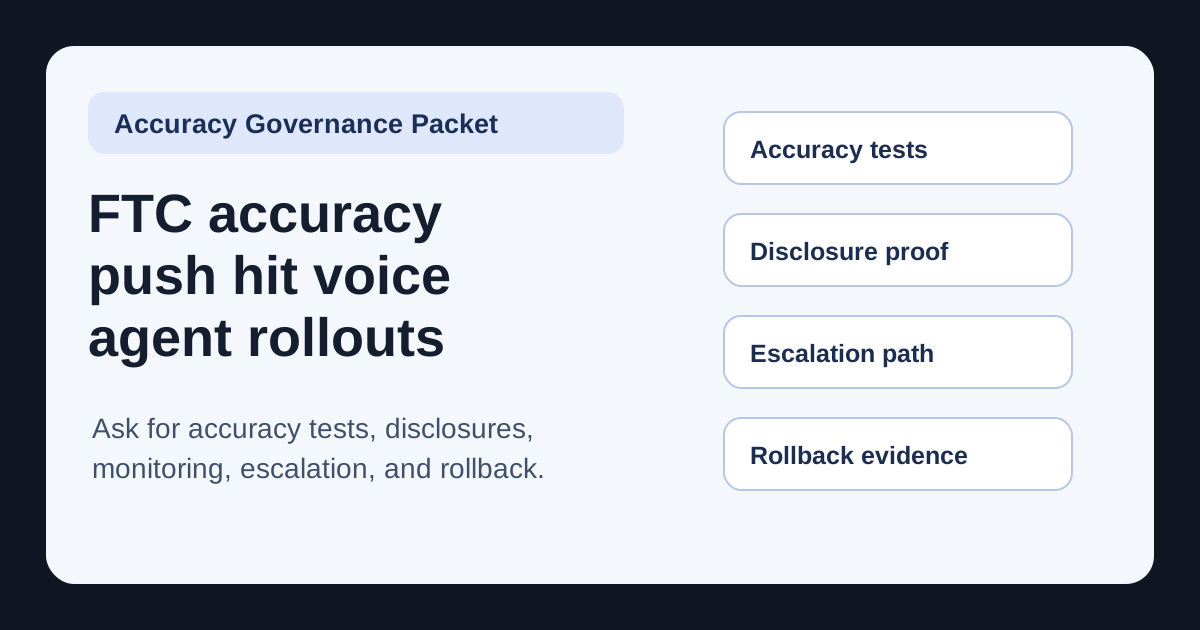
Voice Agent Accuracy Governance Packet
A buyer checklist for validating production voice AI accuracy across scenario tests, disclosures, knowledge-source control, live monitoring, escalation, rollback, and evidence retention.
| Proof item | Why it matters | Buyer ask |
|---|---|---|
| Scenario accuracy tests | General model accuracy does not prove the voice agent can answer your billing, booking, eligibility, refund, or policy questions correctly. | Show call-specific test scenarios, transcripts, expected answers, pass/fail criteria, and edge cases before launch. |
| Caller disclosure | Callers should understand when they are interacting with automation and when a human is available. | Provide disclosure wording, placement, fallback options, language support, and escalation instructions. |
| Knowledge-source control | A voice agent can be wrong because the model hallucinated, the source was stale, or the workflow forced an answer from incomplete data. | List approved sources, refresh cadence, source owner, blocked topics, confidence thresholds, and citation or audit evidence. |
| Live monitoring | Accuracy can degrade after policy changes, prompt changes, model updates, data drift, or new caller behavior. | Track wrong answers, uncertainty events, transfers, complaints, repeat calls, refund events, tool failures, and supervisor corrections by release. |
| Escalation and human review | High-risk calls should not depend on the AI agent improvising through legal, medical, financial, identity, or safety-sensitive issues. | Define topics that must route to humans, warm handoff notes, supervisor review, callback ownership, and emergency language. |
| Rollback and evidence retention | A production release can create inaccurate call guidance before a dashboard shows the pattern. | Set rollback triggers, transcript retention, recording access, release logs, dispute workflow, and customer-repair procedures. |
What buyers should do next
- Choose one production call flow and write the accuracy scenarios callers will actually test.
- Require vendors to show source-control rules, blocked topics, and answer boundaries before launch.
- Add caller disclosure, human escalation, and callback recovery to the call design.
- Monitor wrong-answer reports, repeat calls, transfers, complaints, refund events, and supervisor corrections by release.
- Turn every inaccurate or disputed call into a regression test and define rollback thresholds before scaling.
Turn this brief into a vendor packet
Make the vendor prove the workflow before the demo gets polished.
Use the RFP generator and call-test script to turn this news framework into concrete evidence requests, acceptance tests, and escalation rules for your own voice AI rollout.
Buyer FAQs
What did the FTC announce?
On July 1, 2026, the FTC sought public comment on a proposed policy statement addressing concerns about AI accuracy and consumer expectations for objective, accurate AI system behavior.
Does the FTC action specifically ban voice agents?
No. The FTC action is a proposed policy statement and comment request about AI accuracy. Voice AI buyers should treat it as a governance signal rather than a product ban.
What proof should voice AI buyers ask for first?
Ask for scenario accuracy tests, caller disclosure, source controls, live monitoring, escalation rules, rollback thresholds, and retained evidence for disputed calls.
Sources
- FTC press release: Primary FTC announcement that the agency is seeking public comment on a proposed policy statement addressing AI accuracy.
- FTC legal-library entry: FTC legal-library page for the proposed policy statement concerning suppression of accuracy in artificial intelligence systems.
- Bloomberg Law: Independent legal-news coverage of the FTC's proposed AI accuracy policy statement and comment request.
- Consumer Financial Services Law Monitor: Legal analysis summarizing the proposed statement and its Section 5 consumer-deception framing.