
Direct answer: Indian entertainment and legal coverage in early August 2026 shows a fast-moving AI identity-rights problem: public figures are seeking protection from AI-generated impersonation, deepfakes, fake endorsements, and unauthorized use of identity attributes, while musicians are publicly warning against voice cloning. Voice-agent buyers should respond with a Voice Consent Evidence Packet before using cloned, synthetic, celebrity-like, employee-like, or brand-persona voices in production.
What happened
- Times of India reported on August 5, 2026 that Tabu approached the Delhi High Court seeking protection of personality and publicity rights against alleged unauthorized use of her name, image, likeness, and other identity attributes, including AI-generated content and digital impersonation.
- The same report said the court asked her legal team to correct case filings and listed the matter for August 6.
- Hindustan Times reported on August 4 that Mrunal Thakur issued a legal warning over AI deepfakes and unauthorized misuse of her identity.
- Bollywood Hungama reported on August 3 that Shruti Haasan moved the Bombay High Court against AI deepfakes, fake endorsements, unauthorized merchandise, and identity misuse.
- Times of India also reported singer Hariharan's criticism of AI voice cloning and the broader debate over recreating an artist's voice and style.
- Together, the stories show that AI voice and persona use is moving from novelty into rights, consent, and takedown risk.
Why this is trending
- The coverage is current and involves multiple independent outlets and multiple public figures within the same week.
- The legal claims are about practical identity attributes that voice AI can touch: name, likeness, voice, endorsement, persona, and digital impersonation.
- Voice AI products increasingly let buyers choose branded voices, clone employees, mimic personas, localize sales scripts, and produce outbound or inbound voice experiences at scale.
- A voice that sounds natural can still create legal, trust, and brand risk if the buyer cannot prove who consented, where it may be used, and how misuse is removed.
The Voice Agent Index take
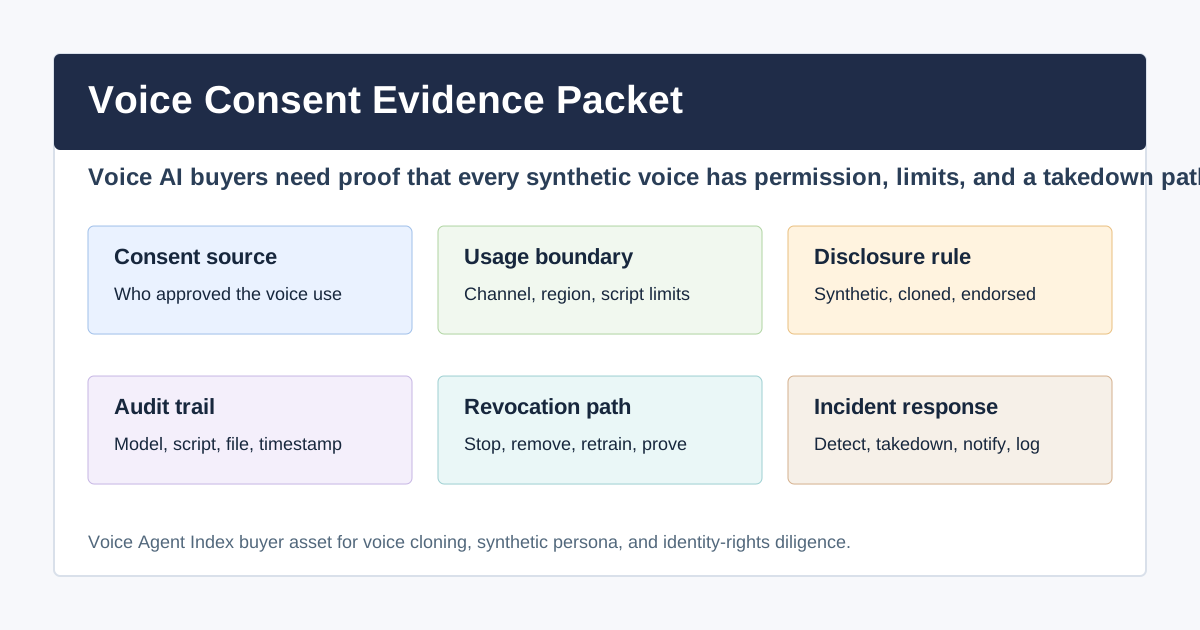
A voice-agent buyer should not approve a voice because it sounds human, famous, friendly, or on-brand. The buyer needs a Voice Consent Evidence Packet showing who approved the voice, which channels and scripts are permitted, whether synthetic disclosure is required, how each generated call is logged, how consent can be revoked, and who owns takedown when a clone or persona is misused.
Voice Consent Evidence Packet
A voice-agent buyer checklist for validating synthetic voice and persona use across consent source, usage boundaries, disclosure, model and script audit trails, revocation, takedown, and incident response.
| Proof item | Why it matters | Buyer ask |
|---|---|---|
| Consent source | A synthetic or cloned voice can imply endorsement, employment, agency, or identity use even when the call script is harmless. | Require signed consent, license scope, talent or employee authority, covered languages, allowed training materials, and renewal dates. |
| Usage boundary | A voice approved for one demo, region, script, or internal workflow may not be approved for outbound sales, regulated service, ads, or public content. | Document approved channels, geographies, scripts, campaign types, prohibited uses, and region-specific legal review. |
| Synthetic disclosure | Customers, candidates, patients, or citizens may need to know when they are hearing AI or a synthetic voice rather than a human representative. | Ask for disclosure rules, transcript wording, call-start prompts, recording notices, and exception handling by jurisdiction. |
| Audit trail | When a voice is challenged, the buyer needs to prove which model, script, voice asset, approval, and timestamp produced the interaction. | Keep voice asset IDs, model versions, script versions, consent records, call logs, audio retention policy, and reviewer notes. |
| Revocation path | Talent, employees, brands, or partners may withdraw consent, end a campaign, or restrict future voice use. | Require stop-use controls, model removal steps, campaign kill switch, retraining evidence, asset deletion proof, and vendor owner. |
| Incident response | Deepfake and impersonation incidents move fast across social, messaging, ads, calls, and content platforms. | Define detection, takedown, platform reporting, customer notice, regulator/legal escalation, and public-response ownership. |
What buyers should do next
- Inventory every synthetic, cloned, employee-like, celebrity-like, brand-persona, and vendor-provided voice used in calls, demos, videos, ads, training, and support flows.
- Attach each voice to a consent record, license scope, allowed scripts, channel limits, language limits, retention rule, and revocation owner.
- Add synthetic-voice disclosure to regulated, outbound, hiring, healthcare, financial, and customer-service workflows where required or trust-critical.
- Log model version, voice asset, script version, campaign, call ID, disclosure status, consent record, and reviewer decision for every sensitive deployment.
- Create a takedown and stop-use process for unauthorized clones, fake endorsements, impersonation complaints, consent withdrawal, and disputed audio.
- Use the Voice Agent Index RFP generator and call-test script to require consent, disclosure, audit, and revocation evidence from every voice AI vendor.
Turn this brief into a vendor packet
Make the vendor prove the workflow before the demo gets polished.
Use the RFP generator and call-test script to turn this news framework into concrete evidence requests, acceptance tests, and escalation rules for your own voice AI rollout.
Buyer FAQs
What is the India AI deepfake and personality-rights wave?
Indian outlets reported multiple current cases and warnings involving AI-generated impersonation, deepfakes, fake endorsements, unauthorized identity use, and voice cloning concerns among public figures.
Why does this matter to voice-agent buyers?
Voice-agent buyers may use synthetic, cloned, employee-like, celebrity-like, or brand-persona voices. Without proof of consent, limits, disclosure, audit logs, and takedown, the voice can create legal and trust risk.
What proof should buyers ask for first?
Ask for a Voice Consent Evidence Packet covering consent source, usage boundaries, disclosure rules, audit trail, revocation path, and incident response.
Sources
- Times of India: August 5, 2026 coverage of Tabu approaching the Delhi High Court over personality rights, AI-generated content, and digital impersonation.
- Hindustan Times: August 4, 2026 coverage of Mrunal Thakur's legal warning over AI deepfakes and unauthorized identity misuse.
- Bollywood Hungama: August 3, 2026 coverage of Shruti Haasan moving the Bombay High Court against AI deepfakes, fake endorsements, and unauthorized identity use.
- Times of India Music: August 3, 2026 coverage of Hariharan's criticism of AI voice cloning and the debate over recreating artist voices and styles.