

Direct answer: Microsoft launched MAI-Transcribe-2-Streaming and two MAI-Voice-2.1 variants on October 1. Its streaming recognizer returns provisional text before a speaker finishes. That can accelerate preparation, but a buyer should require a Partial Transcript Action Gate before a voice agent commits an appointment, payment, cancellation or disclosure. Measure recognition speed and business-action accuracy separately.
What happened
- Microsoft says the streaming recognizer covers 60 languages and returns initial hypotheses in just over 100 milliseconds, then revises them as context arrives.
- The company lists an introductory transcription price of $0.54 per audio hour through year-end, plus voice prices of $22 and $15 per million characters for the standard and Flash variants.
- These figures are vendor descriptions of model behavior and pricing, not measurements of an entire telephone call or a buyer's deployment.
- Independent launch coverage establishes a timely voice-market development; it does not independently certify Microsoft's comparative performance claims.
Why this is trending
- Streaming speech changes when applications can begin processing a request, which makes action timing a practical procurement issue.
- A caller can finish an apparent booking request with a correction or negation. The earlier transcript must not become an irreversible instruction.
- This differs from a general full-duplex or SIP-launch story: the asset focuses on provisional recognition, correction and commitment boundaries.
The Voice Agent Index take
Consider an illustrative caller who starts with 'cancel my appointment' and then says 'actually, move it to Friday.' A fast recognizer may make the first phrase available before the correction. Use provisional text to prepare a lookup, but keep changes reversible until the complete request and any required confirmation are accepted. The following framework is our proposed acceptance plan, not a claim that Microsoft currently mishandles corrections.
Partial Transcript Action Gate
An original buyer checklist for transcript stability, irreversible tool calls, correction handling, language changes, interruption and all-in call cost.
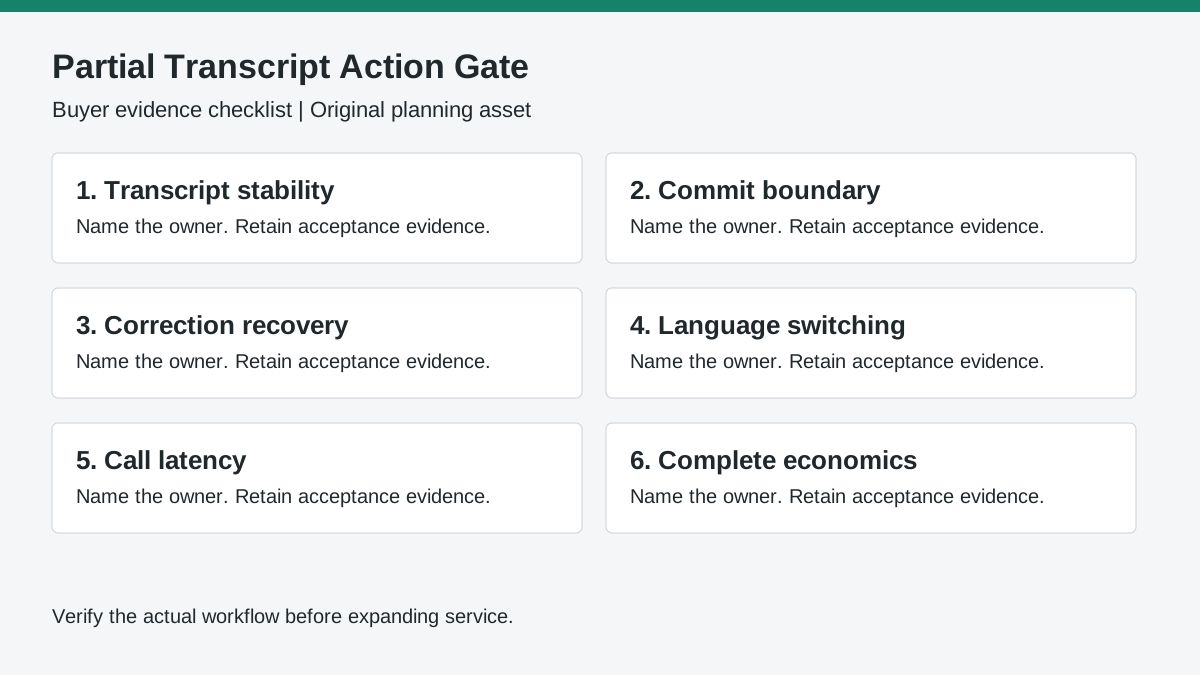
| Proof item | Why it matters | Buyer ask |
|---|---|---|
| Transcript stability | The first hypothesis can change after more audio arrives. | Show interim and final transcripts for negation, dates, names, numbers and mid-sentence corrections. |
| Commit boundary | An early tool call can alter a record before intent is settled. | Identify read-only preparation, reversible changes and actions requiring final intent or explicit confirmation. |
| Correction recovery | Repeating a tool call can create duplicate work. | Demonstrate correction, idempotency, rollback and an audit trail connecting audio, accepted intent and tool result. |
| Language switching | Language detection does not prove the business request was understood. | Replay approved mixed-language calls and verify entities, consent wording and human escalation. |
| Call latency | Recognition speed excludes reasoning, tools, transport and synthesis. | Measure caller-to-response timing across the actual carrier and production tool path, including interruptions. |
| Complete economics | Audio hours and generated characters are different billing units. | Add recognition, synthesis, reasoning, telephony, retries, storage and human fallback using an explicit call-volume model. |
What buyers should do next
- Label every tool by reversibility and impact before changing transcript timing.
- Replay a bounded set of corrected, negated and mixed-language requests through the actual tools.
- Require final intent and applicable confirmation before consequential changes.
- Record interim-to-final changes and tool outcomes without exposing unnecessary customer audio.
- Compare complete call cost and recovery behavior against the current working service.
Turn this brief into a vendor packet
Make the vendor prove the workflow before the demo gets polished.
Use the RFP generator and call-test script to turn this news framework into concrete evidence requests, acceptance tests, and escalation rules for your own voice AI rollout.
Buyer FAQs
Does a 100ms partial mean a 100ms telephone response?
No. A provisional transcript is one component. Carrier transport, turn decisions, reasoning, tools and generated speech add time.
Can an agent use partial text safely?
It can prepare a lookup or another approved reversible operation. The action policy should decide what must wait for settled intent and confirmation.
Are the quoted prices a complete agent-call quote?
No. They describe different speech-model billing units. A complete quote also accounts for telephony, reasoning, retries, storage and fallback.
Sources
- Microsoft AI launch: October 1 primary descriptions and prices; vendor performance claims remain attributed.
- ITmedia launch reporting: Independent October 2 coverage of the streaming recognizer and multilingual voice launch.