
Direct answer: OpenAI introduced Presence on July 22, 2026 as an enterprise product for trusted AI agents across customer and internal workflows, available for voice and chat agents through limited general availability. OpenAI says Presence supports realtime voice and chat experiences such as customer support, outbound sales, and high-risk internal workflows, and packages policies, SOPs, guardrails, approved actions, simulations, evaluation tools, and a Codex-powered improvement process. Voice-agent buyers should treat the launch as a production-control benchmark: require proof of policy scope, caller verification, tool permissions, approved actions, simulations, live monitoring, human handoff, evaluation, and controlled change management.
What happened
- OpenAI published its Presence announcement on July 22, 2026 and described it as an enterprise product for putting AI agents to work across customer and internal workflows.
- OpenAI says Presence is available for voice and chat agents and can support customer support, outbound sales, and high-risk internal workflows.
- The product description says each deployment starts with a specific job, gives the agent only the knowledge and system access required for that job, and lets the company define policies, approvals, and human takeover rules.
- OpenAI says Presence combines policies, standard operating procedures, guardrails, approved actions, simulations, evaluation tools, and a Codex-powered improvement process.
- OpenAI reported that its English-language phone support channel now resolves 75% of inbound issues without human assistance and that the improvement loop reduced human handoffs by 15 percentage points in 10 days.
- The announcement says Presence is available to eligible enterprise customers through limited general availability, with deployments led by OpenAI Forward Deployed Engineers and selected systems integrators rather than self-serve signup.
Why this is trending
- The launch moves the voice-agent conversation away from demo fluency and into production controls, system access, approvals, and live-quality feedback.
- Presence is a vendor/product launch, but independent coverage focused on guardrails, governance, and enterprise deployment risk, making it relevant as a buyer-proof story rather than simple promotion.
- OpenAI's own phone-support numbers give buyers a concrete benchmark to interrogate: resolution rate is useful only if the buyer also gets handoff, exception, QA, and customer-impact evidence.
- Limited general availability and FDE-led deployment signal that high-value voice agents are still operational projects, not plug-and-play phone bots.
The Voice Agent Index take
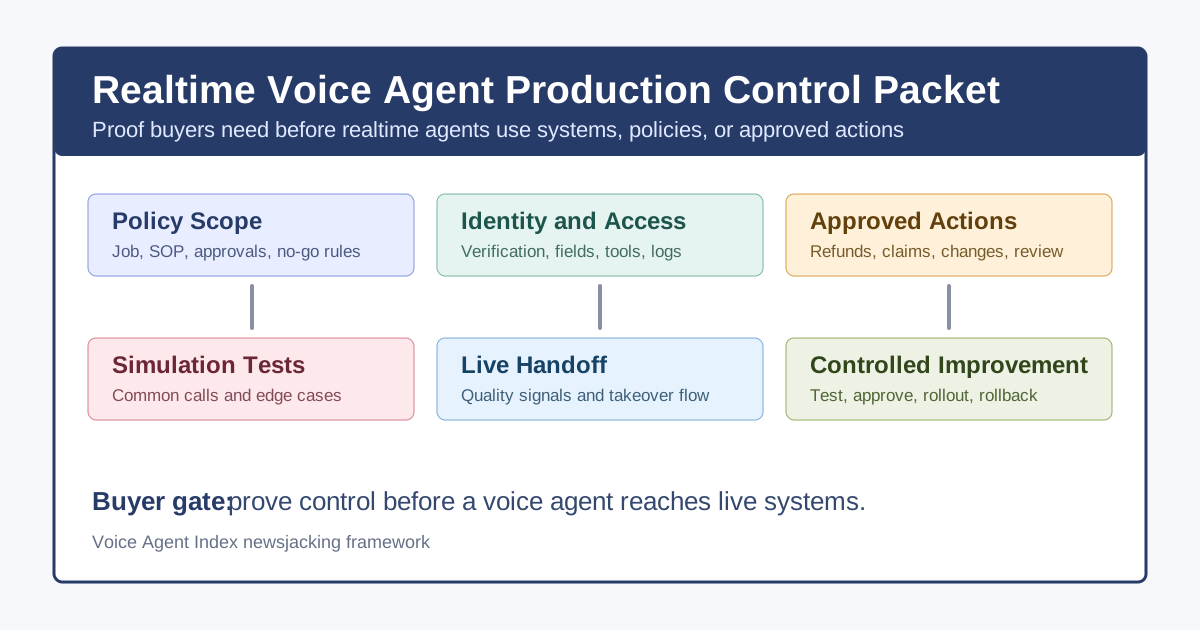
A voice-agent buyer should use Presence as a control checklist for any realtime agent, whether from OpenAI or another vendor. The required packet is a Realtime Voice Agent Production Control Packet: job scope, caller identity rules, data-access boundaries, tool permissions, approved action list, policy tests, simulation results, handoff triggers, live monitoring, evaluation history, rollout approvals, and rollback path.
Realtime Voice Agent Production Control Packet
A voice-agent buyer checklist for validating production readiness across policy scope, identity checks, tool permissions, approved actions, simulations, live monitoring, handoff, evaluation, and controlled rollout.
| Proof item | Why it matters | Buyer ask |
|---|---|---|
| Policy scope | A realtime voice agent can sound confident while applying the wrong policy, using stale rules, or failing to recognize a high-risk case. | Require a job-specific policy map, SOP version, allowed topics, no-go topics, approval rules, and tested examples for edge cases. |
| Identity and access | Voice agents that can look up accounts or act in systems need caller verification and least-privilege access before they touch records. | Ask for identity checks, account-context rules, field-level access, tool scopes, audit logs, and proof that the agent receives only required knowledge and access. |
| Approved actions | Resolving a billing issue, claim, refund, or account request may require actions that create financial, compliance, or customer-experience risk. | Document every action the agent can take, which actions require approval, and which actions always trigger human review. |
| Simulation and evaluation | Production voice agents need evidence across common requests, edge cases, adversarial callers, noisy audio, accents, interruptions, and policy conflict. | Require simulation results, graders, failed-scenario examples, regression tests, and acceptance thresholds before launch. |
| Live monitoring and handoff | A voice agent can fail through low confidence, poor audio, frustration, silence, tool failure, or policy ambiguity after it reaches production. | Ask for live-quality signals, handoff triggers, supervisor takeover flow, failed-transfer handling, customer notice logic, and post-call review queues. |
| Controlled improvement | Agents must adapt as products, policies, and caller behavior change, but uncontrolled updates can create new failures. | Require change proposals, test-against-production comparison, owner approval, staged rollout, rollback, and version history. |
What buyers should do next
- Pick one high-value voice workflow and write the exact job scope, allowed systems, forbidden actions, and human-takeover rules.
- Create a caller-verification and data-access matrix before giving the agent account context or tool access.
- List every approved action and mark which ones need manager, compliance, payment, or human review.
- Run simulation tests for common calls, edge cases, distressed callers, noisy audio, interruptions, tool failures, and policy conflicts.
- Define live monitoring, handoff, failed-transfer, customer-notice, and rollback criteria before production launch.
- Use the voice AI readiness checklist and RFP generator to ask vendors for production evidence instead of demo claims.
Turn this brief into a vendor packet
Make the vendor prove the workflow before the demo gets polished.
Use the RFP generator and call-test script to turn this news framework into concrete evidence requests, acceptance tests, and escalation rules for your own voice AI rollout.
Buyer FAQs
What is OpenAI Presence?
OpenAI Presence is an enterprise product announced on July 22, 2026 for deploying AI agents across customer and internal workflows, including voice and chat agents.
Is Presence self-serve?
OpenAI says Presence is available to eligible enterprise customers through limited general availability and is deployed by OpenAI Forward Deployed Engineers and selected systems integrators, not as a self-serve product.
What should voice-agent buyers ask after the launch?
Ask for policy scope, identity checks, tool permissions, approved actions, simulation results, live monitoring, human handoff, evaluation history, rollout approvals, and rollback evidence.
Sources
- OpenAI: July 22, 2026 Presence launch announcement covering voice and chat agents, policies, guardrails, approved actions, simulations, evaluation tools, deployment model, and availability.
- Help Net Security: July 22, 2026 independent coverage describing Presence as an enterprise platform for voice and chat AI agents with policies and guardrails.
- CX Today: July 22, 2026 coverage framing Presence around enterprise AI-agent governance, safety, privacy, and deployment risk.
- Business Insider: July 2026 coverage describing OpenAI's move into corporate software for customer service, sales, guardrails, simulations, and human review.