

Direct answer: Juarez v. Pegasystems Inc. is a proposed class action filed October 2 in the District of Massachusetts. The plaintiffs allege that Pega Voice AI received, transcribed and analyzed U.S. Bank customer calls without the callers' consent. Pegasystems has not yet answered, no class is certified and the allegations have not been tested. For voice-agent buyers, the immediate operational task is to document call notice, every live-audio recipient, data handling and a working objection path before a program goes live.
What happened
- Public docket listings identify Juarez et al. v. Pegasystems Inc., case 1:26-cv-14506, as filed in the District of Massachusetts on October 2.
- The filed complaint, as described in public complaint reporting, alleges that a vendor's voice-AI service received and analyzed customer-support calls. The named bank is not a defendant in the complaint.
- This article reports allegations, not established facts: Pegasystems has not filed a public merits response, no class has been certified and no court has ruled on liability.
Why this is trending
- The complaint focuses on the operational line between a customer using call-center software and a vendor that receives live call audio for transcription or analysis.
- Voice-agent stacks often join a contact center, carrier, speech service, analytics provider, CRM and quality workflow; a buyer needs a defensible map of who touches a call.
- The story is distinct from outbound-call consent and deepfake evidence coverage because it concerns notice and third-party handling of inbound service conversations.
The Voice Agent Index take
Consider an illustrative support line that uses speech-to-text and next-best-action assistance. Even when the business records calls, a caller may care whether another provider receives live audio, what the provider does with it, and how that scope is disclosed. The acceptance test is factual: play an approved test call, preserve the notice played, list every downstream recipient, inspect retention and access settings, and test the escalation path. This is not a claim that any vendor's configuration is unlawful.
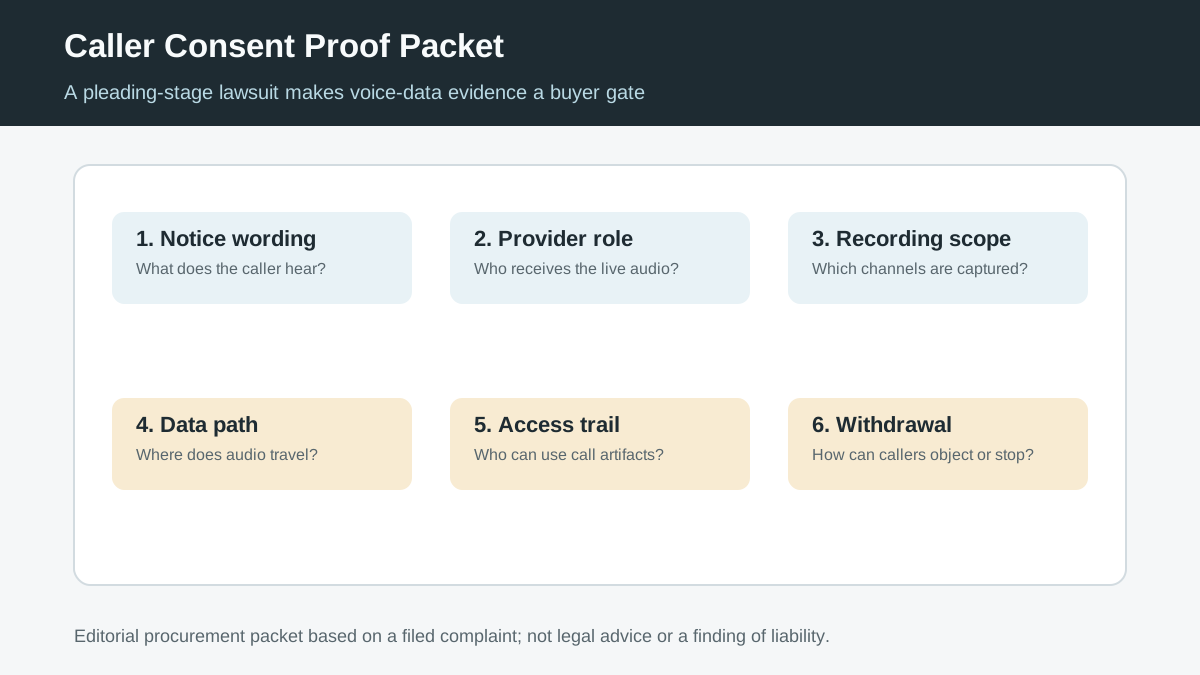
Caller Consent Proof Packet
An original six-part buyer packet for notice wording, provider role, recording scope, audio data path, artifact access and objection or withdrawal handling. It is a procurement aid, not legal advice.
| Proof item | Why it matters | Buyer ask |
|---|---|---|
| Notice wording | A generic recording notice may not answer what the actual workflow does with live audio. | Provide the exact spoken and written notice, locale variants, trigger point and proof that the production call flow plays it. |
| Provider role | Procurement needs to distinguish the business, contact-center operator, speech vendor and any analytics or model provider. | Name every entity that receives live audio, transcripts, summaries or derived signals and state its documented role. |
| Recording scope | Transfers, hold music, agent channels and callback segments can have different capture behavior. | Demonstrate which channels and segments are recorded, transcribed, excluded or sent for real-time analysis in an authorized test. |
| Data path | A contract label is not a substitute for a working path map showing destinations and processing stages. | Provide an architecture map for audio, transcript, metadata and derived summaries, including regions, encryption and subprocessors. |
| Access trail | Teams need to know who can replay, export, train on or annotate a call artifact. | Export a sample access and export log, state known logging gaps and show role-based restrictions. |
| Withdrawal and escalation | A caller or agent may object, ask a question or need a human path during a sensitive interaction. | Test the escalation script, objection routing, suppression or preference workflow and the accountable owner for a response. |
What buyers should do next
- Choose an authorized synthetic or internal test call; do not use customer data for a demonstration.
- Capture the exact notice, call identifiers, transfer events, transcript outputs and every receiving system.
- Compare the technical path with the data-processing schedule and public-facing notice; document gaps rather than assuming alignment.
- Have privacy and legal advisers determine which disclosures, consents, retention rules and state-law requirements apply to the real program.
- Make notice and data-path evidence a release gate whenever a new speech, analytics or agent-assist provider is added.
Turn this brief into a vendor packet
Make the vendor prove the workflow before the demo gets polished.
Use the RFP generator and call-test script to turn this news framework into concrete evidence requests, acceptance tests, and escalation rules for your own voice AI rollout.
Buyer FAQs
Did the Pega lawsuit establish liability?
No. The sources describe a filed complaint. Pegasystems has not yet answered, no class is certified and the allegations have not been decided by a court.
Does every voice AI program require the same notice?
No. The applicable answer depends on jurisdiction, workflow, roles and facts. Use qualified counsel for the program-specific legal analysis.
Is a recording notice enough by itself?
Not necessarily. Buyers should also be able to explain which parties receive audio, what happens to derivatives, who can access them and how objections are handled.
Does this packet prohibit voice analytics?
No. It is an evidence checklist for evaluating a proposed deployment and does not determine legality or suitability of any product.
Sources
- CourtListener: Juarez complaint PDF: Primary filed complaint in Juarez et al. v. Pegasystems Inc., case 1:26-cv-14506, filed October 2, 2026. Allegations are untested.
- Open Class Actions case summary: Independent public summary of the allegations, proposed state classes and untested procedural status.
- Pega Academy: Voice AI architecture: Vendor technical background on the product architecture; it does not establish the complaint allegations.