

Direct answer: Retell announced Conductor as a graph-native review system and copilot for production voice agents, according to the company's launch materials and independent coverage. Buyers should treat the story as a change-control warning, not a reason to ship more complex agents faster. Every voice-agent flow needs proof that changes are versioned, tested, monitored, recoverable, and owned before they affect live callers.
What happened
- Retell positioned Conductor as a graph-native review interface for production voice agents.
- The launch emphasizes reviewing proposed changes directly inside the agent workflow and keeping humans in approval control before changes go live.
- Independent coverage framed the announcement around production voice-agent review, testing, and workflow visibility.
- Graph-style review can make voice agents easier to reason about, but it also creates more release surfaces: nodes, transitions, tools, fallback paths, and escalation rules.
- For buyers, the practical issue is whether the vendor can prove that a flow change will not break appointments, payments, compliance scripts, emergency transfers, or human handoffs.
Why this is trending
- Voice-agent buyers are moving from first demos to production call flows that branch, call tools, write records, and transfer to people.
- Orchestration tools are getting attention because a natural voice is not enough when the agent has to complete a regulated or revenue-critical workflow.
- The Retell story sits in the same market shift as recent funding for voice-agent testing and evaluation: buyers now need proof of controlled change, not only proof of conversation quality.
The Voice Agent Index take
A voice AI buyer should not approve a production rollout because a flow builder looks visual or a demo sounds natural. The buyer needs a change-control packet: who owns each call path, how every branch is tested, which tools can write data, what triggers handoff, how rollback works, and how failed calls become new regression tests.
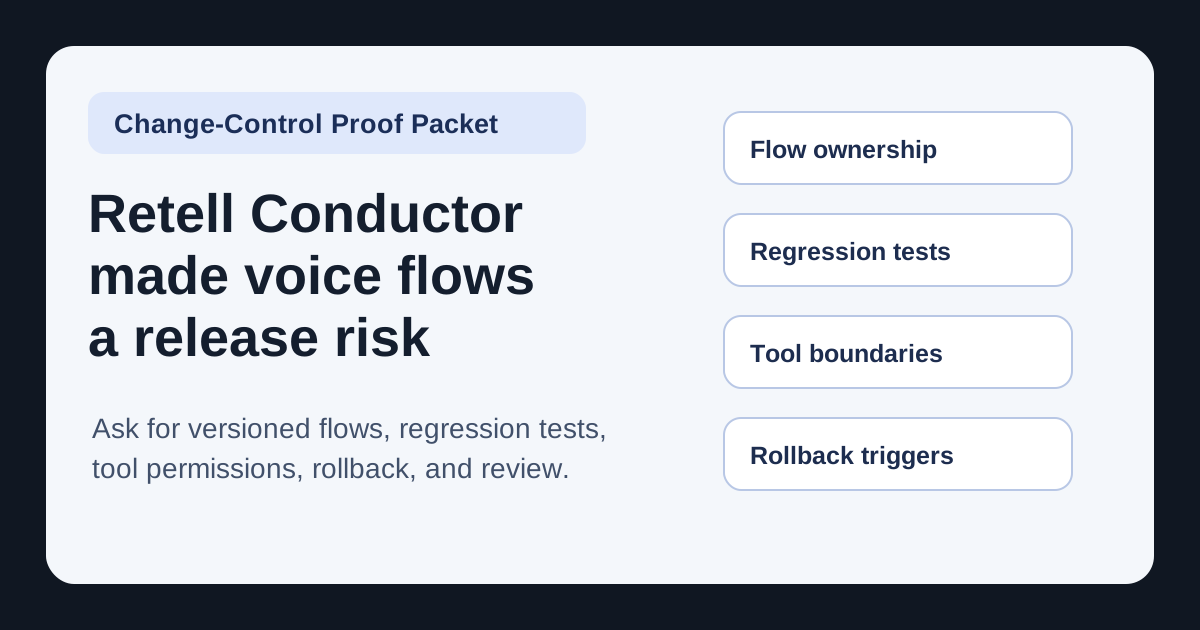
Voice Agent Change-Control Proof Packet
A buyer checklist for validating production voice-agent changes across flow ownership, scenario tests, tool permissions, escalation paths, rollback triggers, monitoring, and human review.
| Proof item | Why it matters | Buyer ask |
|---|---|---|
| Flow ownership | Graph-based workflows can hide risk when no one owns a branch, transition, or fallback path. | Show the named owner for every call path, node, tool action, escalation, and blocked behavior. |
| Scenario regression | Changing one node can break interruptions, confirmations, compliance wording, or downstream actions. | Provide before-and-after tests for happy path, correction, silence, angry caller, wrong intent, tool failure, and transfer. |
| Tool permissions | Voice agents can schedule, cancel, update records, collect data, or trigger irreversible follow-up. | List allowed writes, confirmations, blocked actions, audit logs, and approval steps for every tool call. |
| Rollback triggers | Production callers should not become the test set when a flow change causes loops, wrong routing, or compliance drift. | Define rollback thresholds for hangups, reopens, complaints, transfer spikes, failed tool calls, and QA failures. |
| Human review | Automated tests miss tone, customer frustration, edge-case judgment, and compliance nuance. | Show review samples, rubric scores, failed-call notes, escalation coaching, and how failures are added to regression tests. |
| Production monitoring | A voice-agent release can degrade slowly through new intents, new policies, model changes, or stale data. | Track flow exits, repeats, silent pauses, fallback reasons, transfer quality, customer complaints, and recovery work. |
What buyers should do next
- Pick one production call flow and name the owner for every branch, tool action, and human handoff.
- Ask vendors to show regression tests before and after any prompt, node, model, voice, policy, or knowledge change.
- Block write actions unless the agent confirms the caller intent and logs the action.
- Define rollback triggers before launch: hangups, transfer spikes, failed tools, complaints, compliance misses, and reopen rates.
- Review failed-call samples with humans and turn the failures into new test scenarios.
Turn this brief into a vendor packet
Make the vendor prove the workflow before the demo gets polished.
Use the RFP generator and call-test script to turn this news framework into concrete evidence requests, acceptance tests, and escalation rules for your own voice AI rollout.
Buyer FAQs
What did Retell announce?
Retell announced Conductor, described in launch materials as a graph-native review system and copilot for production voice agents.
Why does orchestration matter for buyers?
Production voice agents branch, call tools, update records, transfer calls, and follow policies. That makes change control and rollback as important as conversation quality.
What proof should buyers ask for first?
Ask for flow ownership, scenario regression tests, tool-permission lists, rollback thresholds, failed-call samples, human review, and production monitoring metrics.
Sources
- Retell Conductor launch: Primary Retell launch material describing Conductor, graph-native review, human approval, and production voice-agent workflow changes.
- CMSWire: Independent coverage of Retell's Conductor launch, graph-native review system positioning, and human approval controls.
- CXM Today: Independent CX coverage of Conductor as a production voice-agent review and optimization system.
- Speech Technology: Speech technology coverage of Retell Conductor and graph-native review for production voice agents.