
Direct answer: Consumer Federation of America urged the FTC and state attorneys general to investigate Speechify over AI voice-cloning practices, alleging the service can create realistic voice clones from seconds of audio and relies on self-attestation controls. CFA then testified at a Senate Aging Committee hearing on AI deception and fraud. Voice-agent buyers should respond with a Voice-Cloning Consent Proof Packet before using cloned or synthetic voices in customer workflows.
What happened
- Consumer Federation of America published a July 27, 2026 release urging the FTC and state attorneys general to investigate Speechify over AI voice-cloning practices.
- CFA said the complaint was prepared with UCLA Law Information Policy Lab students.
- CFA alleges Speechify can generate realistic voice clones from seconds of audio and relies on self-attestation controls to confirm permission.
- CFA connected the issue to impersonation and scam risk, citing FTC-reported impersonation scam losses and older-adult fraud impact.
- CFA's Ben Winters also submitted testimony for the Senate Special Committee on Aging hearing called The AI Deception Machine.
- CFA's Scam Economy report framed AI-enabled impersonation as part of a broader online scam economy, which raises buyer expectations for consent, disclosure, abuse response, and audit evidence.
Why this is trending
- The story combines a named voice-cloning product, a consumer-group complaint, FTC and state attorney general requests, and a Senate Aging Committee hearing.
- Voice cloning is moving from novelty to procurement risk because a synthetic voice can sound like an employee, executive, customer, patient, family member, or public figure.
- Self-attestation and upload controls are not enough for many business buyers if a clone can later be used in customer calls, marketing, collections, support, or fraud scenarios.
- The hearing context makes consent proof and impersonation safeguards a buyer checklist item rather than a narrow product controversy.
The Voice Agent Index take
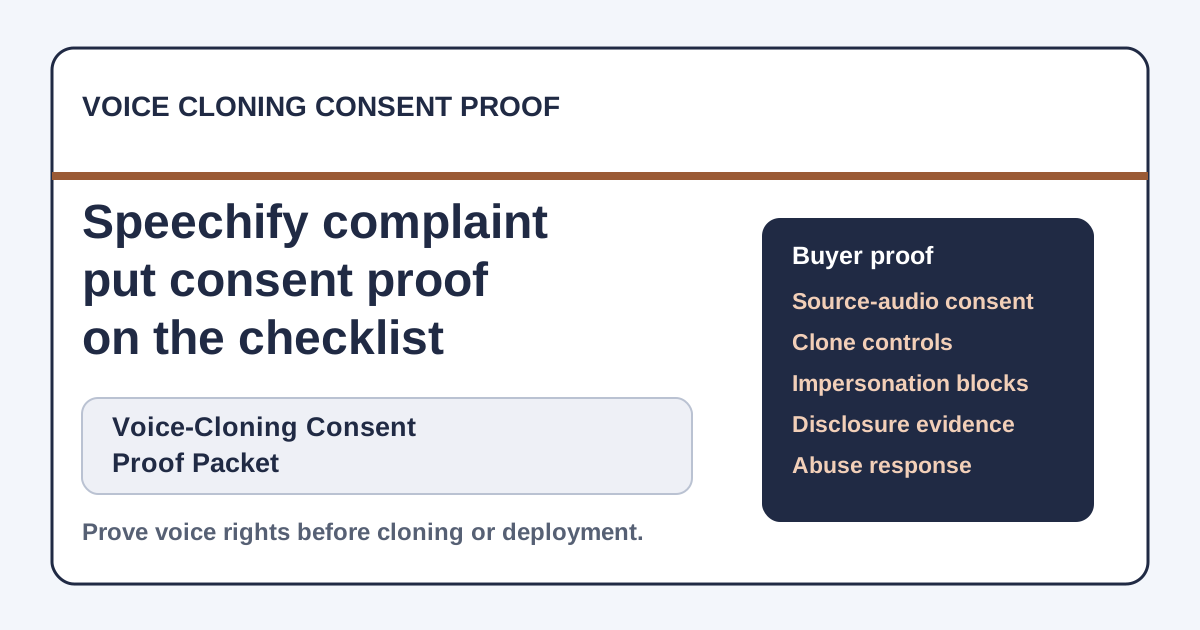
A voice-agent buyer should not approve cloning or synthetic-voice deployment because the voice sounds natural. The buyer needs a Voice-Cloning Consent Proof Packet showing where the source audio came from, who consented, what uses are allowed, how impersonation is blocked, how disclosure is delivered, how abuse is reported, what logs exist, how consent can be revoked, and who owns customer recovery when a clone is misused.
Voice-Cloning Consent Proof Packet
A voice-agent buyer checklist for validating source-audio consent, voice-clone creation controls, impersonation blocking, disclosure, abuse reporting, audit logs, revocation, and recovery evidence.
| Proof item | Why it matters | Buyer ask |
|---|---|---|
| Source-audio consent | A voice sample can be taken from calls, videos, podcasts, webinars, voicemails, or uploaded clips, and the speaker may not have approved cloning or commercial use. | Require source-audio records, consent scope, speaker identity proof, permitted-use terms, jurisdiction review, and excluded-audio enforcement. |
| Clone creation controls | Upload gates and self-attestation can be weaker than the downstream risk of a realistic voice clone. | Ask for identity checks, permission workflow, sample threshold, blocked sources, reviewer approval, and clone creation logs. |
| Impersonation blocking | Voice clones can be used to impersonate executives, support agents, family members, public figures, or customers in high-pressure workflows. | Review blocked-person policies, voice similarity checks, fraud scenarios, transaction limits, sensitive-use exclusions, and escalation rules. |
| Disclosure evidence | Customers, employees, and regulators may need to know when a voice is synthetic, cloned, or automated. | Require disclosure wording, channel placement, language coverage, call recordings, transcript markers, and consent capture evidence. |
| Abuse reporting | Misuse can spread through calls, messages, ads, social posts, or scam scripts before the buyer sees it. | Ask for abuse intake, takedown workflow, response SLA, affected-call report, law-enforcement handoff, and customer support scripts. |
| Audit and revocation | A cloned voice can outlive a contract, campaign, employee role, consent period, or customer relationship. | Define clone ownership, access logs, usage logs, revocation workflow, deletion evidence, retention limits, and vendor offboarding proof. |
What buyers should do next
- List every natural, synthetic, and cloned voice used in customer calls, marketing audio, support workflows, demos, or agent testing.
- Attach source-audio records and consent scope to each voice before it is approved for production.
- Block impersonation scenarios for executives, employees, customers, public figures, relatives, regulated roles, and sensitive transactions.
- Write synthetic-voice disclosure language for phone, web, SMS handoff, voicemail, and transcript contexts.
- Create an abuse reporting and revocation workflow with owner, SLA, affected-call reporting, and customer recovery scripts.
- Use the Voice Agent Index readiness checklist and RFP generator to require consent, clone controls, disclosure, abuse response, and audit evidence from voice AI vendors.
Turn this brief into a vendor packet
Make the vendor prove the workflow before the demo gets polished.
Use the RFP generator and call-test script to turn this news framework into concrete evidence requests, acceptance tests, and escalation rules for your own voice AI rollout.
Buyer FAQs
What did Consumer Federation of America do?
CFA urged the FTC and state attorneys general to investigate Speechify over AI voice-cloning practices and later submitted testimony for a Senate Aging Committee hearing on AI deception and fraud.
Why does this matter to voice-agent buyers?
Voice agents and cloned voices can be used in customer-facing workflows. Buyers need proof that source audio was authorized, clone creation is controlled, impersonation is blocked, disclosure is clear, abuse can be reported, and access can be revoked.
What proof should buyers request first?
Ask for a Voice-Cloning Consent Proof Packet covering source-audio consent, clone creation controls, impersonation blocking, disclosure evidence, abuse reporting, audit logs, revocation, and recovery.
Sources
- Consumer Federation of America: July 27, 2026 CFA release urging FTC and state attorney general investigation of Speechify over AI voice-cloning practices.
- Consumer Federation of America: CFA testimony for the Senate Special Committee on Aging hearing The AI Deception Machine, covering AI-enabled scam and impersonation risk.
- Consumer Federation of America: CFA Scam Economy report on online scams, AI-enabled fraud pressure, and consumer harm estimates.
- Legis1: Independent recap of the Senate Aging Committee hearing on AI-powered senior fraud.