

Direct answer: The July 30, 2026 arXiv posting of Voice AI in Firms reports a natural field experiment in which 70,000 job applicants were randomly assigned to human recruiters or AI voice agents, while human recruiters made the final hiring decisions. The paper says AI-interviewed applicants were 12% more likely to receive offers, with higher starts and retention and no productivity decline. Voice-agent buyers should treat the study as a proof challenge: do not copy automated interviews into hiring until interview scope, disclosure, human authority, fairness review, transcripts, opt-out, retention outcomes, and audit trails are documented.
What happened
- Brian Jabarian and Luca Henkel posted Voice AI in Firms: A Natural Field Experiment on Automated Job Interviews on arXiv on July 30, 2026.
- The abstract says the field experiment randomly assigned 70,000 job applicants to be interviewed by human recruiters or AI voice agents.
- In both conditions, human recruiters evaluated the interviews and made hiring decisions.
- The paper says applicants interviewed by AI voice agents were 12% more likely to receive job offers.
- The abstract also reports higher job starts and worker retention, with no decline in the productivity of hired workers.
- The researchers describe the mechanism as controlled variance: AI interviews were more structured and consistent while still responsive to individual applicants.
Why this is trending
- The arXiv posting is current, large-scale, and directly relevant to enterprise voice-agent decisions rather than a small lab demo.
- The story connects voice AI to a high-stakes workflow: employment screening, where consistency, fairness, consent, accessibility, and human decision authority matter.
- The experiment kept humans in the final decision loop, which makes it useful for buyers evaluating voice AI as information collection instead of full hiring automation.
- The outcome claims are concrete enough for procurement: offers, starts, retention, productivity, transcript structure, and recruiter variance can all become proof requirements.
The Voice Agent Index take
A voice-agent buyer should not approve automated interviews because one field experiment showed promising outcomes. The buyer needs a Voice AI Interview Proof Packet showing what the voice agent asks, who is informed, who can opt out, which recruiter makes the final decision, how transcripts are reviewed, whether protected-class and accessibility risks are tested, which outcomes are measured, and how adverse decisions are audited.
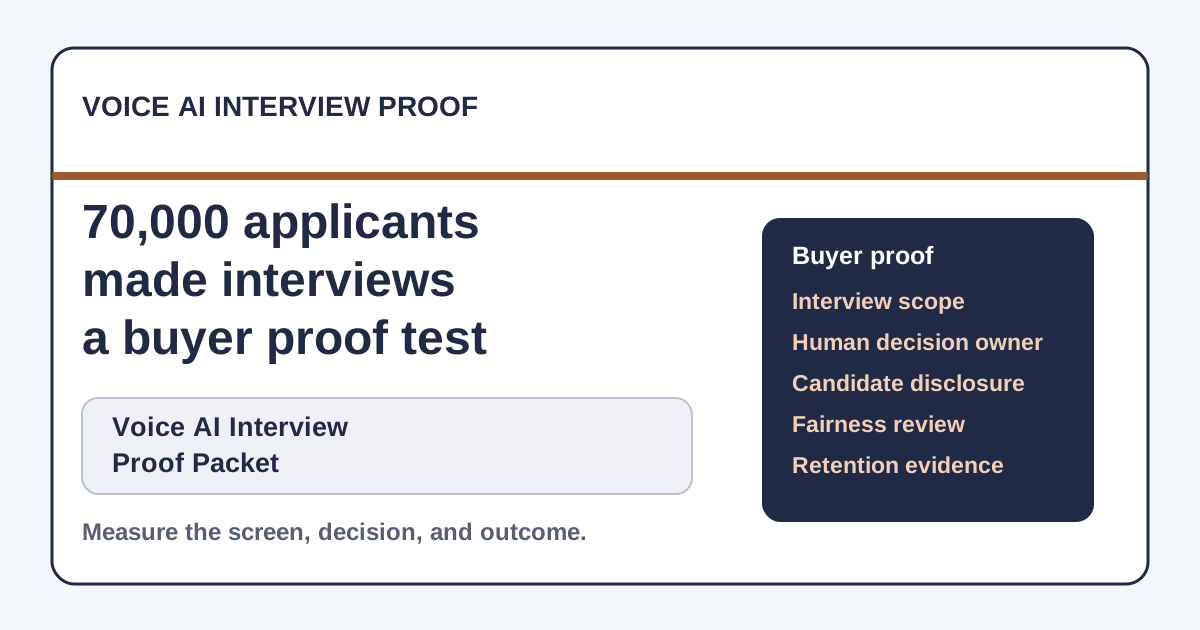
Voice AI Interview Proof Packet
A voice-agent buyer checklist for validating automated hiring interviews across interview scope, human decision authority, candidate disclosure, structured evidence, fairness review, opt-out, outcome tracking, and adverse-action auditability.
| Proof item | Why it matters | Buyer ask |
|---|---|---|
| Interview scope | A voice AI interview can collect structured information, but it may not be appropriate for every role, region, accommodation, language, or candidate population. | Define eligible roles, screening questions, excluded decisions, language support, accommodation handling, and human-only fallback paths. |
| Human hiring authority | The field experiment kept human recruiters responsible for final hiring decisions, which is a different risk profile from autonomous rejection. | Require a decision-owner record, recruiter review checklist, no-auto-reject rule, escalation triggers, and evidence that humans can override the agent. |
| Candidate disclosure | Applicants need to know when an interview is conducted by AI and what data is recorded or assessed. | Review disclosure wording, consent capture, recording notice, transcript use, data retention, and alternate interview options. |
| Structured evidence | The reported advantage depends on more consistent collection of hiring-relevant information, not simply a natural-sounding voice. | Ask for question maps, scoring rubrics, transcript samples, missing-information checks, recruiter review notes, and job-related validation. |
| Fairness and accessibility review | Voice interviews can interact with accent, speech differences, disability accommodations, device quality, language fluency, and candidate anxiety. | Require adverse-impact review, accommodation workflow, appeal process, ASR error sampling, language coverage, and protected-class monitoring. |
| Outcome and audit trail | Offers alone do not prove safe deployment. Starts, retention, productivity, candidate complaints, recruiter overrides, and adverse decisions must be tracked. | Track offers, starts, retention, productivity, opt-outs, complaints, overrides, rejected-candidate samples, and adverse-action evidence. |
What buyers should do next
- Separate voice AI information collection from final hiring decisions in the workflow design.
- Write candidate-facing disclosure and opt-out language before the first production interview.
- Map every interview question to role requirements, scoring rubrics, and recruiter review evidence.
- Test ASR, turn-taking, language coverage, accessibility, accommodations, and device quality with realistic applicants.
- Measure offers, starts, retention, productivity, complaints, overrides, and adverse-impact signals together.
- Use the Voice Agent Index readiness checklist and RFP generator to require interview scope, disclosure, fairness, audit, and outcome proof from vendors.
Turn this brief into a vendor packet
Make the vendor prove the workflow before the demo gets polished.
Use the RFP generator and call-test script to turn this news framework into concrete evidence requests, acceptance tests, and escalation rules for your own voice AI rollout.
Buyer FAQs
What did the 70,000-applicant study test?
The arXiv paper says job applicants were randomly assigned to human recruiters or AI voice agents for interviews, while human recruiters still evaluated the interviews and made the hiring decisions.
What outcomes did the paper report?
The paper reports that AI-interviewed applicants were 12% more likely to receive job offers, with higher job starts and worker retention and no decline in productivity among hired workers.
What proof should buyers ask for first?
Ask for interview scope, candidate disclosure, human decision authority, structured evidence, fairness and accessibility review, opt-out workflow, outcome tracking, and adverse-action audit trails.
Sources
- arXiv: July 30, 2026 posting of Voice AI in Firms: A Natural Field Experiment on Automated Job Interviews, including the 70,000-applicant experiment and headline findings.
- Brian Jabarian: Author project page summarizing the field experiment, applicant count, 12% more offers, higher retention, and no productivity decline.
- Chicago Booth: University of Chicago Booth applied AI coverage of AI interviews, job offers, starts, and retention outcomes.
- SSRN: Research paper landing page for the automated job-interview field experiment.