
Direct answer: A July 17, 2026 arXiv paper on professional voice actors found that fixed-threshold voice-clone attribution can hit a geometry-limited reliability floor. The study evaluated 1,168 Japanese voice actors, 56,568 segments, and about 63 hours of audio, and reported both false attribution risk for non-enrolled speakers and missed clones of enrolled targets. Voice-agent buyers should not use clone-attribution scores as automatic enforcement. Require domain-matched encoders, anti-spoofing gates, per-speaker calibration, abstain thresholds, human review, and documented appeal or recovery paths.
What happened
- The arXiv paper was published on July 17, 2026 and focused on voice-clone attribution among professional Japanese voice actors.
- The study evaluated 1,168 actors, 56,568 audio segments, and about 63 hours of speech.
- The authors warned that fixed-threshold attribution can falsely accuse an enrolled speaker when non-enrolled cloned voices crowd the embedding space.
- The paper also reported missed clones of enrolled targets at the same threshold, showing that higher certainty on one error type can worsen another.
- The authors argued for stronger reliability controls, including anti-spoofing, domain-matched encoders, per-speaker calibration, abstention, and human review.
Why this is trending
- Voice cloning has moved from novelty to procurement risk for call centers, financial services, healthcare, media, customer support, and voice-agent identity workflows.
- Attribution is harder than generic clone detection because the question is not only whether audio is synthetic. It is whether a specific person should be linked to that audio.
- A false accusation or a missed clone can both become operational failures if the buyer uses a detection score as an automatic block, account action, compliance decision, or public claim.
The Voice Agent Index take
A voice-agent buyer should treat attribution as decision support, not final enforcement. The buyer needs a Voice Clone Attribution Reliability Packet: representative dataset tests, anti-spoofing gate results, false-positive and false-negative rates by speaker class, per-speaker thresholds, abstain rules, human review workflow, audit logs, and recovery path for disputed decisions.
Voice Clone Attribution Reliability Packet
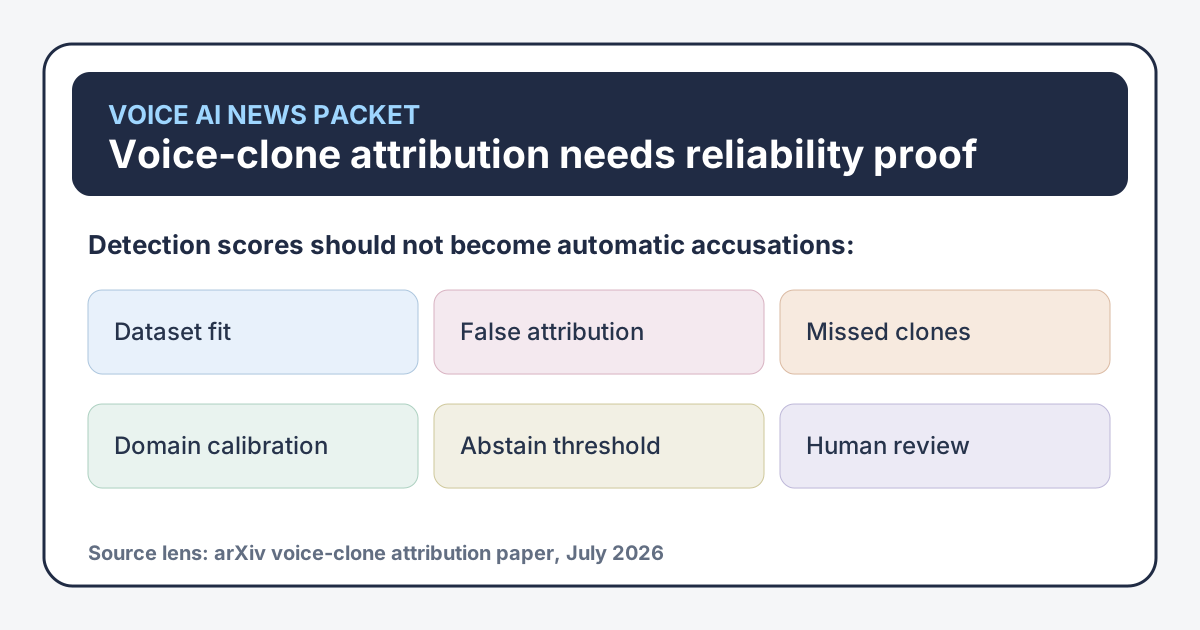
A buyer checklist for validating voice-clone detection across dataset fit, false attribution, missed clones, domain-matched encoders, anti-spoofing gates, per-speaker calibration, abstain rules, and human review.
| Proof item | Why it matters | Buyer ask |
|---|---|---|
| Dataset fit | A model tested on generic speech may behave differently when voices are professional, similar, accented, compressed, noisy, multilingual, or cloned with a different synthesis tool. | Require evaluation on the buyer's speaker types, channels, audio quality, languages, call lengths, and known spoofing examples before production use. |
| False attribution | A clone or non-enrolled speaker can be incorrectly tied to a real enrolled person when the embedding space is crowded. | Ask for false-attribution rates, high-risk speaker clusters, threshold rationale, and examples where the system must abstain instead of naming a person. |
| Missed clones | Tight thresholds can reduce false accusations but also miss cloned voices from enrolled targets. | Require missed-clone rates by speaker, channel, duration, clone method, language, and risk tier. |
| Domain calibration | Professional voice actors, public figures, contact-center agents, and internal executives can have different similarity patterns from generic benchmark speakers. | Use domain-matched encoders, per-speaker calibration, and periodic retesting when speaker pools or synthesis tools change. |
| Abstain rule | Some cases should not produce a named attribution because the evidence is too close, too noisy, too short, or outside the model's tested domain. | Document abstain thresholds, manual review queues, evidence retention, and language for inconclusive decisions. |
| Human enforcement review | Attribution errors can trigger account locks, fraud investigations, public claims, labor disputes, or legal escalation. | Require human review, audit logs, appeal paths, customer notification rules, and a policy that detection scores are not standalone enforcement. |
What buyers should do next
- Inventory every workflow where a voice-agent or fraud system names, blocks, flags, or escalates a speaker based on audio similarity.
- Separate clone detection from speaker attribution and document which decisions require which evidence.
- Test the system on representative buyer-domain audio, including short calls, compressed audio, accents, noisy speech, and known synthetic examples.
- Set abstain rules for close matches, short samples, low-quality audio, non-enrolled voices, and high-impact decisions.
- Use the voice AI readiness tools and comparisons to evaluate vendors on proof, not demo confidence.
Turn this brief into a vendor packet
Make the vendor prove the workflow before the demo gets polished.
Use the RFP generator and call-test script to turn this news framework into concrete evidence requests, acceptance tests, and escalation rules for your own voice AI rollout.
Buyer FAQs
What did the new voice-clone attribution paper find?
The July 17, 2026 arXiv paper warned that fixed-threshold voice-clone attribution can face a reliability floor, including false attribution of non-enrolled voices and missed clones of enrolled targets.
Can buyers use attribution scores for automatic enforcement?
They should not use attribution scores alone. High-impact actions need domain testing, anti-spoofing gates, calibration, abstention, human review, and recovery paths.
What is the first procurement question to ask?
Ask whether the vendor has tested false attribution and missed-clone rates on audio that matches your speakers, channels, language, call length, and risk tier.
Sources
- arXiv: July 17, 2026 paper on a geometry-limited identification floor in professional voice-actor clone attribution, including dataset size, false attribution, missed clones, and reliability limits.
- FTC Voice Cloning Challenge: FTC context on voice cloning risks to families, businesses, creators, and deception controls.
- FCC AI-generated voices ruling: Regulatory context for AI-generated voices in robocalls under the TCPA.