

Direct answer: Fortune's Bloomberg report said Point72, Millennium, Citadel, and Two Sigma were among major investment firms targeted in an August 2026 cyberattack wave featuring voice phishing. The Financial Times independently reported audio phishing against Point72, Citadel, and Millennium, including helpdesk impersonation aimed at authenticator credentials. Buyers should treat the story as a voice verification gate: voice, caller ID, urgency, and role claims cannot authorize account access, MFA, payments, or workflow changes without trusted callback and out-of-band proof.
What happened
- Fortune, republishing Bloomberg reporting, said hackers launched a wave of sophisticated attacks on Wall Street firms and that Point72, Millennium, Citadel, and Two Sigma were among targeted hedge funds.
- That reporting said Point72 told investors it had been attacked and initially did not believe client information had been stolen, while Two Sigma said it had no indication of impact to its data or systems.
- The same report described the attack as featuring voice phishing, where criminals use technology to mimic voices in phone calls or messages to trick employees into revealing sensitive information or granting access.
- The Financial Times independently reported audio phishing attempts against Point72, Citadel, and Millennium, including a case where criminals impersonated a firm's help desk to seek authenticator-app credentials.
- TechRadar covered a broader vishing and extortion campaign against hedge funds, private equity firms, law firms, and other targets, with phone impersonation used to steer employees toward credential capture.
- InvestmentNews and Cybernews described the Wall Street targeting as AI vishing or AI voice cloning, which reinforces the verification risk while still requiring careful confirmation for individual incidents.
Why this is trending
- The story involved high-profile investment firms that already spend heavily on security, making voice-based social engineering harder for buyers to dismiss as a small-business problem.
- It appeared across financial, business, and security outlets within the same week, with both attempted-breach reporting and broader campaign context.
- The attack path targeted helpdesk and authenticator workflows, the same human-verification layer many companies rely on when digital controls are under pressure.
- Voice AI, caller-ID spoofing, recorded audio, deepfake clips, and live social engineering all push buyers toward the same rule: voice is not authentication.
- Voice-agent buyers are beginning to automate inbound support, identity checks, appointment changes, billing questions, and access workflows, so verification boundaries matter before launch.
The Voice Agent Index take
A voice-agent buyer should not approve any phone workflow where a convincing voice can move money, unlock an account, reset MFA, change payroll, alter customer records, disclose data, or approve a vendor request. The buyer needs a Voice Verification Proof Packet showing how callers are identified, when trusted callback is mandatory, which actions are blocked over voice, how suspected mimicry is escalated, and what evidence closes the incident.
Voice Verification Proof Packet
A voice-agent buyer checklist for validating caller identity, trusted callback paths, transaction limits, voice-AI mimicry risk, fraud escalation, and evidence closeout after vishing attempts.
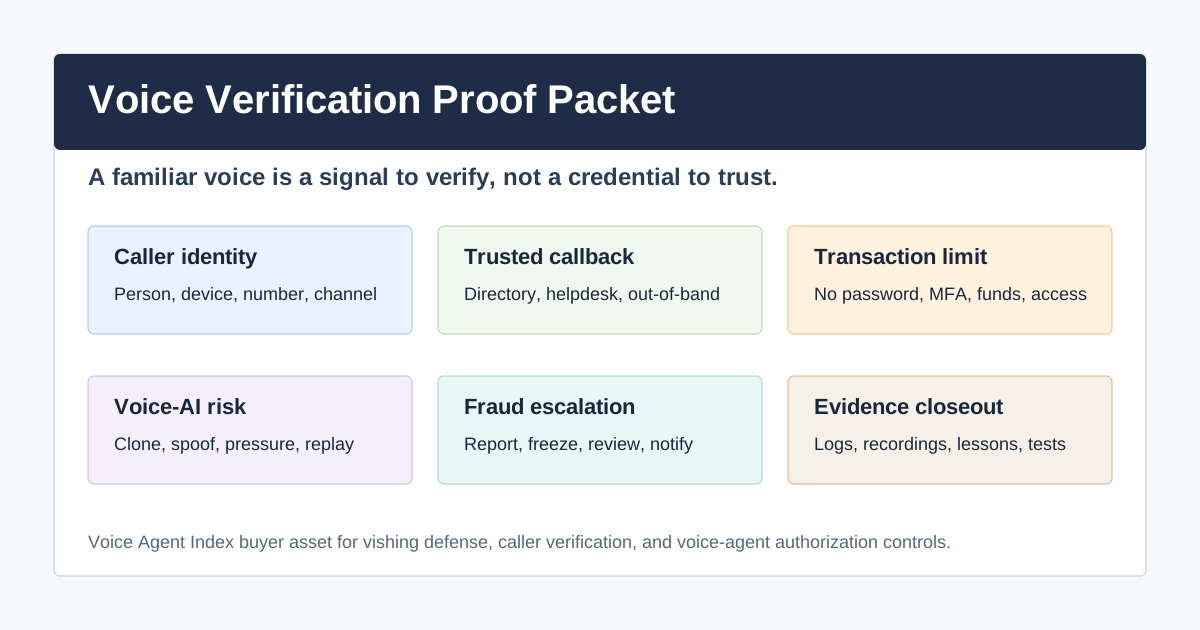
| Proof item | Why it matters | Buyer ask |
|---|---|---|
| Caller identity | A phone number, voice match, job title, urgent tone, or internal reference can all be spoofed or socially engineered. | Require person, role, device, number, channel, directory record, recent account activity, and risk score before sensitive voice workflows proceed. |
| Trusted callback | Helpdesk and finance workflows are vulnerable when the caller controls the phone number, callback path, or meeting link. | Use a known directory number, ticketed callback, manager-confirmed route, or secure app notification before resetting access or approving changes. |
| Transaction limit | Voice should not be enough to grant MFA codes, password resets, fund transfers, payroll edits, app access, refunds, or data exports. | Define no-voice authorization classes, dual approval, cooling-off windows, amount limits, and blocked actions for every phone workflow. |
| Voice-AI risk | A synthetic or manipulated voice can sound familiar while carrying false instructions, urgent pressure, or replayed context. | Test cloned-voice, replay, caller-ID spoofing, urgent executive, fake helpdesk, noisy-call, and transcript-injection scenarios before launch. |
| Fraud escalation | Frontline agents need a fast path when a caller sounds suspicious but has enough context to seem legitimate. | Create report, freeze, supervisor, security, legal, customer-notice, and law-enforcement decision paths with owners and timestamps. |
| Evidence closeout | After a vishing attempt, buyers need to know which calls, prompts, transcripts, accounts, tokens, and actions were affected. | Capture call recording policy, transcript, caller metadata, agent decision log, access changes, remediation steps, retest, and final signoff. |
What buyers should do next
- List every phone workflow that can reset access, approve MFA, change account details, move money, alter payroll, disclose data, or trigger a customer-impacting action.
- Mark which workflows require trusted callback, secure app confirmation, manager approval, dual control, or a no-voice rule.
- Update helpdesk and support scripts so agents never accept caller ID, familiar voice, urgency, or internal jargon as standalone proof.
- Run vishing tests with spoofed numbers, voice mimicry, replayed audio, fake helpdesk requests, executive pressure, noisy calls, and partial insider context.
- Capture evidence for every suspicious call: metadata, transcript, recording policy, claimed identity, requested action, verification path, and escalation outcome.
- Use the Voice Agent Index RFP generator and call-test script to require verification, escalation, and transaction-limit proof from every voice AI vendor.
Turn this brief into a vendor packet
Make the vendor prove the workflow before the demo gets polished.
Use the RFP generator and call-test script to turn this news framework into concrete evidence requests, acceptance tests, and escalation rules for your own voice AI rollout.
Buyer FAQs
What happened in the Wall Street vishing reports?
Current business and financial reporting said major investment firms including Point72, Millennium, Citadel, and Two Sigma were targeted by voice or audio phishing attempts, including helpdesk impersonation aimed at credentials or access.
Was every incident confirmed as AI voice cloning?
No. Some outlets described AI-powered or voice-cloning tactics, while other reporting used broader audio phishing and technology-to-mimic-voices language. The buyer lesson remains that voice cannot be treated as authentication.
What proof should buyers ask for first?
Ask for a Voice Verification Proof Packet covering caller identity, trusted callback, transaction limits, voice-AI risk tests, fraud escalation, and evidence closeout.
Sources
- Fortune / Bloomberg: August 6, 2026 Bloomberg report republished by Fortune on hedge funds targeted by a cyberattack wave featuring voice phishing and technology used to mimic voices.
- Financial Times: August 2026 independent reporting on audio phishing attempts against major hedge funds and helpdesk impersonation aimed at authenticator credentials.
- TechRadar: August 2026 security coverage of a broader vishing and extortion campaign against hedge funds, private equity, law firms, and related targets.
- InvestmentNews: August 5, 2026 coverage describing the Wall Street targeting as AI vishing and voice cloning.
- Cybernews: August 2026 report summarizing AI-powered voice phishing claims against Citadel, Two Sigma, and Point72.