
Direct answer: The Guardian's July 2026 coverage of AI-generated political campaign content shows why synthetic-media disclosure is becoming a public-trust issue, not only a campaign-law issue. For voice agent buyers, the operational response is clear: every production AI phone workflow should prove when it identifies itself as AI, how consent and recording are handled, what call purpose is logged, when humans take over, and who can shut the agent down.
What happened
- The Guardian reported on July 9, 2026 that AI is reshaping political campaign ads while raising concerns about misinformation and manipulation.
- The article described candidates and campaign actors using AI-generated content, with disclosure rules varying across states and legal challenges shaping enforcement.
- NCSL's June 2026 elections-and-campaigns summary says generative AI can create realistic images, videos, and voices and that state policymakers have responded with deepfake and disclosure rules.
- The FCC's 2024 declaratory ruling says TCPA restrictions on artificial or prerecorded voices apply to AI technologies used to generate unwanted and unlawful robocalls.
- The voice-agent lesson is that disclosure cannot be a marketing tagline. It needs to be a testable production control.
Why this is trending
- AI political content is a high-visibility trust test because synthetic media can influence people at scale and because disclosure rules are uneven.
- Voice is more intimate than a banner or text ad. A caller may make decisions in real time before reading a policy page or checking a transcript.
- Businesses are deploying AI receptionists, outbound reminders, appointment agents, debt-collection helpers, healthcare intake bots, and sales callers while public sensitivity to synthetic voices increases.
The Voice Agent Index take
A voice agent buyer should not approve production calls only because the agent sounds natural. The buyer needs a voice disclosure proof packet: exact AI identity wording, timing, consent and recording logic, jurisdiction routing, caller opt-out, human handoff, blocked claims, call-purpose logs, transcript retention, review samples, and emergency shutdown ownership.
Voice Disclosure Proof Packet
A buyer checklist for proving AI voice identity disclosure, consent and recording logic, synthetic-content marking, call-purpose logs, human escalation, blocked actions, and kill-switch readiness.
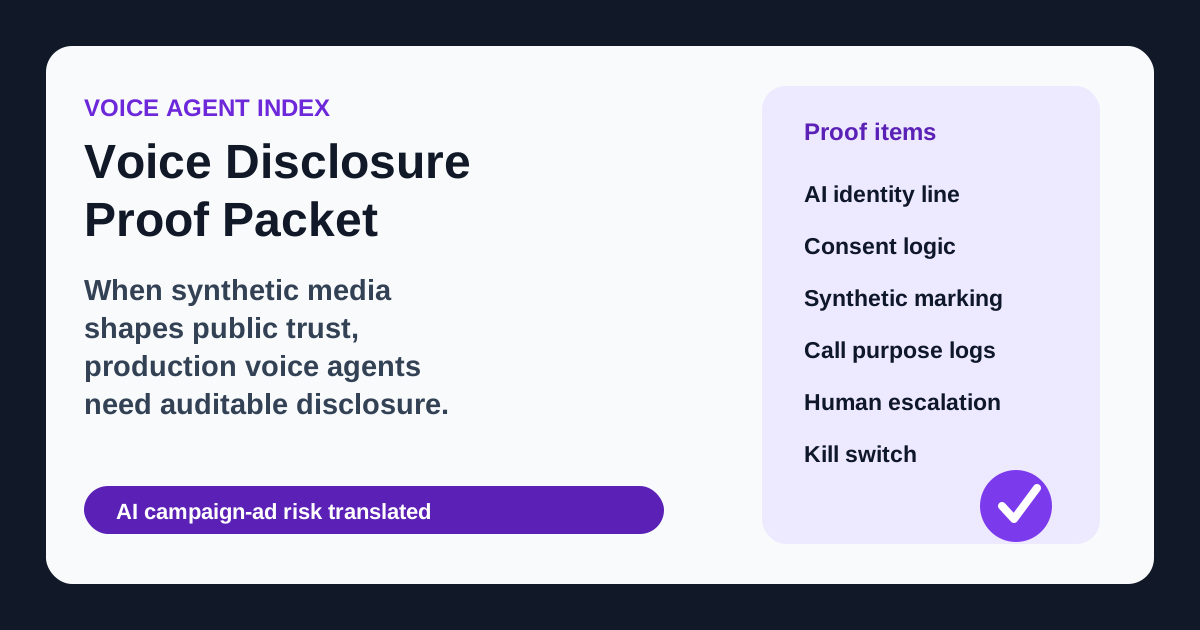
| Proof item | Why it matters | Buyer ask |
|---|---|---|
| AI identity disclosure | Callers need to know when they are interacting with automation before they share sensitive information or rely on a statement. | Provide disclosure wording, placement, language variants, test-call recordings, and evidence that the disclosure fires in inbound and outbound flows. |
| Consent and recording logic | Voice workflows can cross consent, recording, telemarketing, and sector-specific rules depending on jurisdiction and call purpose. | Show consent capture, recording opt-out, suppression handling, do-not-call behavior, jurisdiction rules, and audit logs for every call type. |
| Synthetic-content marking | A voice agent may generate speech, summaries, follow-up messages, or ads that need different labels and retention evidence. | Document which synthetic outputs are marked, logged, retained, excluded from public use, or routed for human review. |
| Call-purpose logs | The same platform may handle appointment reminders, sales outreach, collections, support, surveys, or political-style persuasion risks. | Log call purpose, campaign, script version, caller list source, consent basis, prompt version, and tool actions for every production workflow. |
| Human escalation | Disclosure is incomplete if the caller cannot reach a person when confused, vulnerable, angry, or outside the approved script. | Require handoff triggers, supervisor routing, callback recovery, live transfer evidence, and QA samples for failed or sensitive calls. |
| Shutdown and incident response | Synthetic voice failures can scale quickly if a bad script, wrong list, cloned voice, or misleading disclosure keeps running. | Show kill switch, incident owner, stop-list upload, rollback process, provider contact, audit export, and post-incident review. |
What buyers should do next
- Write the exact AI identity disclosure line for each voice workflow and record test calls proving it plays at the right moment.
- Separate informational, transactional, sales, collections, healthcare, political-style, and regulated workflows before approving outbound calls.
- Map consent, recording, do-not-call, suppression, jurisdiction, and transcript-retention rules by call type.
- Log call purpose, script version, prompt version, voice version, tool actions, caller list source, and human handoff outcomes.
- Run a shutdown drill before launch so operators can stop a campaign, block a caller segment, or force human review without waiting for engineering.
Turn this brief into a vendor packet
Make the vendor prove the workflow before the demo gets polished.
Use the RFP generator and call-test script to turn this news framework into concrete evidence requests, acceptance tests, and escalation rules for your own voice AI rollout.
Buyer FAQs
Is the Guardian story about business voice agents?
No. The current story is about AI-generated political campaign content and disclosure concerns. It matters to voice-agent buyers because the same public-trust problem appears whenever a synthetic or AI-generated voice speaks to people at scale.
Do AI voice agents always need disclosure?
Buyers should assume disclosure is a production requirement unless counsel and jurisdiction-specific policy say otherwise. Even when a rule does not explicitly require it, disclosure reduces trust, consent, and complaint risk.
What proof should a voice-agent vendor provide before outbound calls?
Ask for AI identity wording, consent and recording logic, DNC and suppression handling, jurisdiction routing, call-purpose logs, prompt and voice versioning, human escalation, QA recordings, and kill-switch evidence.
Sources
- The Guardian: July 2026 coverage of AI-generated political campaign content, misinformation concerns, and uneven disclosure rules.
- NCSL: Updated June 23, 2026 summary explaining that generative AI can create realistic images, videos, and voices and tracking state responses to deepfakes in elections and campaigns.
- FCC declaratory ruling: FCC ruling making clear that TCPA restrictions on artificial or prerecorded voices apply to AI technologies used to generate unwanted and unlawful robocalls.
- FCC AI political ad disclosure proposal: FCC proposal requiring on-air and written disclosure of AI-generated content in radio and television political advertisements.