

Direct answer: TechCrunch reported on July 10, 2026 that Apple sued OpenAI and former Apple employees over alleged trade-secret theft tied to AI hardware development, and AP independently reported the lawsuit while noting OpenAI's denial. Voice-agent buyers should not treat the case as proof of wrongdoing. They should treat it as a roadmap-risk signal: if a vendor's future voice device, smart speaker, ambient assistant, or dedicated AI endpoint is central to the buying plan, require written proof for availability, controls, fallback channels, support, and what happens if litigation or product delays change the roadmap.
What happened
- TechCrunch reported that Apple's lawsuit accuses former Apple employees and OpenAI of misusing confidential information connected to AI hardware development.
- The report said Apple asked the court to bar use or disclosure of the alleged materials, require return of information, and preserve evidence.
- AP independently covered the lawsuit, naming OpenAI, io Products, and former Apple employees, and reported OpenAI's denial.
- The Verge reported separately on OpenAI's reported ChatGPT smart-speaker ambitions, including a device roadmap beyond software-only voice experiences.
- Axios framed the litigation as a potential complication for OpenAI's post-io hardware plans after the company's acquisition of Jony Ive's AI hardware startup.
Why this is trending
- Voice AI is moving from browser demos and phone APIs toward dedicated devices, ambient assistants, reception endpoints, and smart-speaker style experiences.
- Hardware roadmaps are harder for buyers to unwind than software pilots because they affect procurement, support, privacy notices, room placement, recording policy, and fallback operations.
- A lawsuit involving a major platform and a high-profile AI hardware effort makes roadmap proof more important than launch rumors or polished concept videos.
The Voice Agent Index take
A voice-agent buyer should not approve a production plan because a future AI device sounds strategically exciting. The buyer needs a Voice Hardware Roadmap Risk Packet: litigation/IP disclosure, model and API availability, device-management controls, recording and data policy, fallback phone/web path, procurement timeline, warranty/support terms, and exit plan if the device slips or changes.
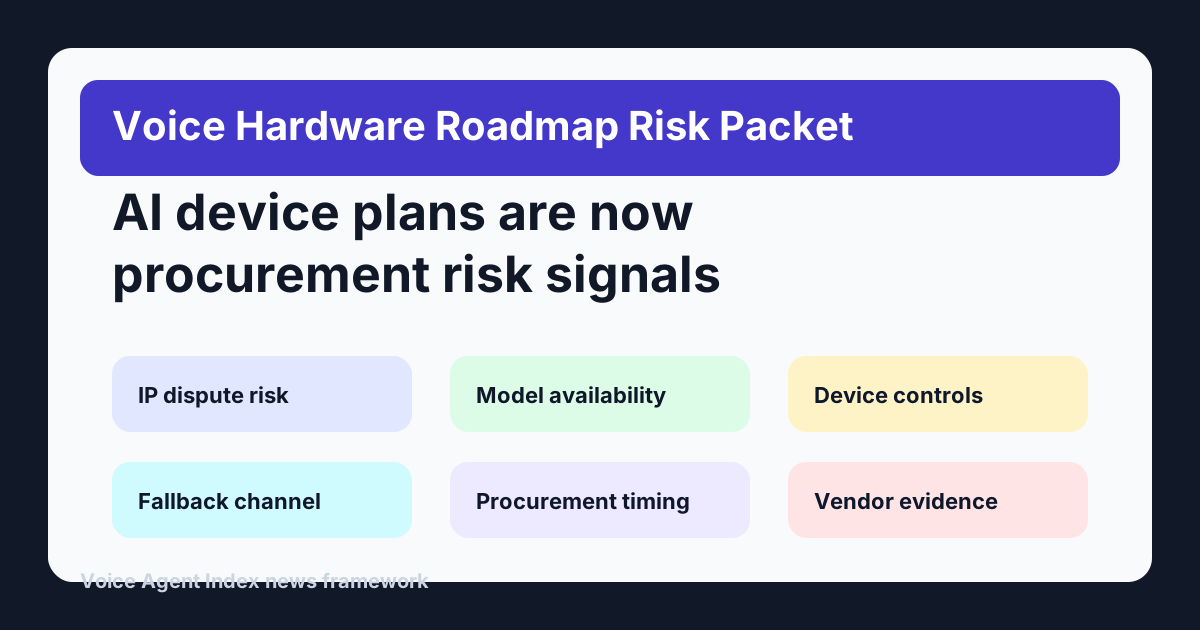
Voice Hardware Roadmap Risk Packet
A buyer checklist for validating voice AI hardware roadmaps across IP dispute risk, model availability, device controls, fallback channels, procurement timing, and vendor evidence.
| Proof item | Why it matters | Buyer ask |
|---|---|---|
| IP dispute risk | Litigation can delay launches, change features, restrict distribution, or force roadmap revisions even before any court decides the merits. | Ask vendors to disclose material IP disputes, roadmap dependencies, indemnity terms, support commitments, and what happens to your deployment if a device is paused. |
| Model availability | A voice behavior shown in a consumer device concept may not be available in the API, region, telephony path, or enterprise plan a buyer can actually use. | Confirm model version, API access, region, latency, pricing, retention settings, update cadence, and fallback model behavior in writing. |
| Device controls | A dedicated voice endpoint needs fleet management, authentication, mute behavior, update control, logs, physical placement rules, and tamper handling. | Request admin-console screenshots, policy controls, device inventory exports, update settings, access logs, and deprovisioning evidence. |
| Recording and data policy | Always-available voice hardware can create privacy, consent, retention, and customer-notice issues that a standard phone bot may not trigger. | Document wake behavior, recording triggers, consent language, transcript storage, retention, deletion, training use, and data-processing terms. |
| Fallback channel | A hardware roadmap should not be the only route for reception, intake, support, or urgent escalation. | Show phone, web, SMS, live-agent, and manual fallback paths with transfer tests and customer context preserved. |
| Procurement evidence | Buyers need real dates, support terms, warranty coverage, security documentation, and exit rights before allocating budget to dedicated devices. | Require release status, pilot limits, hardware terms, warranty, SLA, security review, support path, data export, and cancellation or replacement terms. |
What buyers should do next
- Separate voice-agent requirements that can run through today's phone or API stack from requirements that depend on unreleased hardware.
- Ask every hardware-roadmap vendor for written model availability, region, latency, support, privacy, and device-management evidence.
- Add IP-dispute, product-delay, and roadmap-change questions to the vendor risk review before buying dedicated endpoints.
- Keep a phone, web, SMS, or live-agent fallback path for every customer workflow planned for a dedicated voice device.
- Do not commit procurement volume until the vendor can provide pilot terms, warranty, support path, security review, and data-export commitments.
Turn this brief into a vendor packet
Make the vendor prove the workflow before the demo gets polished.
Use the RFP generator and call-test script to turn this news framework into concrete evidence requests, acceptance tests, and escalation rules for your own voice AI rollout.
Buyer FAQs
What is Apple's lawsuit against OpenAI about?
Apple alleges that OpenAI and former Apple employees misappropriated trade secrets connected to AI hardware development. OpenAI denies wanting or using other companies' trade secrets. The lawsuit has not established wrongdoing.
Why does this matter for voice-agent buyers?
Voice AI buyers are increasingly evaluating dedicated devices, smart speakers, ambient assistants, and hardware endpoints. Litigation or roadmap uncertainty can affect availability, controls, support, procurement timing, and fallback planning.
What should buyers ask before relying on AI voice hardware?
Ask for IP-risk disclosure, model availability, API parity, device controls, recording policy, data retention, fallback channels, support terms, warranty, security review, pilot limits, and exit rights if the roadmap changes.
Sources
- TechCrunch: July 10, 2026 coverage of Apple's lawsuit alleging trade-secret theft tied to AI hardware development and OpenAI's denial.
- Associated Press: Independent coverage of the California federal lawsuit naming OpenAI, io Products, and former Apple employees.
- The Verge: Independent coverage of OpenAI's reported ChatGPT smart-speaker roadmap and voice-hardware direction.
- Axios: Independent business coverage of how the litigation could complicate OpenAI's AI-device plans after the io acquisition.