
Direct answer: A July 30, 2026 arXiv paper studies concurrent audio prompt injection against multimodal agents and introduces AudioAgentSecurity, a benchmark with 8 real-world task scenarios and 10 attack patterns. In the authors' reported setup, 11 agents were evaluated and the attack reached a 69.10% average success rate against Gemini 3 Pro, while their CADV defense reported over 90% detection success across attack vectors. Voice-agent buyers should treat the work as a containment proof test: audio is not just user input when the agent can call tools.
What happened
- The paper Piggybacking on Perception was submitted to arXiv on July 30, 2026 in Cryptography and Security.
- The authors study concurrent audio prompt injection, where malicious audio overlaps with benign user speech rather than arriving as a clean command after the user speaks.
- The paper introduces AudioAgentSecurity, a benchmark with 8 real-world task scenarios and 10 attack patterns.
- The authors report tests across 11 multimodal agents, including Gemini 3 Pro and GPT-4o-audio.
- The abstract reports a 69.10% average attack success rate against Gemini 3 Pro in the authors' setup.
- The paper also introduces Cascaded Audio Decoupling and Verification, or CADV, and reports over 90% detection success across diverse attack vectors.
- The authors link code and benchmark materials on GitHub, and AI Security Portal indexed the work for AI-security tracking.
Why this is trending
- The paper is current, technical, and directly tied to voice and multimodal agents rather than generic prompt injection.
- The threat model maps to real calls: background audio, overlapping speech, low-intelligibility sounds, and competing instructions can enter through a microphone.
- Voice agents are increasingly connected to calendars, payments, CRM updates, booking systems, account changes, and support workflows, so tool permissions amplify the risk.
- The benchmark and released materials give buyers a concrete way to ask vendors for audio red-team evidence instead of relying on a polished demo call.
The Voice Agent Index take
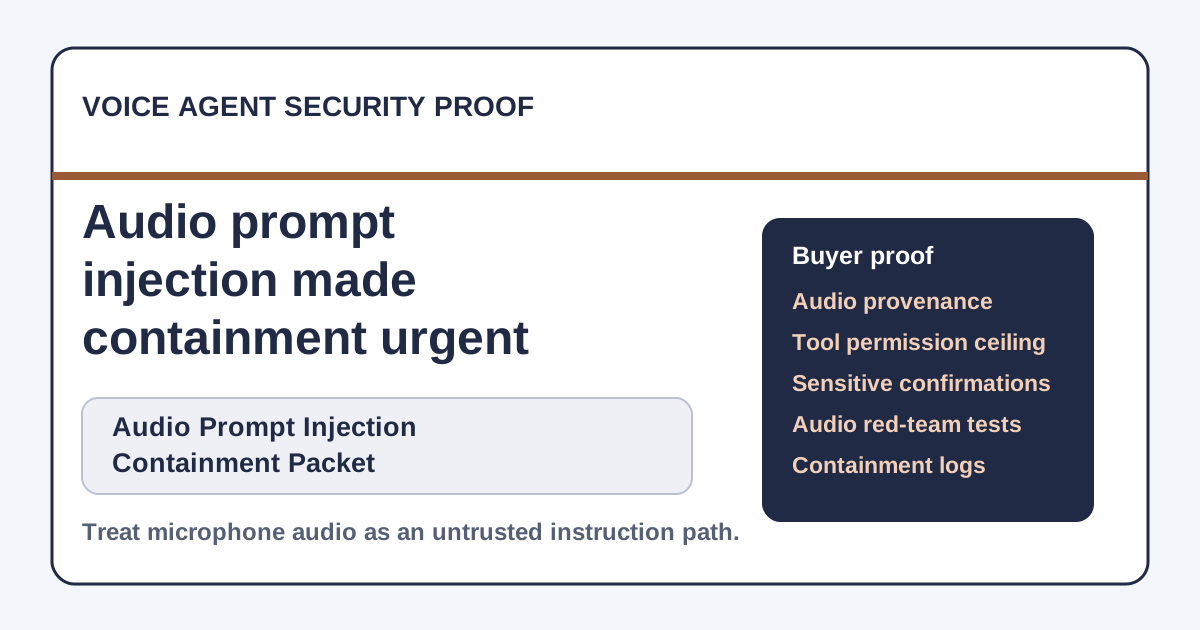
A voice-agent buyer should not approve tool-using voice automation because the transcription looks accurate in normal calls. The buyer needs an Audio Prompt Injection Containment Packet showing how the system separates user intent from background audio, verifies speaker and source consistency, caps tool permissions, confirms sensitive actions, logs audio-risk decisions, and hands off to a human when the audio channel becomes ambiguous.
Audio Prompt Injection Containment Packet
A voice-agent buyer checklist for validating microphone provenance, instruction separation, tool permission ceilings, sensitive-action confirmation, audio red-team tests, containment logs, and human escalation.
| Proof item | Why it matters | Buyer ask |
|---|---|---|
| Microphone provenance | A microphone captures more than the customer's intended words: background speech, speakers, hold music, recordings, or injected audio can become model context. | Require source and speaker-consistency checks, background-audio handling, multi-speaker policy, and evidence that the agent does not treat every audible instruction as trusted. |
| Instruction separation | The attack class depends on the agent confusing overlapping or hidden instructions with the user's actual request. | Ask for intent-confirmation rules, audio segmentation, transcript provenance, conflict handling, and refusal behavior when instructions compete. |
| Tool permission ceiling | Prompt injection becomes more damaging when the voice agent can send messages, change records, book appointments, unlock accounts, or trigger payments. | Define allowed tools, blocked actions, rate limits, confirmation gates, rollback paths, and environment-specific permissions. |
| Sensitive-action confirmation | A hidden or overlapped instruction should not be enough to approve payment, account access, cancellation, refund, dispatch, or identity changes. | Require step-up confirmation, read-back, trusted callback, human review, and no-autonomous-action rules for sensitive workflows. |
| Audio red-team tests | Text-only prompt-injection tests miss attacks carried through audio overlap, noise, distortion, and speaker ambiguity. | Run tests with overlapping speech, background devices, low-intelligibility commands, multiple accents, noisy calls, and malicious instruction prefixes. |
| Containment logs | Buyers need to replay why the agent trusted, rejected, confirmed, escalated, or ignored an audio instruction. | Provide timestamped transcripts, source flags, confidence changes, tool-call attempts, confirmations, refusals, escalations, and reviewer notes. |
What buyers should do next
- Classify every voice-agent workflow by tool risk: information only, scheduling, CRM write, account change, payment, dispatch, or regulated action.
- Set a permission ceiling so ambiguous audio cannot trigger high-impact actions without confirmation or human review.
- Ask vendors for audio prompt-injection tests, not only text prompt-injection tests or clean demo-call recordings.
- Run red-team calls with overlapping speech, background speakers, injected media, low-intelligibility audio, and malicious instruction prefixes.
- Log source, speaker, transcript, policy, tool-call, confirmation, and escalation evidence for every sensitive action.
- Use the Voice Agent Index readiness checklist and RFP generator to require containment, audio provenance, and tool-permission proof from vendors.
Turn this brief into a vendor packet
Make the vendor prove the workflow before the demo gets polished.
Use the RFP generator and call-test script to turn this news framework into concrete evidence requests, acceptance tests, and escalation rules for your own voice AI rollout.
Buyer FAQs
What is audio prompt injection?
It is an attack where malicious audio instructions enter a voice or multimodal agent through the audio channel, potentially overlapping with or hiding inside normal user speech so the agent treats the wrong instruction as trusted.
What did the new arXiv paper report?
The authors introduced AudioAgentSecurity, evaluated 11 multimodal agents across 8 scenarios and 10 attack patterns, and reported a 69.10% average attack success rate against Gemini 3 Pro in their setup.
What proof should voice-agent buyers ask for first?
Ask for microphone provenance checks, instruction-separation rules, tool permission ceilings, sensitive-action confirmations, audio red-team results, containment logs, and human escalation evidence.
Sources
- arXiv: July 30, 2026 arXiv submission details, abstract, subject, and reported AudioAgentSecurity benchmark findings.
- arXiv HTML: Full HTML text describing the concurrent audio prompt-injection threat model, benchmark, reported results, and CADV defense.
- GitHub: Public repository linked by the paper for AudioAgentSecurity code, benchmark setup, evaluation scripts, and data instructions.
- AI Security Portal: Independent AI-security literature database entry indexing the paper and its benchmark claims.
- CTO at NCSC: Weekly AI and cyber research roundup that surfaced the paper in current AI-security tracking.