

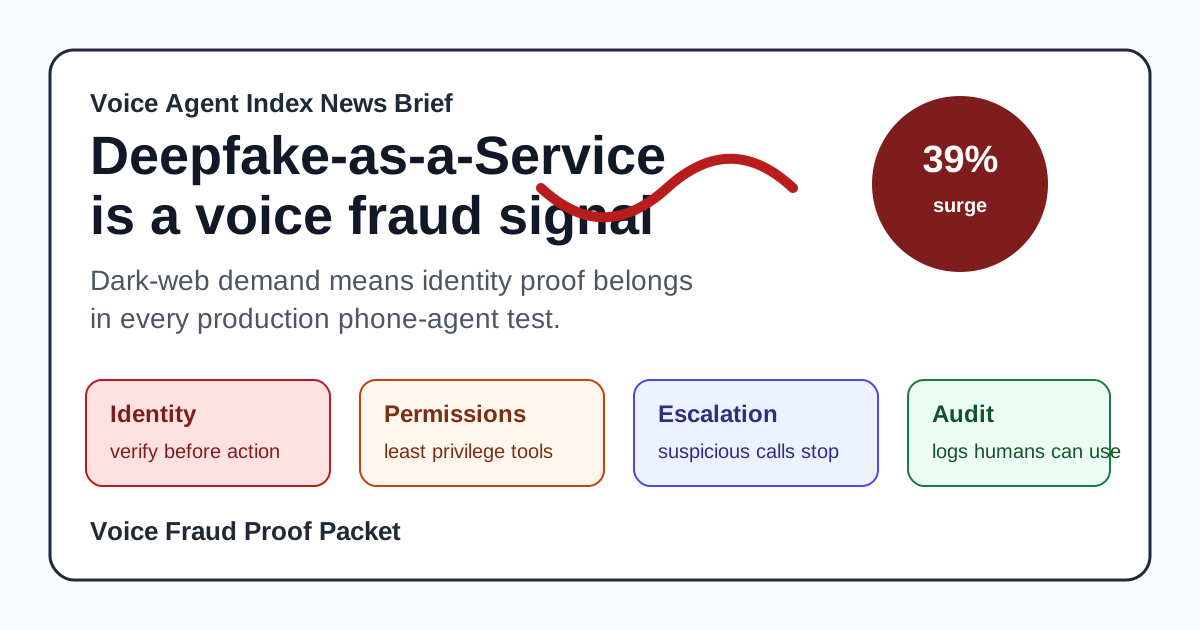
Direct answer: NordStellar reported on June 23, 2026 that dark-web discussions about deepfake-as-a-service exceeded the full-year 2025 total in the first five months of 2026, rising 39%. TechRadar independently covered the finding on June 24 and warned that turnkey voice cloning, face swapping, synthetic video, and fake-document services could fuel more convincing fake-boss scams. Voice-agent buyers should respond by requiring fraud proof, not just natural-sounding demos.
What happened
- NordStellar said deepfake-as-a-service discussions on the dark web surpassed the full 2025 total in just five months of 2026.
- The company reported 924 deepfake-as-a-service posts from January through May 2026, up 39% from the 663 posts recorded for all of 2025.
- NordStellar defines the category to include turnkey voice cloning, face swapping, synthetic videos, virtual cameras, fake documents, and synthetic profiles.
- TechRadar independently covered the report and connected the trend to fake-boss scams and business email compromise risk.
- The FBI's 2025 IC3 report said complaints reporting AI-related information exceeded $893 million in adjusted losses.
Why this is trending
- The story turns voice-clone fraud from a hypothetical risk into a visible cybercrime supply-chain signal.
- It connects directly to business workflows where a caller can pressure an employee, impersonate an executive, or manipulate a phone agent.
- Voice AI buyers are evaluating agents that can hear, speak, summarize, and call tools, which makes caller identity and action limits a production requirement.
The Voice Agent Index take
A voice agent should not be judged only by latency, accent, or conversational quality. Buyers need proof that the system resists impersonation pressure: it should verify identity before account actions, reject urgent money or credential requests, limit tool permissions, escalate suspicious calls, and leave an audit trail humans can inspect.
Voice Fraud Proof Packet
A buyer checklist for testing caller identity, voice-clone risk, urgent-pressure scripts, tool permissions, payment-adjacent workflows, and human override before deploying voice agents.
| Proof item | Why it matters | Buyer ask |
|---|---|---|
| Caller identity rules | Deepfake voice can imitate executives, customers, relatives, or staff who normally receive trust. | Show when the agent verifies identity, what data it uses, and what it refuses to reveal before verification. |
| Urgent-pressure script tests | Fake-boss scams often use urgency, secrecy, authority, and fear to force unsafe actions. | Run calls where a caller demands a refund, credential reset, wire-related action, private data, or emergency exception. |
| Tool permission matrix | A voice agent with broad CRM, calendar, ticket, or payment-adjacent rights can become an automated fraud path. | List every readable field and writable action, then mark which actions are human-only. |
| Voice-clone escalation triggers | The agent needs a way to respond when caller behavior sounds suspicious even if the voice sounds familiar. | Define triggers for unusual requests, high-value changes, repeated failed verification, caller-ID mismatch, and voice-clone suspicion. |
| Transcript and audit evidence | Fraud investigations need a record of what the caller asked, what the agent did, and why it escalated or refused. | Require timestamped transcript, tool-call log, verification result, escalation reason, and retention policy. |
| Human override and kill switch | Fraud patterns change quickly, so production systems need fast containment without waiting for a model update. | Show who can disable actions, force human review, block a caller pattern, and export incident evidence. |
What buyers should do next
- Add voice-clone and fake-boss scenarios to the voice agent acceptance test.
- Restrict account changes, refunds, credential resets, and payment-adjacent actions until identity proof is complete.
- Require logs for caller verification, transcript, tool calls, escalation, refusal, and human takeover.
- Review fraud controls before adding outbound calling, CRM writes, calendar actions, or ticket updates.
Turn this brief into a vendor packet
Make the vendor prove the workflow before the demo gets polished.
Use the RFP generator and call-test script to turn this news framework into concrete evidence requests, acceptance tests, and escalation rules for your own voice AI rollout.
Buyer FAQs
What is deepfake-as-a-service?
Deepfake-as-a-service is a cybercrime market category for turnkey tools or services such as voice cloning, face swapping, synthetic video, fake documents, virtual cameras, and synthetic profiles.
Why does this matter for voice agent buyers?
Voice agents interact with callers and may connect to CRMs, calendars, tickets, and account workflows. Deepfake and impersonation risk raises the proof bar for identity checks, tool limits, and escalation.
Does this mean buyers should avoid voice AI?
No. It means buyers should require fraud-resistance evidence before production: caller verification, least-privilege permissions, suspicious-call escalation, audit logs, and human override.
What should be in a voice fraud proof packet?
It should include identity rules, voice-clone test calls, urgent-pressure scenarios, tool permissions, transcript logs, escalation triggers, incident contacts, and a kill switch.
Sources
- NordStellar deepfake-as-a-service report: Primary source for the June 23, 2026 dark-web analysis, 924 posts, 39% increase, and deepfake-as-a-service category definition.
- TechRadar coverage: Independent coverage connecting the NordStellar finding to fake-boss scams, BEC risk, and business prevention steps.
- FBI 2025 IC3 report: Primary FBI source for AI-related complaint and loss context, including voice-cloning and BEC scam risk.