
Direct answer: Bloomberg-reported coverage says ElevenLabs has held early talks for an employee tender offer that could value the AI voice startup at roughly $22 billion. TNW and other outlets reported that the figure would nearly double ElevenLabs' February 2026 $11 billion valuation. Voice-agent buyers should not treat that market signal as production proof; they should ask vendors for real call evidence across latency, interruptions, tool use, escalation, monitoring, and rollback.
What happened
- TNW reported on July 3, 2026 that ElevenLabs was in early talks with investors about an employee tender offer valuing the company at roughly $22 billion, citing Bloomberg.
- Investing.com/Reuters coverage also carried the Bloomberg-reported $22 billion tender-offer valuation discussion.
- ElevenLabs' February Series D announcement said the company raised $500 million at an $11 billion valuation and was doubling down on ElevenAgents for enterprise voice and conversational AI.
- TechCrunch independently covered the February Series D as a $500 million round at an $11 billion valuation led by Sequoia.
- The production question for buyers is whether any AI voice vendor can prove real-world call handling, not whether investors are valuing voice AI highly.
Why this is trending
- A potential move from an $11 billion February valuation to a reported $22 billion tender discussion keeps voice AI in the center of enterprise AI buying conversations.
- ElevenLabs is associated with realistic voice generation and is expanding into conversational agents for customer experience, sales, marketing, and internal workflows.
- High market momentum can push buyers to approve voice AI pilots faster than their evidence process, especially when demos sound polished.
The Voice Agent Index take
A voice-agent buyer should not approve production calls because a vendor is valuable, well-funded, or impressive in a demo. The buyer needs a voice AI production proof packet: recorded scenario tests, latency and barge-in metrics, tool-permission limits, consent and disclosure logic, human handoff evidence, monitoring dashboards, incident thresholds, rollback owner, and post-call audit exports.
Voice AI Production Proof Packet
A buyer checklist for proving voice AI readiness across scenario coverage, latency, interruptions, tool permissions, human handoff, monitoring, rollback, and audit evidence.
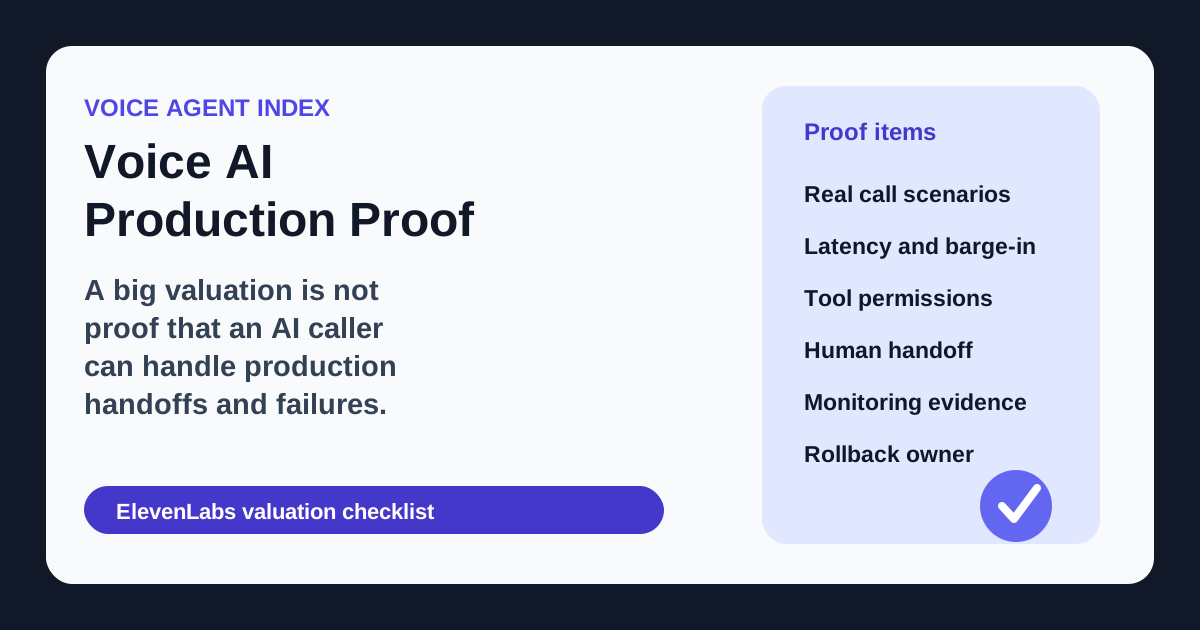
| Proof item | Why it matters | Buyer ask |
|---|---|---|
| Scenario coverage | Voice agents fail in the long tail: accents, noisy callers, interruptions, emotional customers, policy exceptions, and multi-step tasks. | Provide test recordings, transcripts, pass/fail rubrics, and coverage for the top real call reasons before launch. |
| Latency and interruption handling | A realistic voice still fails if it talks over callers, waits too long, misses barge-ins, or loses context after silence. | Show latency metrics, interruption tests, silence handling, retry behavior, and QA samples from noisy and mobile callers. |
| Tool permissions | Production agents may book appointments, update CRM records, send messages, start payments, or expose sensitive information. | Document allowed tools, blocked actions, approval thresholds, data scopes, error handling, and audit logs for every integration. |
| Human handoff | A voice agent is not production-ready if callers get trapped when confused, angry, vulnerable, or outside policy. | Require live-transfer tests, callback recovery, queue ownership, escalation triggers, and evidence that handoffs include useful context. |
| Monitoring and evaluation | Voice AI behavior changes with scripts, prompts, models, integrations, caller lists, and knowledge updates. | Show monitoring dashboards, regression tests, scenario evaluation, bad-call tags, review cadence, and owner signoff. |
| Rollback and shutdown | A bad voice deployment can scale wrong answers, bad disclosures, failed bookings, or compliance issues quickly. | Provide kill-switch procedure, rollback plan, provider contact, incident owner, stop-list handling, and post-incident export. |
What buyers should do next
- List the live call types the voice agent will handle and rank them by revenue, safety, complaint, and regulated-data risk.
- Collect real test recordings for noisy callers, interruptions, silence, accents, emotional callers, and policy exceptions.
- Separate demo evidence from production evidence: latency metrics, handoff success, tool actions, monitoring, and rollback.
- Require consent, recording, AI identity disclosure, transcript retention, and human escalation rules by call type.
- Run a shutdown drill before approving outbound or main-line inbound production traffic.
Turn this brief into a vendor packet
Make the vendor prove the workflow before the demo gets polished.
Use the RFP generator and call-test script to turn this news framework into concrete evidence requests, acceptance tests, and escalation rules for your own voice AI rollout.
Buyer FAQs
Does a reported $22 billion valuation mean ElevenLabs is production-ready for every call center?
No. Valuation is a market signal, not operational proof. Buyers still need scenario tests, latency data, tool-permission controls, human handoff evidence, monitoring, and rollback procedures for their own workflows.
Why does an investment story matter to voice-agent buyers?
Investment momentum can accelerate executive pressure to deploy voice AI. The safe response is to turn the headline into a proof checklist before any AI caller reaches real customers.
What evidence should a voice AI vendor provide before production?
Ask for real call recordings, transcripts, evaluation rubrics, latency and interruption metrics, escalation proof, consent and disclosure logic, tool-action logs, monitoring reports, and rollback ownership.
Sources
- The Next Web: July 3, 2026 coverage of Bloomberg-reported early tender-offer talks that could value ElevenLabs at roughly $22 billion.
- Investing.com / Reuters: Market coverage carrying the Bloomberg-reported $22 billion tender-offer valuation discussion.
- ElevenLabs Series D announcement: Primary February 2026 company announcement of a $500 million Series D at an $11 billion valuation and expansion of ElevenAgents for enterprise voice and conversational AI.
- TechCrunch: Independent February 2026 coverage of the $500 million Series D led by Sequoia at an $11 billion valuation.