

Direct answer: On June 22, 2026, Five Eyes cyber security agencies warned that AI is already accelerating the speed, scale, and sophistication of cyber threats, and that frontier AI models could transform cyber capabilities on a timeline of months, not years. The warning is not a reason to stop evaluating voice agents. It is a reason to require proof: identity controls, least-privilege tool access, transcript retention, fraud detection, incident response, and human override must be verified before an AI phone agent reaches production.
What happened
- The NSA-hosted Five Eyes statement says AI is not a future consideration and that it lowers barriers for malicious actors while increasing attack speed and complexity.
- The statement says cyber risk assumptions can become outdated in months, not years, and frames resilience as a business continuity and market-trust issue.
- The 2026 International AI Safety Report says AI capabilities continue to improve and that AI systems can be used maliciously, can malfunction, and can create systemic risks.
- Senator Maggie Hassan's April 2026 inquiry to voice-cloning companies cited FBI-reported AI-related scam losses of more than $893 million in 2025 and requested stronger scam-prevention details.
Why this is trending
- The warning came from government cyber agencies across the U.S., U.K., Canada, Australia, and New Zealand, which gave it credibility beyond vendor security marketing.
- The phrase 'months, not years' turns AI security from a future policy debate into an immediate procurement gate.
- Voice agents sit directly on risky surfaces: caller identity, phone numbers, recordings, transcripts, CRM records, payment-adjacent requests, and tool calls.
The Voice Agent Index take
The practical takeaway is not that every voice AI product is unsafe. The takeaway is that a buyer should stop accepting generic security pages. Any voice agent with CRM access, scheduling access, ticket access, payment workflows, or outbound calling ability needs a proof packet that shows exactly what the agent can do, what it cannot do, who can override it, and what happens when a caller tries to manipulate it.
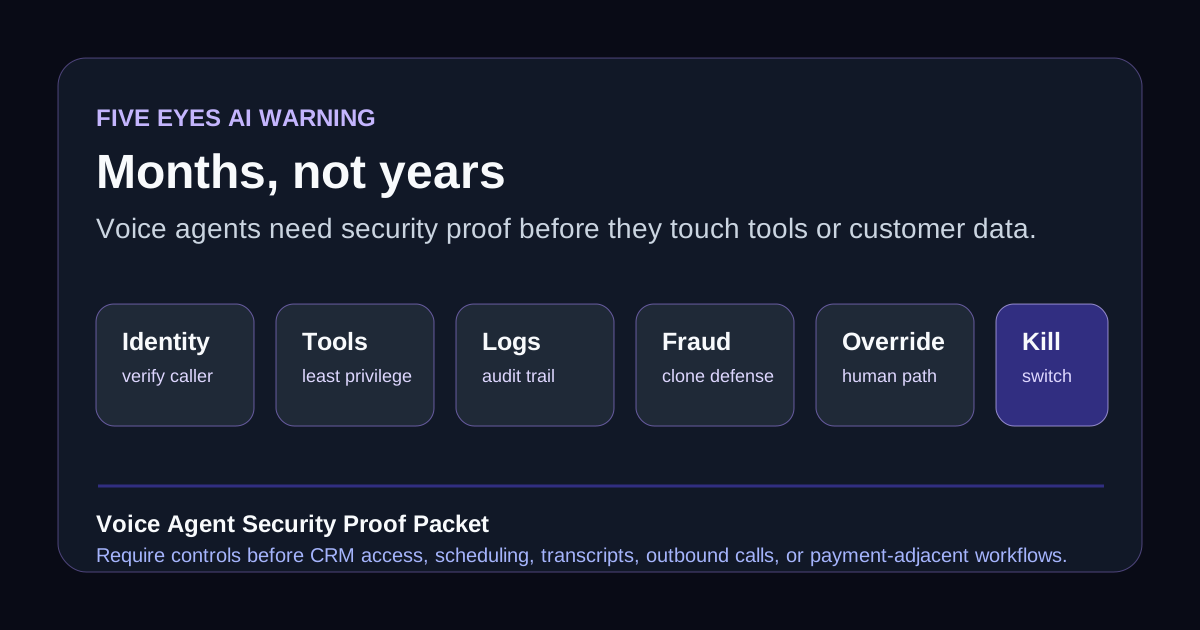
Voice Agent Security Proof Packet
A buyer checklist for verifying identity, tool permissions, transcript handling, fraud prevention, incident response, and human override before deploying AI phone agents.
| Proof item | Why it matters | Buyer ask |
|---|---|---|
| Caller identity controls | Voice agents can be tricked by spoofed numbers, cloned voices, social pressure, or repeat-caller context. | Show how the agent verifies identity before exposing account details, changing bookings, or escalating sensitive requests. |
| Tool permission matrix | An agent with broad CRM, calendar, ticket, or payment-adjacent access becomes an automated insider. | List every tool, field, action, and write permission the voice agent can use, plus the human-only actions. |
| Transcript and recording policy | Calls can contain addresses, health details, account data, payment context, family information, and private background audio. | Document retention, redaction, training use, deletion, access logs, and customer notice language. |
| Prompt-injection and manipulation tests | Callers can try to override instructions, extract data, force actions, or trick the agent into unsafe tool use. | Run scripted attacks against the actual workflow and provide failure logs, mitigations, and retest results. |
| Fraud and voice-cloning response | AI-assisted voice fraud is now a public policy and consumer-loss issue, not a hypothetical demo edge case. | Show escalation triggers for suspicious callers, urgent money pressure, identity mismatch, and voice-clone risk. |
| Incident and human override path | Five Eyes agencies warned breaches will occur, so production systems need containment and recovery evidence. | Provide incident contacts, kill switch, rollback process, audit export, and human takeover behavior. |
What buyers should do next
- Create a permission matrix before connecting a voice agent to CRM, calendar, ticketing, SMS, or payment-adjacent workflows.
- Run identity, prompt-injection, caller-spoofing, repeat-caller, and urgent-pressure tests on the actual call script.
- Approve transcript retention, redaction, deletion, and model-training rules before recording real customers.
- Require a kill switch, incident owner, audit export, and human override path before production launch.
Turn this brief into a vendor packet
Make the vendor prove the workflow before the demo gets polished.
Use the RFP generator and call-test script to turn this news framework into concrete evidence requests, acceptance tests, and escalation rules for your own voice AI rollout.
Buyer FAQs
What did the Five Eyes agencies warn?
The agencies warned that AI is accelerating cyber threats and that frontier AI models could transform offensive and defensive cyber capabilities on a timeline of months, not years.
Why does this matter for voice agent buyers?
Voice agents often touch phone numbers, caller identity, recordings, transcripts, CRMs, calendars, ticketing systems, and customer workflows. Those connections need security proof before production.
Does this mean buyers should avoid voice AI?
No. Buyers should require stronger evidence. A secure deployment needs identity controls, least-privilege tool access, transcript policies, abuse testing, incident response, and human override.
What should be in a voice agent security proof packet?
It should include caller identity rules, tool permissions, transcript and recording policy, prompt-injection test results, fraud escalation triggers, incident contacts, a kill switch, and audit logs.
Sources
- NSA Five Eyes statement: Primary source for the June 22, 2026 Five Eyes warning on AI cyber risk, months-not-years timing, leadership accountability, and practical cyber actions.
- International AI Safety Report 2026: Primary report source for frontier AI capability and emerging-risk context, including malicious use, malfunction, and systemic risk framing.
- Joint Economic Committee voice-cloning inquiry: U.S. congressional source for AI voice-cloning scam scrutiny and the FBI-reported $893 million AI-related scam loss reference.