
Direct answer: TechCrunch reported on July 9, 2026 that Paris-based voice AI startup Gradium raised a $100 million seed round backed by Nvidia and plans Bay Area expansion. Gradium's own announcement says the company is building real-time voice AI infrastructure across streaming speech-to-text, text-to-speech, pronunciation, translation, and low-latency models. Sifted independently reported that the round included about $30 million in fresh extension funding and took the seed over $100 million. Buyers should treat the funding as a proof trigger, not proof by itself: require latency, streaming, pronunciation, deployment, QA, and fallback evidence before production calls depend on any model stack.
What happened
- TechCrunch reported on July 9, 2026 that Gradium raised a $100 million seed round backed by Nvidia.
- TechCrunch also reported that Gradium plans Bay Area expansion and competes in real-time voice AI infrastructure.
- Gradium's announcement says the company is building low-latency voice AI infrastructure for streaming speech-to-text, text-to-speech, pronunciation, and translation.
- Sifted independently reported that Gradium added about $30 million in extension funding, taking its seed financing to more than $100 million.
- For buyers, the story is not simply a large seed round. It is that real-time voice infrastructure is becoming a production dependency that must be evidenced before deployment.
Why this is trending
- The Nvidia backing and unusually large seed total make Gradium a high-momentum signal in the race to supply infrastructure for real-time voice agents.
- Voice-agent buyers increasingly care about lower-level infrastructure, not only application UX, because latency, turn-taking, pronunciation, and streaming errors decide whether callers trust the system.
- Funding can accelerate model and infrastructure development, but it does not replace production proof across noisy callers, long calls, tool use, compliance, and human handoff.
The Voice Agent Index take
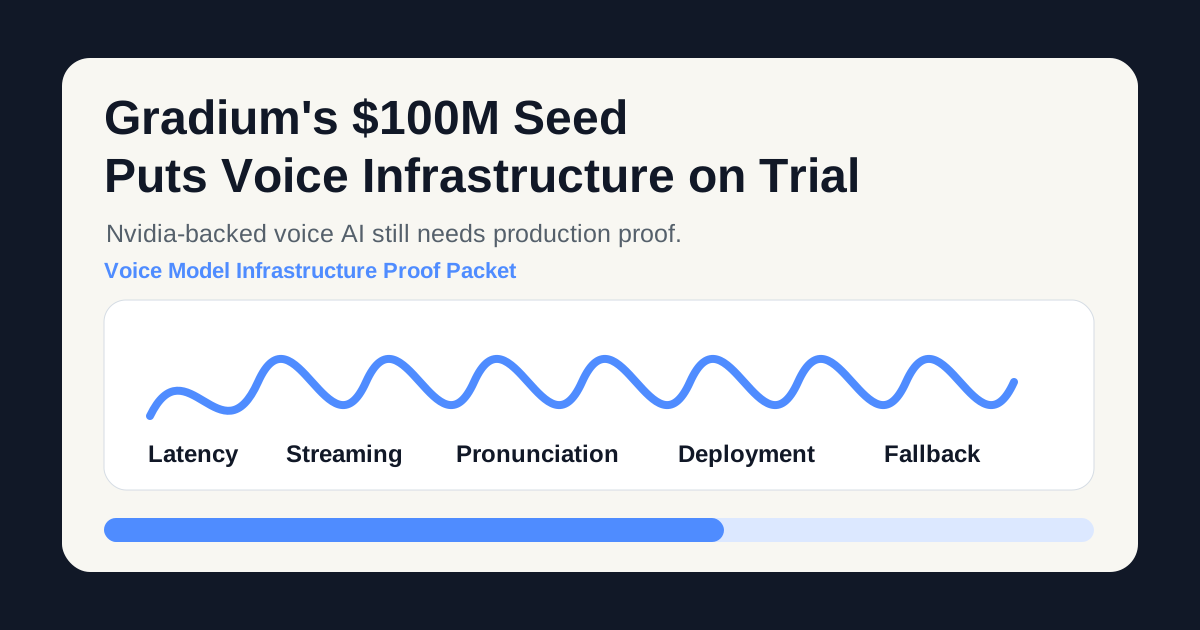
A voice-agent buyer should not approve a platform because its infrastructure vendor is well funded. The buyer needs a Voice Model Infrastructure Proof Packet: live-channel latency evidence, streaming STT and TTS tests, pronunciation set, deployment boundary, call outcome QA, monitoring, escalation, and rollback ownership.
Voice Model Infrastructure Proof Packet
A buyer checklist for validating real-time voice AI infrastructure across latency, streaming speech pipelines, pronunciation, deployment control, call outcome QA, and fallback ownership.
| Proof item | Why it matters | Buyer ask |
|---|---|---|
| Live-channel latency | Real-time voice agents fail when callers hear delays, clipped speech, slow tool responses, or awkward interruption handling. | Require latency measurements through the exact telephony path, region, model, tool stack, barge-in behavior, and long-call scenario planned for production. |
| Streaming STT and TTS | Streaming infrastructure must listen and speak continuously without losing context, double-talking, or producing unstable transcripts. | Ask for live test recordings, transcript confidence, interruption tests, noise handling, failover behavior, and streaming error logs. |
| Pronunciation and domain language | Names, locations, medications, policy terms, product names, and accents can break trust faster than generic benchmark scores. | Build a test set from real transcripts and require pronunciation scoring, correction workflow, regression tests, and release notes. |
| Deployment control | Healthcare, finance, insurance, and enterprise calls need boundaries for data residency, retention, access logs, model updates, and audit exports. | Request deployment options, environment boundaries, retention settings, data-processing terms, model-update controls, and audit evidence. |
| Call outcome QA | A model can sound fluent while collecting the wrong information, missing intent, calling the wrong tool, or failing the customer job. | Score calls against outcome rubrics, tool actions, escalation quality, repeat contacts, customer corrections, and defect categories. |
| Fallback ownership | Production voice infrastructure needs a named owner for bad audio, failed tool use, urgent callers, provider incidents, and model rollback. | Require handoff tests, supervisor ownership, rollback thresholds, monitoring alerts, incident timelines, and customer recovery evidence. |
What buyers should do next
- Separate infrastructure claims from production evidence: latency, streaming, interruption handling, pronunciation, tool use, and fallback.
- Build a test set from real names, addresses, accents, long calls, noisy callers, objections, and domain vocabulary.
- Ask every voice infrastructure vendor for data rights, retention, deployment-boundary, model-update, and audit-export documentation.
- Run live-channel tests through the exact telephony, region, model, voice, tool, and handoff path planned for production.
- Set rollback thresholds for latency spikes, transcript errors, pronunciation defects, failed tool calls, bad handoffs, and customer complaints.
Turn this brief into a vendor packet
Make the vendor prove the workflow before the demo gets polished.
Use the RFP generator and call-test script to turn this news framework into concrete evidence requests, acceptance tests, and escalation rules for your own voice AI rollout.
Buyer FAQs
What did Gradium announce?
Gradium announced in July 2026 that it had extended its seed financing to more than $100 million with Nvidia backing and is building real-time voice AI infrastructure.
Why does this matter to voice-agent buyers?
Real-time voice agents depend on infrastructure quality. Latency, streaming speech, pronunciation, deployment controls, QA, and fallback ownership affect whether callers can complete the job in production.
What proof should buyers ask for?
Ask for live-channel latency tests, streaming STT and TTS evidence, pronunciation test results, deployment controls, model-update policies, call outcome QA, monitoring, handoff tests, and rollback ownership.
Sources
- TechCrunch: July 9, 2026 coverage of Gradium's $100 million seed round, Nvidia backing, Bay Area expansion, and real-time voice AI infrastructure positioning.
- Gradium: Company announcement on the $100 million funding round and Gradium's low-latency real-time voice AI infrastructure work.
- Sifted: Independent coverage of Gradium's extension funding and seed round passing $100 million with Nvidia backing.