
Direct answer: Hume introduced Real World VoiceEQ on July 14, 2026 as a benchmark for the human quality of voice AI. Hume says it evaluates more than 40 proprietary and open-source models across 15-plus dimensions and more than 60 metrics spanning ASR, TTS, speech-to-speech, and speech understanding, built from more than 1 million individual human ratings. The arXiv technical report says clean-speech and transcript-centered benchmarks can miss failures with accents, emotion, noise, vocal affect, identity stability, and conversation conditions. Buyers should use the news as a proof trigger: require human-rated, workflow-specific voice evidence before production calls depend on any voice model.
What happened
- Hume published Real World VoiceEQ on July 14, 2026 as a benchmark for measuring the human quality of voice AI.
- Hume says the benchmark evaluates more than 40 proprietary and open-source voice models across 15-plus dimensions and more than 60 metrics.
- Hume and Hugging Face say Real World VoiceEQ was developed from more than 1 million individual human ratings, including 785,000 TTS ratings and 48,000 STS ratings.
- The arXiv technical report, submitted July 16, 2026, presents RW-Voice-EQ Bench as a multidimensional benchmark across TTS, speech-to-speech, speech understanding, and ASR robustness.
- The technical report says ASR can fail on accents, emotional speech, noisy audio, and conversational conditions that clean-speech benchmarks do not capture.
Why this is trending
- Voice-agent buyers are moving past demo fluency into harder production questions: whether a caller feels heard, whether a voice stays stable, and whether noisy or emotional calls still complete the job.
- The benchmark is large enough and broad enough to challenge single-score vendor claims because it separates naturalness, expressiveness, reliability, identity, audio sensitivity, and robustness.
- The story gives procurement teams a neutral way to ask for evidence instead of accepting latency, word error rate, or synthetic demo recordings as proof of production quality.
The Voice Agent Index take
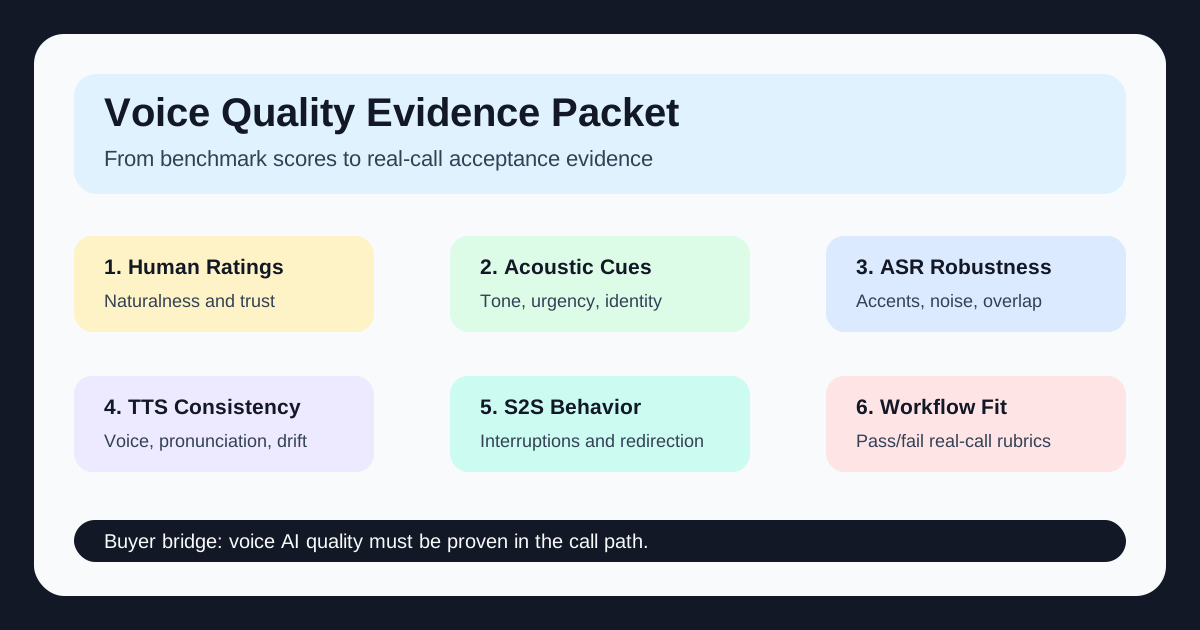
A voice-agent buyer should not approve a model because it sounds natural in a demo or performs well on a single transcript metric. The buyer needs a Voice Quality Evidence Packet: human-rated samples, acoustic cue tests, ASR robustness, TTS identity and reliability evidence, speech-to-speech stress tests, and workflow-specific acceptance criteria tied to real calls.
Voice Quality Evidence Packet
A buyer checklist for validating production voice AI quality across human-rated naturalness, acoustic cues, ASR robustness, TTS consistency, speech-to-speech behavior, and workflow-specific acceptance.
| Proof item | Why it matters | Buyer ask |
|---|---|---|
| Human-rated quality | Production callers judge whether a voice sounds natural, trustworthy, emotionally appropriate, and reliable, not only whether words are transcribed. | Request human-rated samples from the buyer's own call scenarios, languages, accents, customer moods, and failure cases. |
| Acoustic cue handling | Tone, hesitation, urgency, uncertainty, background context, speaker identity, and emotion can change what the agent should do next. | Test whether the model responds differently when the same words are spoken with stress, anger, fear, confusion, noise, or interruption. |
| ASR robustness | Clean transcription scores can hide failures on accents, emotional speech, background speakers, low-quality phone audio, and conversational overlap. | Score real phone-channel recordings across accents, noise, crosstalk, numbers, names, policy terms, and long conversations. |
| TTS consistency | A voice that drifts in identity, pronunciation, expressiveness, language stability, or reliability can break customer trust. | Require long-form voice-stability tests, domain-pronunciation tests, repeated-call samples, and release-to-release regression evidence. |
| Speech-to-speech behavior | Access to audio does not guarantee that a voice agent uses vocal affect or handles interruptions, degraded audio, and problem redirection. | Run stress tests for barge-in, emotional callers, hostile callers, urgent requests, dropped context, and escalation redirection. |
| Workflow-specific acceptance | A model can rank well overall while failing the exact booking, billing, intake, triage, or compliance job the buyer needs. | Define pass/fail rubrics for the production workflow, including outcome completion, handoff quality, customer correction, and rollback thresholds. |
What buyers should do next
- Convert current voice-agent demos into a test set with real accents, noisy calls, emotional callers, interruptions, long turns, and domain vocabulary.
- Ask vendors for human-rated evidence, not only word error rate, latency, or polished sample recordings.
- Test ASR, TTS, speech-to-speech, and speech-understanding behavior separately before collapsing them into an overall vendor score.
- Tie every score to workflow acceptance criteria: booking completion, correct intake, safe escalation, compliant disclosure, and customer recovery.
- Keep benchmark-style regression evidence for every model, voice, prompt, telephony, or tool update that reaches production.
Turn this brief into a vendor packet
Make the vendor prove the workflow before the demo gets polished.
Use the RFP generator and call-test script to turn this news framework into concrete evidence requests, acceptance tests, and escalation rules for your own voice AI rollout.
Buyer FAQs
What is Real World VoiceEQ?
Real World VoiceEQ is Hume's July 2026 benchmark for evaluating the human quality of voice AI across ASR, TTS, speech-to-speech, and speech understanding using human ratings and real-world acoustic conditions.
Why does it matter to voice-agent buyers?
It shows that traditional voice metrics can miss production failures around accents, emotion, noise, speaker identity, vocal affect, and conversation behavior. Buyers need evidence for the actual call workflow.
What proof should buyers ask for?
Ask for human-rated samples, acoustic cue tests, ASR robustness reports, TTS identity and pronunciation evidence, speech-to-speech stress tests, workflow-specific rubrics, and regression evidence after updates.
Sources
- Hume AI: July 14, 2026 Hume announcement of Real World VoiceEQ, including model count, evaluation dimensions, metrics, and human-rating scale.
- Hugging Face: Independent July 2026 publication of Real World VoiceEQ details, including more than 1 million human ratings and current TTS and STS rating counts.
- arXiv: RW-Voice-EQ Bench technical report submitted July 16, 2026, covering TTS, speech-to-speech, speech understanding, and ASR robustness.