
Direct answer: OpenAI introduced GPT-Live on July 8, 2026 as a more continuous full-duplex voice model for ChatGPT voice conversations. OpenAI's system card describes GPT-Live as supporting simultaneous speaking and listening, and TechCrunch independently covered the release as a new voice model for more natural live conversations. Voice-agent buyers should treat the launch as a proof bar: natural turn-taking is useful, but production systems still need evidence for interruptions, tool actions, safety, handoff, monitoring, and whether the same capability is available in the buyer's intended channel.
What happened
- OpenAI announced GPT-Live on July 8, 2026, describing it as a voice model for more natural, continuous interaction in ChatGPT.
- OpenAI's system card describes GPT-Live as full-duplex, meaning it can process user speech while generating its own response, supporting overlapping speech and interruptions.
- The system card says GPT-Live includes safety integrations and is used for ChatGPT voice experiences rather than being a generic proof that every third-party voice stack has the same behavior.
- TechCrunch independently covered the release and described OpenAI's new voice models as designed for more natural live conversations, including full-duplex interaction.
- The buyer issue is not whether GPT-Live sounds natural. It is whether a production voice workflow can prove interruption handling, safe tool use, escalation, monitoring, and recovery before customer calls depend on it.
Why this is trending
- Full-duplex voice changes buyer expectations because callers are used to interrupting, correcting, overlapping, and steering live human conversations.
- Most voice-agent demos still fail under messy conditions: talk-over, background noise, long calls, corrections, emotional callers, policy exceptions, and tool-action uncertainty.
- OpenAI's release pushes the market conversation from latency and voice quality toward production proof for natural conversational behavior.
The Voice Agent Index take
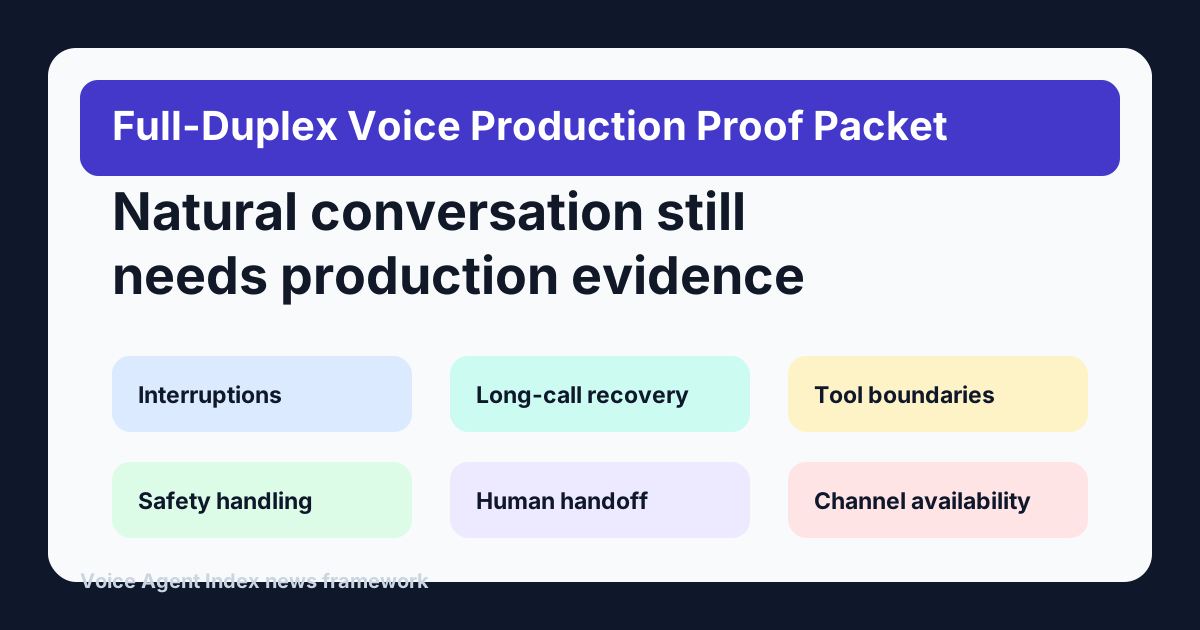
A voice-agent buyer should not approve production because a model can hold a natural demo. The buyer needs a Full-Duplex Voice Production Proof Packet: interruption tests, barge-in recovery, long-call memory, tool-action limits, safety and refusal handling, human handoff, monitoring, rollback, and proof that the capability is available in the exact channel being deployed.
Full-Duplex Voice Production Proof Packet
A buyer checklist for validating natural voice AI across interruptions, barge-in, long-context recovery, tool boundaries, safety handling, human handoff, monitoring, and availability.
| Proof item | Why it matters | Buyer ask |
|---|---|---|
| Interruption and barge-in | Callers interrupt, correct, talk over scripts, change intent, and object mid-sentence. A production voice agent must recover without trapping or ignoring them. | Show recordings, transcripts, latency metrics, model decisions, and pass/fail results for interruptions, corrections, overlapping speech, and cancelled actions. |
| Long-context recovery | Natural voice can make calls longer and less scripted, which increases the chance of lost context, repeated questions, or wrong summaries. | Test 10-minute and 20-minute calls with changing intent, prior facts, callbacks, summaries, and final disposition review. |
| Tool-action boundaries | A natural voice model may sound confident while scheduling, updating CRM records, taking payments, or changing customer data. | Document which actions the agent can read, draft, update, send, book, refund, or block, plus approval and rollback rules. |
| Safety and refusal handling | A voice system needs safe behavior for distress, fraud, medical, financial, legal, harassment, and policy-edge cases. | Provide scenario tests, refusal language, escalation triggers, audit logs, and examples of calls routed to a person. |
| Human handoff | Full-duplex conversation does not remove the need for a human when the call becomes sensitive, confused, high value, or unresolved. | Show transfer tests, callback recovery, context handoff, queue owner, SLA, failed-handoff review, and customer outcome evidence. |
| Channel availability | A capability available inside ChatGPT voice may not be available with the same behavior, controls, cost, or limits inside a buyer's phone stack. | Confirm API or platform availability, model version, region, latency, pricing, recording policy, integration limits, and fallback model behavior. |
What buyers should do next
- Add interruption, talk-over, correction, and cancelled-action tests to every voice-agent evaluation set.
- Separate natural conversation quality from production action safety when the agent can update records, book appointments, or send messages.
- Require a human handoff path for distress, policy exceptions, unresolved intent, sensitive data, and high-value customers.
- Ask whether full-duplex behavior is available in the exact API, telephony, region, model version, and integration path being deployed.
- Run rollback drills for the workflows where a natural voice failure could create compliance, safety, fraud, or customer-harm risk.
Turn this brief into a vendor packet
Make the vendor prove the workflow before the demo gets polished.
Use the RFP generator and call-test script to turn this news framework into concrete evidence requests, acceptance tests, and escalation rules for your own voice AI rollout.
Buyer FAQs
What is GPT-Live?
GPT-Live is OpenAI's July 2026 voice model for more continuous ChatGPT voice conversations. OpenAI describes it as full-duplex, supporting simultaneous listening and speaking so conversations can include interruptions and overlapping speech.
Does full-duplex voice make AI agents production-ready by itself?
No. Full-duplex voice can improve natural interaction, but buyers still need proof for interruptions, tool boundaries, safety handling, human handoff, monitoring, rollback, and channel availability.
What should buyers ask vendors after this launch?
Ask for interruption recordings, long-call tests, tool-action controls, human handoff evidence, safety scenarios, monitoring dashboards, rollback triggers, and confirmation that the same model behavior is available in the intended phone or API channel.
Sources
- OpenAI: Primary July 8, 2026 announcement introducing GPT-Live for more natural, continuous ChatGPT voice interaction.
- OpenAI GPT-Live system card: OpenAI safety page describing GPT-Live, full-duplex behavior, release timing, and safety integrations.
- TechCrunch: Independent July 8, 2026 coverage of OpenAI's new voice models for more natural live conversations.
- The Verge: Independent consumer-tech coverage of the ChatGPT voice upgrade and the full-duplex GPT-Live rollout.