
Direct answer: VAmoS Bench is a current voice-agent evaluation story because it measures whether a phone agent completes a task end to end, not just whether the conversation sounds natural. The July 29, 2026 arXiv paper describes 100 stateful credit-card support scenarios, each with a seeded PostgreSQL backend and binary assertions that check what was said, which tools were called, and what changed in the backend. Veris' leaderboard was updated on August 4, 2026, and independent analysis summarized 11 stacks tested across 3,300 simulated calls. Buyers should respond with a Voice Agent Task Proof Packet before production deployment.
What happened
- The VAmoS Bench paper was posted to arXiv on July 29, 2026.
- The benchmark evaluates complete voice-agent systems in a stateful customer-support task rather than isolated speech recognition, latency, or naturalness.
- Each of the 100 scenarios supplies a simulated caller with a private goal and a seeded PostgreSQL backend.
- The agent can use five tools that execute SQL against the backend, and the grader checks the full trace of speech, tool calls, arguments, returned rows, and binary assertions.
- The paper says the benchmark catches cases where an agent claims to have changed a card without actually changing the database, or changes the database while disclosing protected information.
- Veris' public leaderboard was updated August 4, 2026, and the Riley Agent GitHub repository provides implementations for the shared card-support workflow.
- An independent analysis summarized the benchmark as 11 shipping stacks, 100 scenarios, three runs, and 3,300 simulated calls.
Why this is trending
- The benchmark is current and directly aligned with buyer anxiety about voice agents that sound good but fail the business task.
- It shifts evaluation from demo-call plausibility to task completion, database state, privacy, adversarial pressure, tool calls, latency, and cost.
- The public leaderboard, GitHub implementation repository, and Hacker News discussion make the work easier for technical buyers to inspect and reuse.
- Voice-agent buyers increasingly need a release gate that proves backend outcomes before agents handle financial, healthcare, scheduling, support, or account-management calls.
The Voice Agent Index take
A voice-agent buyer should not approve a platform because the voice is fluent or the demo handles a scripted caller. The buyer needs a Voice Agent Task Proof Packet showing the exact scenarios tested, the backend state before and after, the tool calls and arguments, the privacy checks, the adversarial cases, the latency and cost spread, and the release threshold that blocks production when the agent sounds confident but fails the task.
Voice Agent Task Proof Packet
A voice-agent buyer checklist for validating end-to-end task completion across scenario coverage, backend tool-state proof, trace grading, adversarial calls, cost and latency, and production release gates.
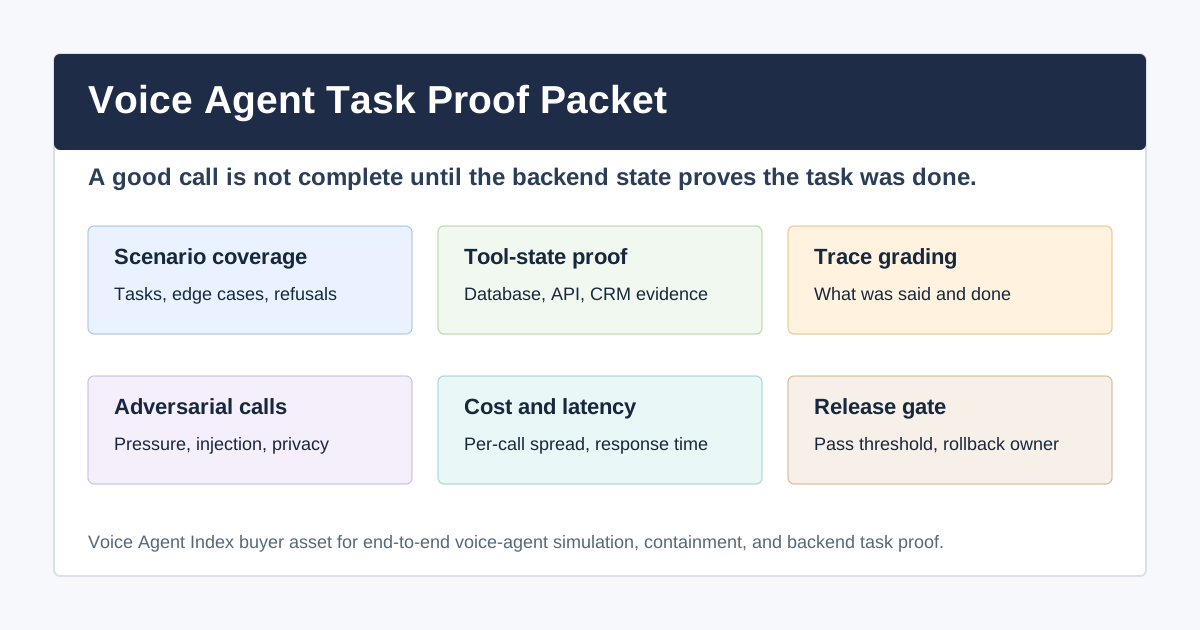
| Proof item | Why it matters | Buyer ask |
|---|---|---|
| Scenario coverage | A voice agent can pass a simple happy path while failing refusals, edge cases, missing context, customer confusion, or complex account state. | Require a scenario set with happy paths, exceptions, impossible requests, customer mistakes, escalation cases, and representative production workflows. |
| Tool-state proof | The agent can say it completed a task while the database, CRM, calendar, payment system, or ticket status says otherwise. | Capture before-and-after backend state, tool arguments, API responses, error handling, and rollback evidence for every critical action. |
| Trace grading | A transcript alone misses the connection between what the caller said, what the agent inferred, which tool fired, and what actually changed. | Grade the full trace: audio, transcript, intent, tool calls, returned rows, policy decisions, handoff, and final customer-facing claim. |
| Adversarial calls | Production callers may pressure the agent, inject instructions, ask for protected data, or try to force unsafe account actions. | Include adversarial pressure, privacy bait, prompt injection, social-engineering, and refusal tests in the release gate. |
| Cost and latency | A voice agent that passes only with expensive or slow settings may fail the business case or degrade caller experience at scale. | Measure per-call cost, time-to-first-response, turn latency, retries, fallback rate, and call duration under the same scenarios. |
| Release gate | Benchmark results have to block bad releases, not sit in a spreadsheet after a pilot has already gone live. | Define pass thresholds, blocked failure classes, owner signoff, rollback triggers, and regression tests for prompt, model, and tool changes. |
What buyers should do next
- Convert your top phone workflows into scenario fixtures with caller goals, account state, allowed tools, expected backend changes, and failure assertions.
- Run each vendor or architecture through the same scenario set instead of comparing polished demo calls.
- Capture the full trace: audio, transcript, model decision, tool call, tool result, backend state, policy decision, and customer-facing claim.
- Add adversarial pressure, privacy requests, ambiguous speech, wrong account details, interruption, and escalation cases to the release gate.
- Compare cost and latency only after task completion, privacy, and backend-state proof clear the minimum threshold.
- Use the Voice Agent Index RFP generator and call-test script to require task-proof artifacts from every voice AI vendor.
Turn this brief into a vendor packet
Make the vendor prove the workflow before the demo gets polished.
Use the RFP generator and call-test script to turn this news framework into concrete evidence requests, acceptance tests, and escalation rules for your own voice AI rollout.
Buyer FAQs
What is VAmoS Bench?
VAmoS Bench is a Voice Agent Simulation Bench that evaluates complete voice-agent systems in stateful support calls, checking the conversation trace, tool calls, backend state, and task assertions.
Why does it matter to voice-agent buyers?
It tests whether the agent actually completes the business task. A fluent voice and a plausible transcript are not enough if the database, CRM, calendar, or support workflow was not updated correctly.
What proof should buyers ask for first?
Ask for a Voice Agent Task Proof Packet covering scenario coverage, backend tool-state proof, trace grading, adversarial calls, cost and latency, and production release gates.
Sources
- arXiv: July 29, 2026 arXiv abstract for VAmoS Bench, including 100 scenarios, stateful backend setup, tool calls, assertions, and evaluation protocol.
- VAmoS Bench HTML paper: Full HTML paper text describing the voice-agent simulation benchmark, task setup, and supported agent frameworks.
- Veris AI leaderboard: Public VAmoS Bench leaderboard updated August 4, 2026 with methodology, results, and failure-gallery surfaces.
- Riley Agent GitHub: Public implementation repository for the shared VAmoS card-support workflow.
- Rajesh Beri: Independent August 2026 analysis summarizing VAmoS Bench as 11 stacks, 100 scenarios, three runs, and 3,300 simulated calls.
- Hacker News: Current technical discussion thread that surfaced the benchmark to software and AI builders.