
Direct answer: VISH-GUARD makes vishing detection a procurement evidence question for voice-agent buyers. The Scientific Reports paper proposes a multi-agent framework that combines acoustic, semantic, emotion and behavioral signals, with LLM reasoning to explain risk. Buyers should not treat any detector score as authentication. They should require a Vishing Detection Proof Packet that proves caller verification, trusted callback, blocked actions, analyst review, run logs, red-team scenarios and closure evidence.
What happened
- Scientific Reports published VISH-GUARD on September 18, 2026 as an open-access article on multilingual voice phishing detection.
- The paper says existing approaches can be limited by monolingual assumptions, unimodal signals and poor interpretability.
- The proposed framework coordinates specialized agents for acoustic feature analysis, semantic intent recognition, emotion detection and behavioral profiling.
- The authors report that an LLM-based reasoning layer generates structured explanations to support human analysts.
- The paper introduces a synthetic annotated dataset of vishing calls in English, French and Arabic with background noise, emotional cues and persuasion strategies.
- The authors report an F1-score of 0.96 in their experiments and note that the research used synthetic audio rather than real human voice recordings.
Why this is trending
- Vishing is moving from a training-awareness topic into real-time call and voice-agent architecture.
- The paper puts explainability and multilingual coverage at the center of detection, which matters for global support desks and voice-agent deployments.
- Voice-agent vendors may soon claim fraud detection, sentiment recognition or call-risk scoring; buyers need evidence that those claims map to their own workflows.
- Synthetic datasets help research move faster, but buyers still need validation against their industry scripts, accents, noise, handoff rules and sensitive actions.
- The story is especially timely because recent voice-cloning, accent-risk and Wall Street vishing coverage already pushed caller verification into the boardroom.
The Voice Agent Index take
A voice-agent buyer should use VISH-GUARD as a checklist prompt, not as a shortcut. Ask how the vendor detects urgency, secrecy, credential requests, payment pressure, spoofed authority and emotional manipulation. Then ask what the system does with that signal: block the action, require trusted callback, escalate to a trained human, retain an evidence log and retest after updates. A detection score may inform the workflow, but it cannot replace verification.
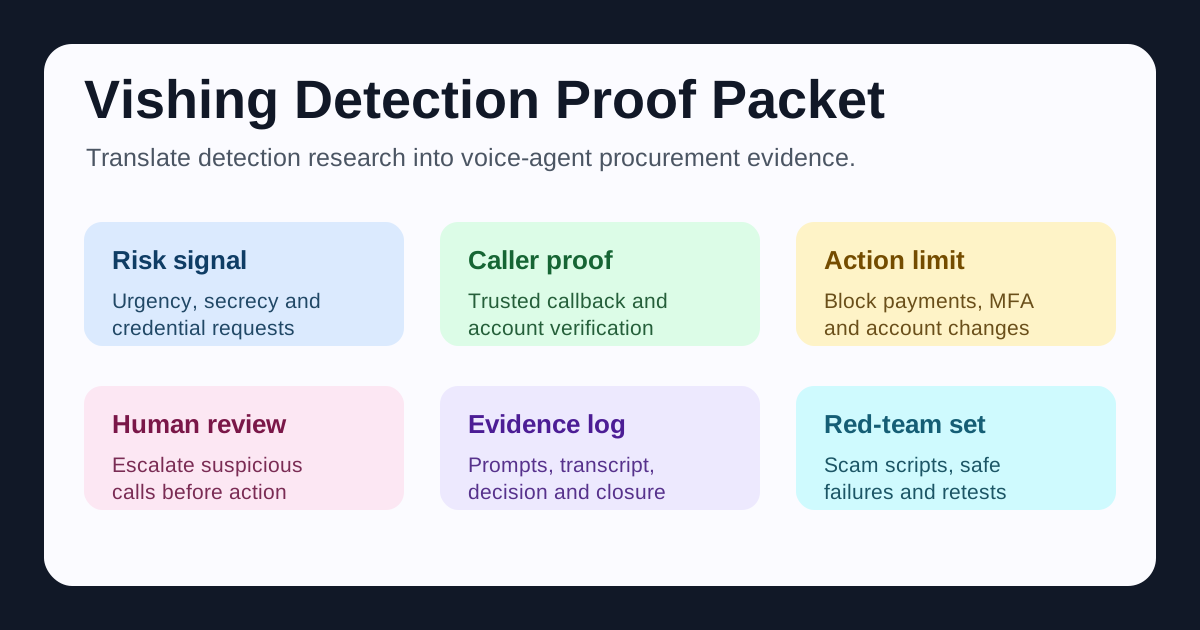
Vishing Detection Proof Packet
A voice-agent buyer checklist for validating vishing risk signals, caller verification, sensitive-action limits, detector explanations, human review, evidence logs and red-team tests.
| Proof item | Why it matters | Buyer ask |
|---|---|---|
| Risk signal library | Vishing often relies on urgency, secrecy, fear, authority, payment pressure and credential requests rather than one obvious phrase. | Show the scam-signal taxonomy, supported languages, sample transcripts, confidence thresholds and how false positives are reviewed. |
| Caller proof | A suspicious score helps triage, but identity still needs trusted records and callback paths. | Require verification through known account records, customer portals, banked numbers or approved channels before sensitive actions. |
| Sensitive-action limit | Fraud callers pressure systems and staff to change payments, credentials, MFA, delivery details or account ownership. | List actions that voice can never complete alone and prove blocked, delayed, callback-required and human-reviewed test cases. |
| Human review | The VISH-GUARD paper emphasizes explanations for analysts, which reinforces that review workflow matters. | Show who reviews high-risk calls, what explanation they see, how overrides are logged and when the customer is contacted. |
| Evidence log | A buyer needs to reconstruct the call, detector output, decision path, tool action and closure after a disputed event. | Retain transcript, audio policy reference, risk explanation, tool calls, reviewer, final decision and follow-up status. |
| Red-team set | Research datasets may not match a buyer's exact customers, industry, accents, noise or business rules. | Run recurring tests with buyer-specific scam scripts, background noise, multilingual callers, spoofed authority and safe-failure expectations. |
What buyers should do next
- Collect your highest-risk phone workflows: payments, password resets, MFA changes, refunds, account ownership, delivery reroutes and executive requests.
- Write vishing scenarios for urgency, secrecy, authority, emotional manipulation, payment pressure and credential requests in every supported language.
- Ask vendors to show how detection signals change the workflow, including blocks, callbacks, human review and evidence retention.
- Test false positives and false negatives with noisy calls, accented callers, short utterances, synthetic audio and ordinary customer frustration.
- Keep a closure packet for each blocked or escalated call with transcript, risk explanation, reviewer decision, callback result and retest status.
Turn this brief into a vendor packet
Make the vendor prove the workflow before the demo gets polished.
Use the RFP generator and call-test script to turn this news framework into concrete evidence requests, acceptance tests, and escalation rules for your own voice AI rollout.
Buyer FAQs
Does VISH-GUARD prove a commercial voice-agent vendor is safe?
No. It is research, not a vendor certification. Buyers can use its structure to ask better evidence questions about detection signals, explanations, review and testing.
Should a vishing detector authenticate callers?
No. Detection can triage risk, but authentication should rely on trusted records, callback paths, portal confirmation, account controls and human review for sensitive actions.
What is the first buyer test after this paper?
Start with a red-team set for your own sensitive workflows. Include scam scripts, multilingual calls, noisy audio, authority pressure and safe-failure requirements.
Sources
- Scientific Reports: September 18, 2026 open-access article on VISH-GUARD, a multi-agent and LLM-powered framework for multilingual voice phishing detection.
- DOI record: Permanent DOI for the VISH-GUARD Scientific Reports article.
- Voice Agent Index prior vishing context: Prior buyer framework on Wall Street vishing coverage, used as context for caller verification and trusted callback controls.
- Voice Agent Index prior research context: Prior framework on AI voice phishing research; the VISH-GUARD paper is a fresh multilingual detection and explainability hook.