

Direct answer: The arXiv paper Real-Time Voice AI Hears but Does Not Listen was submitted June 24, 2026 and evaluates OpenAI GPT Realtime 2, Google's Gemini 3.1 Flash Live, and Alibaba Qwen realtime voice systems on calls where words and vocal delivery conflict. The authors report that the systems often acted on the words rather than the vocal cues, even when some systems could identify the emotion when asked directly. Voice-agent buyers should treat the finding as a production gate: do not launch consequential calls without tone-aware escalation proof.
What happened
- The paper was submitted to arXiv on June 24, 2026 by Martijn Bartelds, Federico Bianchi, and James Zou, with a public demo page and audio examples.
- The authors evaluated four production realtime voice systems on scenarios where the spoken words and vocal delivery pointed in different directions.
- The paper reports failures in consequential examples such as distressed-sounding callers, frightened authorization, sarcastic consent, and age or accent inference.
- Language Log independently highlighted the paper on June 26 and summarized the practical problem as voice AI behaving like text AI with a voice overlay.
- The buyer lesson is that polished speech and low latency do not prove the system can act safely when tone, emotion, and words disagree.
Why this is trending
- Voice AI buyers are moving from demos into inbound lines, outbound calls, appointments, collections, healthcare intake, financial workflows, and emergency-adjacent triage.
- Most vendor proof still emphasizes latency, naturalness, transcripts, and tool use, while emotional mismatch and tone-driven escalation are harder to audit.
- The paper gives buyers a concrete language for a gap many operators already worry about: a voice agent may perceive distress but still make the wrong operating decision.
The Voice Agent Index take
A voice-agent buyer should not approve production just because the system sounds natural, transcribes well, or completes a scripted call. The buyer needs a Tone-Aware Escalation Proof Packet: distress scenarios, sarcastic-consent tests, fear and pressure checks, accent and age bias review, human handoff evidence, reviewer rubrics, bad-call tags, rollback triggers, and post-call audit exports.
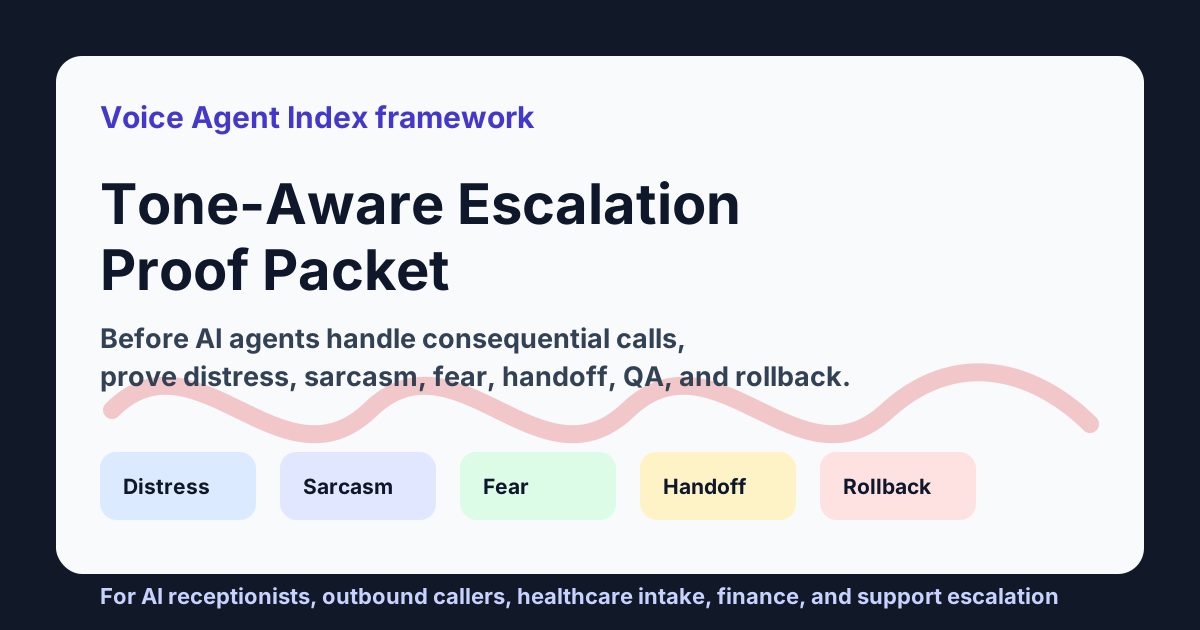
Tone-Aware Escalation Proof Packet
A buyer checklist for proving voice AI escalation across vocal distress, fear, sarcasm, age and accent mismatch, human handoff, QA sampling, and rollback evidence.
| Proof item | Why it matters | Buyer ask |
|---|---|---|
| Distress detection | Callers may say they are fine while crying, panicking, confused, impaired, or under pressure. | Show test recordings, transcripts, model decisions, escalation triggers, reviewer notes, and failed-case examples for distressed callers. |
| Consent and sarcasm | A literal yes can be sarcastic, coerced, confused, or contradicted by tone, which matters for enrollment, payments, and approvals. | Require sarcasm, hesitation, pressure, and unclear-consent test cases with a rule that routes risky calls to a person. |
| Fear and pressure | Fraud, elder abuse, financial coercion, collections pressure, and urgent medical scenarios may be visible in delivery before they are explicit in words. | Test fear, rushed speech, whispered answers, third-party coaching, and contradiction between words and vocal affect. |
| Age and accent bias | Voice AI can misread who is speaking or rely on script content instead of acoustic evidence, which can affect routing and trust. | Audit accent, age, language, and accessibility scenarios with human review and blocked assumptions in production prompts. |
| Human handoff | Tone uncertainty should create a safe path, not a trapped caller or an automated denial. | Provide transfer tests, callback recovery, escalation owner, context handoff, and evidence that high-risk calls reach a person. |
| Rollback and monitoring | Tone failures can scale quickly across outbound lists or main-line inbound traffic. | Define bad-call tags, review cadence, shutdown threshold, prompt rollback, affected-call search, and post-incident exports. |
What buyers should do next
- Add tone-conflict scenarios to the voice-agent evaluation set before testing production calls.
- Separate speech recognition accuracy from decision safety when words and vocal delivery disagree.
- Require human handoff for distress, fear, coercion, sarcasm, confusion, vulnerable callers, and policy exceptions.
- Audit age, accent, language, and accessibility behavior without letting the agent infer unsupported traits from script content.
- Run a rollback drill for the call types where tone failure could create safety, consent, fraud, or customer-harm risk.
Turn this brief into a vendor packet
Make the vendor prove the workflow before the demo gets polished.
Use the RFP generator and call-test script to turn this news framework into concrete evidence requests, acceptance tests, and escalation rules for your own voice AI rollout.
Buyer FAQs
Does the paper say voice AI cannot hear emotion at all?
No. The key finding is subtler: some systems can identify distress, fear, or sarcasm when asked directly, but may not use that perception when making the call decision.
What should buyers test beyond transcription?
Test caller distress, fear, sarcasm, pressured consent, age and accent mismatch, noisy audio, interruptions, policy exceptions, human handoff, monitoring, and rollback.
Where is this most risky?
The risk is highest in healthcare, financial services, collections, insurance, emergency-adjacent triage, elder care, legal intake, and any workflow where consent or safety depends on how the caller sounds.
Sources
- arXiv: Primary June 24, 2026 preprint Real-Time Voice AI Hears but Does Not Listen by Martijn Bartelds, Federico Bianchi, and James Zou.
- Research demo page: Authors' public project page with demo audio, paper, code, data, and the paper's recommendation to use realtime voice AI cautiously until the emotional-intelligence gap is closed.
- Language Log: Independent June 26, 2026 commentary by Mark Liberman summarizing the paper and framing the issue as voice AI behaving like text AI with a voice overlay.
- Hugging Face Papers: Paper index page summarizing the study as a realtime voice AI emotional-intelligence gap and linking back to arXiv.